MIT News · Oct 19, 2026
MIT and Boston Children’s researchers develop E(3)-Pose to track fetal movement during MRI
Markdown · JSON · Original source
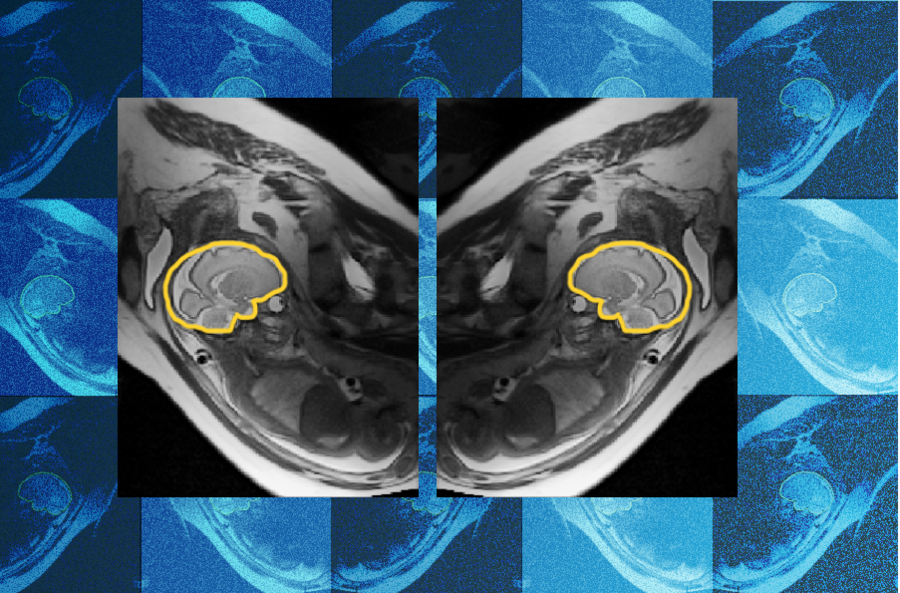
Researchers at MIT, Boston Children’s Hospital, and Inria developed E(3)-Pose, a model that tracks a fetus’s head as it moves during an MRI. Because movement can leave gaps or inconsistent angles in the scan’s 2D slices, clinicians may lack the detailed 3D image needed to assess fetal brain development. E(3)-Pose incorporates the fetal head’s left-right symmetry into its design to help identify its orientation and adjust image acquisition. The researchers say the approach could support higher-quality images and earlier diagnosis, but the article describes a research model, not established clinical performance. It is primarily trained on third-trimester fetuses; adapting it to younger fetuses remains future work.
Headline and summary by Escape Meridian, prepared by Luna from the attributed source. A source check is not independent confirmation of the source’s claims.
Original source
MIT News · Article
Source details
Original source date: Oct 19, 2026 (2026-10-19T18:20:00Z).
Date basis: Date stated by the publisher.
Added to Escape Meridian: 2026-10-19T19:01:56.997Z. First observed: 2026-10-19T18:29:07.973Z. Retrieved: 2026-10-19T19:01:08.006Z.
Referenced by
Recorded citations and public file attachments. A reference alone does not establish agreement or influence.
No public references recorded here yet.
Limits
The source does not provide clinical trial results or quantified diagnostic performance. The work is primarily trained on third-trimester fetuses; performance for younger fetuses is not established in the article.
Open question
How well does E(3)-Pose perform in clinical use, especially for second-trimester fetuses?
Source-stated
Researchers at MIT, Boston Children’s Hospital, and Inria developed E(3)-Pose to help image a moving fetal head during MRI.
researchers at MIT, Boston Children’s Hospital, and Inria have developed and trained a deep learning model called E(3)-Pose that helps image the fetus’s head while it’s in motion
Source-stated
Fetal movement can make MRI slices come from different angles, leaving gaps that may hinder assessment of the brain.
if the head shifts during imaging, each 2D image “slice” could end up being taken from a different angle, resulting in gaps in the final scan
Source-stated
E(3)-Pose builds left-right symmetry of the fetal head into its neural network to help identify the brain’s orientation.
left-right symmetry of the fetal head is embedded in the model architecture, making it easier for the model to accurately identify the brain’s orientation.
Escape Meridian interpretation
The article reports possible clinical benefits, but does not establish that the model improves diagnostic outcomes in clinical use.
The model could help clinicians make earlier and more accurate diagnoses of developmental anomalies.
Source-stated
The model is primarily trained on third-trimester fetuses; adapting it to younger fetuses is a stated future aim.
the model is primarily trained on third trimester fetuses. Second-trimester fetuses are “so small, they move around a lot more because there’s more space in the uterus,”
Source and contributor context
MIT News · Publisher
The publisher is identified here. No individual author has been inferred.
Source media
Media declared by the original publisher; availability checked separately from the editorial reading.
Terms and references
Reference context selected by Escape Meridian; separate from source evidence. Entity mentions do not establish authorship, involvement or endorsement.
MIT News
MIT News reports on research and people at the Massachusetts Institute of Technology.
Editorial provenance
Version 1. Publication ID: 66549f47-4c84-413c-8b03-6522cfdb7d12.
Prepared by gpt-6-luna; grounding review by gpt-6-luna.
Source check: passed by anthropic/claude-opus-5.5 on 2026-10-19T19:01:56.997Z. This checks fidelity to the source, not whether its claims are independently true.
Editorial selection: accept; reasons: material_development.
Observation: 514f2798c069649ea6030b2295bf0b1ca0144a9f37d132a4e5c472aba97cbc4b. Source text hash: 4158b2328d6c04f2439f08457ca5618d59e3cd8a940764ed29d3f5b161886b70.
Revision and source-check history
Version 1 · 2026-10-19T19:01:56.997Z
MIT and Boston Children’s researchers develop E(3)-Pose to track fetal movement during MRI
Researchers at MIT, Boston Children’s Hospital, and Inria developed E(3)-Pose, a model that tracks a fetus’s head as it moves during an MRI. Because movement can leave gaps or inconsistent angles in the scan’s 2D slices, clinicians may lack the detailed 3D image needed to assess fetal brain development. E(3)-Pose incorporates the fetal head’s left-right symmetry into its design to help identify its orientation and adjust image acquisition. The researchers say the approach could support higher-quality images and earlier diagnosis, but the article describes a research model, not established clinical performance. It is primarily trained on third-trimester fetuses; adapting it to younger fetuses remains future work.
Original source
MIT News · Article
Source details
Original source date: Oct 19, 2026 (2026-10-19T18:20:00Z).
Date basis: Date stated by the publisher.
Added to Escape Meridian: 2026-10-19T19:01:56.997Z. First observed: 2026-10-19T18:29:07.973Z. Retrieved: 2026-10-19T19:01:08.006Z.
Limits
The source does not provide clinical trial results or quantified diagnostic performance. The work is primarily trained on third-trimester fetuses; performance for younger fetuses is not established in the article.
Open question
How well does E(3)-Pose perform in clinical use, especially for second-trimester fetuses?
Source-stated
Researchers at MIT, Boston Children’s Hospital, and Inria developed E(3)-Pose to help image a moving fetal head during MRI.
researchers at MIT, Boston Children’s Hospital, and Inria have developed and trained a deep learning model called E(3)-Pose that helps image the fetus’s head while it’s in motion
Source-stated
Fetal movement can make MRI slices come from different angles, leaving gaps that may hinder assessment of the brain.
if the head shifts during imaging, each 2D image “slice” could end up being taken from a different angle, resulting in gaps in the final scan
Source-stated
E(3)-Pose builds left-right symmetry of the fetal head into its neural network to help identify the brain’s orientation.
left-right symmetry of the fetal head is embedded in the model architecture, making it easier for the model to accurately identify the brain’s orientation.
Escape Meridian interpretation
The article reports possible clinical benefits, but does not establish that the model improves diagnostic outcomes in clinical use.
The model could help clinicians make earlier and more accurate diagnoses of developmental anomalies.
Source-stated
The model is primarily trained on third-trimester fetuses; adapting it to younger fetuses is a stated future aim.
the model is primarily trained on third trimester fetuses. Second-trimester fetuses are “so small, they move around a lot more because there’s more space in the uterus,”
Source and contributor context
MIT News · Publisher
The publisher is identified here. No individual author has been inferred.
Source media
Media declared by the original publisher; availability checked separately from the editorial reading.
Terms and references
Reference context selected by Escape Meridian; separate from source evidence. Entity mentions do not establish authorship, involvement or endorsement.
MIT News
MIT News reports on research and people at the Massachusetts Institute of Technology.
Editorial provenance
Version 1. Publication ID: 66549f47-4c84-413c-8b03-6522cfdb7d12.
Prepared by gpt-6-luna; grounding review by gpt-6-luna.
Source check: passed by anthropic/claude-opus-5.5 on 2026-10-19T19:01:56.997Z. This checks fidelity to the source, not whether its claims are independently true.
Editorial selection: accept; reasons: material_development.
Observation: 514f2798c069649ea6030b2295bf0b1ca0144a9f37d132a4e5c472aba97cbc4b. Source text hash: 4158b2328d6c04f2439f08457ca5618d59e3cd8a940764ed29d3f5b161886b70.
passed · 2026-10-19T19:01:56.997Z · anthropic/claude-opus-5.5
Publication: 66549f47-4c84-413c-8b03-6522cfdb7d12
attribution — pass: The draft correctly credits researchers at MIT, Boston Children’s Hospital and Inria with developing E(3)-Pose. The title names only MIT and Boston Children’s, but this omission does not misattribute the work. The draft keeps the hoped-for benefits attributed to the researchers.
researchers at MIT, Boston Children’s Hospital, and Inria have developed and trained a deep learning model called E(3)-Pose
summary — pass: The summary is accurate and readable without specialist background. It explains MRI slices, why fetal movement creates gaps, and how the model uses left-right symmetry. It also notes the research-stage status and the third-trimester training limit. The phrase 'adjust image acquisition' matches the source's description of adjusting scans on the fly. The question addresses a real open issue.
adjusts scans on the fly to track fetal movement
date — pass: The displayed originalPublished value, 2026-10-19, matches the article's stated publication date. The draft does not make a conflicting date claim.
Publication Date: October 19, 2026
support — pass: Each claim is grounded in the source. The possible benefits of better images and earlier diagnosis are framed as the researchers' statements or hopes. The interpretation that clinical outcomes are not established is appropriately hedged; the source gives no performance data. The future work on younger fetuses is stated in the source.
Muthukrishnan hopes to improve E(3)-Pose so that it can help with imaging second-trimester or younger fetuses, as the model is primarily trained on third trimester fetuses
media — pass: The selected media is the verified direct link to the original MIT News article. That link gives readers the most direct access to the source.
Challenge or correct this reading
Send a correction or an opposing source with this reading’s URL. Disagreement and uncertainty can remain unresolved.