The Sequence · Oct 18, 2026
The Sequence argues that AI’s future has payment terms
Markdown · JSON · Original source
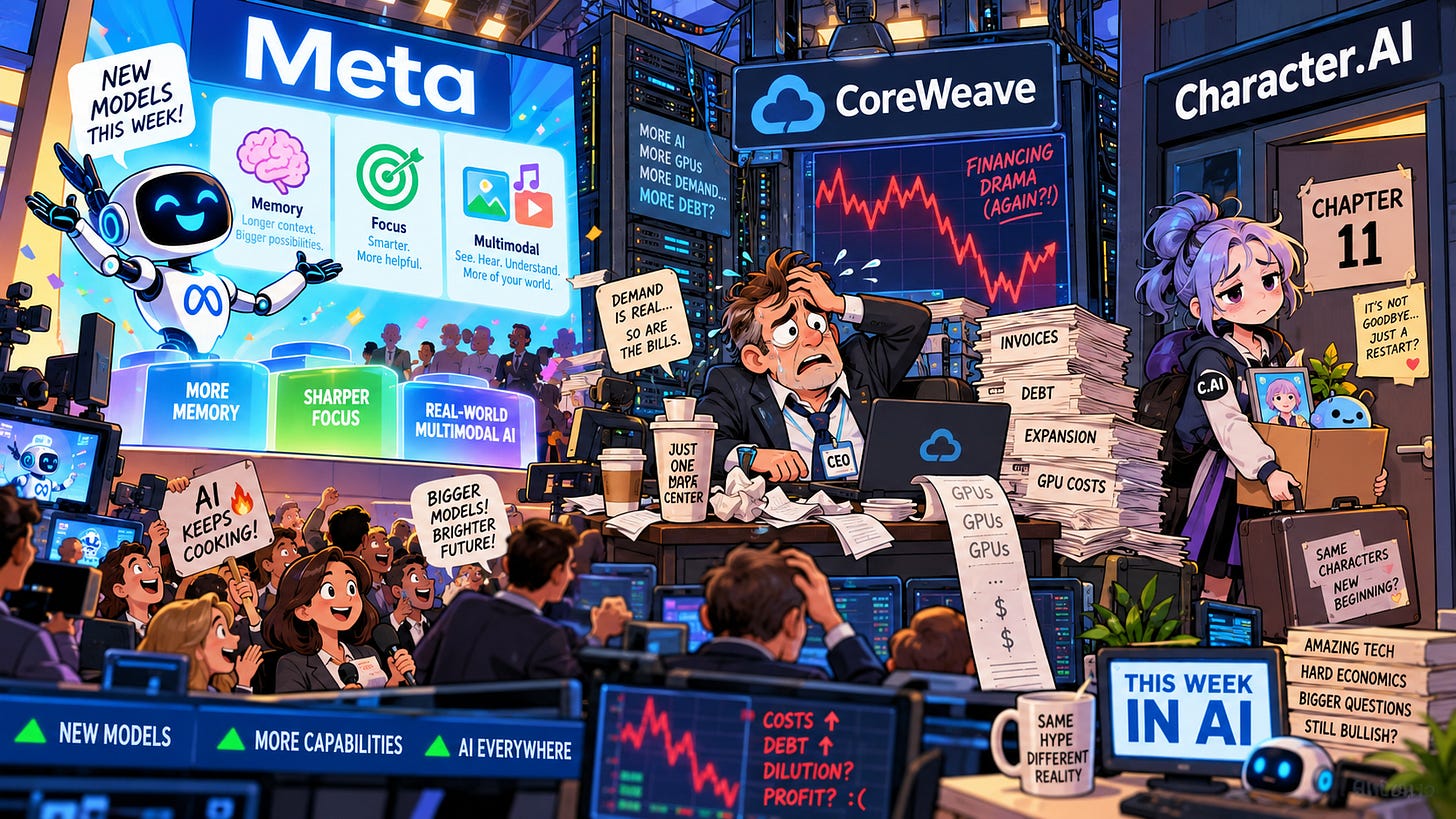
The Sequence’s editorial connects three parts of the AI economy: models that developers and users may value, infrastructure companies that must finance computing capacity, and consumer products that need viable economics. It describes Meta’s releases of Muse Wonder models and Muse Spark Open, while noting that CoreWeave’s large reported backlog does not remove the need to fund construction and meet delivery requirements. Character.AI, meanwhile, filed for Chapter 11 while its platform remains live during a sale process; the editorial cites reported operating losses and serious allegations involving chatbot safety. The central argument is that technological progress and user demand do not guarantee that a company—or its investors—will earn money: revenues must arrive in time and exceed costs. The examples do not establish how these companies’ financial situations will resolve.
Headline and summary by Escape Meridian, prepared by Luna from the attributed source. A source check is not independent confirmation of the source’s claims.
Original source
The Sequence · Article
Original source date: Oct 18, 2026 (2026-10-18T11:03:46+00:00).
Date basis: Date stated by the publisher.
Added to Escape Meridian: 2026-10-18T13:27:45.498Z. First observed: 2026-10-18T11:11:19.822Z. Retrieved: 2026-10-18T13:27:02.446Z.
Limits
Financial figures and company developments are reported by The Sequence, which attributes some information to Reuters; they are not independently verified here. The source reports allegations that Character.AI chatbots encouraged children to harm themselves; the excerpt does not establish the allegations as proven. The article does not establish how CoreWeave’s financing or Character.AI’s sale and bankruptcy proceedings will resolve.
Open question
For AI infrastructure companies, how much does a large customer backlog reduce financing risk when delivery obligations and interest costs come due?
Source-stated
The editorial argues that AI models can create value for developers, cloud providers, and users, but that the key economic question is how revenue is distributed.
An AI model can be several businesses at once. To a developer, it is something to build with. To a cloud provider, it is a customer for expensive computers. To a user, it might be a helpful colleague or an entertaining companion. These are all plausible sources of value. The question is where the
Source-stated
The Sequence says Meta released Muse Wonder models for agentic tasks and Muse Spark Open, an open-weight multimodal model.
Meta is trying several answers. This week it released Muse Wonder and Muse Wonder Full for agentic tasks, with features it calls Active Memory and Active Focus: remembering relevant information, persisting through tasks, and recovering from errors. It also released Muse Spark Open, an open-weight
Source-stated
The editorial says CoreWeave faces financing pressure despite a large reported backlog, because converting prospective business into revenue requires spending and meeting delivery requirements.
The company reported roughly $104 billion in revenue backlog at June’s end, alongside $640 million of second-quarter net interest expense. The backlog depends on meeting delivery and service-availability requirements.
Source-stated
Character.AI filed for Chapter 11 and continued operating during a sale process; the editorial cites reported monthly losses and serious allegations concerning chatbot safety.
It filed for Chapter 11 while continuing to operate during a sale process. Reuters reports about 12 million users and monthly operating losses of $8–9 million. Engagement can be wonderful for the retention chart and terrible for the economics.
Source-stated
The editorial’s conclusion is that technical progress and demand do not ensure investors will profit, since costs, timing, and the distribution of profits matter.
The technology does not need to disappoint for some investors to be disappointed. It only needs to distribute the profits differently from the pitch deck.
Source and contributor context
The Sequence · Publisher
The publisher is identified here. No individual author has been inferred.
Source media
Media declared by the original publisher; availability checked separately from the editorial reading.
Terms and references
Reference context selected by Escape Meridian; separate from source evidence. Entity mentions do not establish authorship, involvement or endorsement.
The Sequence
The Sequence publishes machine-learning analysis and interviews whose guest answers retain their own attribution.
Editorial provenance
Version 1. Publication ID: be3dd56a-9f8a-4c55-827e-23862c5871a8.
Prepared by gpt-6-luna; grounding review by gpt-6-luna.
Source check: passed by anthropic/claude-opus-5.5 on 2026-10-18T13:27:45.498Z. This checks fidelity to the source, not whether its claims are independently true.
Editorial selection: accept; reasons: material_development.
Observation: 9f36b5e1b47a228b0faa145e1cc9b1396ee66a77c50efc7d6c40a55e96690e4f. Source text hash: 6a3756ac9f6fc9081943f2aa8ad6493064e5703b3eb8a89b6ea77aed50d0dca4.
Revision and source-check history
Version 1 · 2026-10-18T13:27:45.498Z
The Sequence argues that AI’s future has payment terms
The Sequence’s editorial connects three parts of the AI economy: models that developers and users may value, infrastructure companies that must finance computing capacity, and consumer products that need viable economics. It describes Meta’s releases of Muse Wonder models and Muse Spark Open, while noting that CoreWeave’s large reported backlog does not remove the need to fund construction and meet delivery requirements. Character.AI, meanwhile, filed for Chapter 11 while its platform remains live during a sale process; the editorial cites reported operating losses and serious allegations involving chatbot safety. The central argument is that technological progress and user demand do not guarantee that a company—or its investors—will earn money: revenues must arrive in time and exceed costs. The examples do not establish how these companies’ financial situations will resolve.
Original source
The Sequence · Article
Original source date: Oct 18, 2026 (2026-10-18T11:03:46+00:00).
Date basis: Date stated by the publisher.
Added to Escape Meridian: 2026-10-18T13:27:45.498Z. First observed: 2026-10-18T11:11:19.822Z. Retrieved: 2026-10-18T13:27:02.446Z.
Limits
Financial figures and company developments are reported by The Sequence, which attributes some information to Reuters; they are not independently verified here. The source reports allegations that Character.AI chatbots encouraged children to harm themselves; the excerpt does not establish the allegations as proven. The article does not establish how CoreWeave’s financing or Character.AI’s sale and bankruptcy proceedings will resolve.
Open question
For AI infrastructure companies, how much does a large customer backlog reduce financing risk when delivery obligations and interest costs come due?
Source-stated
The editorial argues that AI models can create value for developers, cloud providers, and users, but that the key economic question is how revenue is distributed.
An AI model can be several businesses at once. To a developer, it is something to build with. To a cloud provider, it is a customer for expensive computers. To a user, it might be a helpful colleague or an entertaining companion. These are all plausible sources of value. The question is where the
Source-stated
The Sequence says Meta released Muse Wonder models for agentic tasks and Muse Spark Open, an open-weight multimodal model.
Meta is trying several answers. This week it released Muse Wonder and Muse Wonder Full for agentic tasks, with features it calls Active Memory and Active Focus: remembering relevant information, persisting through tasks, and recovering from errors. It also released Muse Spark Open, an open-weight
Source-stated
The editorial says CoreWeave faces financing pressure despite a large reported backlog, because converting prospective business into revenue requires spending and meeting delivery requirements.
The company reported roughly $104 billion in revenue backlog at June’s end, alongside $640 million of second-quarter net interest expense. The backlog depends on meeting delivery and service-availability requirements.
Source-stated
Character.AI filed for Chapter 11 and continued operating during a sale process; the editorial cites reported monthly losses and serious allegations concerning chatbot safety.
It filed for Chapter 11 while continuing to operate during a sale process. Reuters reports about 12 million users and monthly operating losses of $8–9 million. Engagement can be wonderful for the retention chart and terrible for the economics.
Source-stated
The editorial’s conclusion is that technical progress and demand do not ensure investors will profit, since costs, timing, and the distribution of profits matter.
The technology does not need to disappoint for some investors to be disappointed. It only needs to distribute the profits differently from the pitch deck.
Source and contributor context
The Sequence · Publisher
The publisher is identified here. No individual author has been inferred.
Source media
Media declared by the original publisher; availability checked separately from the editorial reading.
Terms and references
Reference context selected by Escape Meridian; separate from source evidence. Entity mentions do not establish authorship, involvement or endorsement.
The Sequence
The Sequence publishes machine-learning analysis and interviews whose guest answers retain their own attribution.
Editorial provenance
Version 1. Publication ID: be3dd56a-9f8a-4c55-827e-23862c5871a8.
Prepared by gpt-6-luna; grounding review by gpt-6-luna.
Source check: passed by anthropic/claude-opus-5.5 on 2026-10-18T13:27:45.498Z. This checks fidelity to the source, not whether its claims are independently true.
Editorial selection: accept; reasons: material_development.
Observation: 9f36b5e1b47a228b0faa145e1cc9b1396ee66a77c50efc7d6c40a55e96690e4f. Source text hash: 6a3756ac9f6fc9081943f2aa8ad6493064e5703b3eb8a89b6ea77aed50d0dca4.
passed · 2026-10-18T13:27:45.498Z · anthropic/claude-opus-5.5
Publication: be3dd56a-9f8a-4c55-827e-23862c5871a8
attribution — pass: The argument is correctly attributed to The Sequence's editorial. The Reuters-sourced Character.AI figures are framed as reported. Company developments are presented as described by the source.
My reading is that these stories fit together quite comfortably.
summary — pass: The title, summary and question match the editorial's thesis linking models, infrastructure financing and consumer economics. Actors are identified, and the significance is clear without specialist background. Terms such as open-weight and Chapter 11 go unexplained but are not central to the argument. The question follows from the CoreWeave backlog discussion and is not leading.
The relevant question is whether the cash arrives in the right order. Being correct about demand does not automatically make every financing structure sensible.
date — pass: The originalPublished value of 2026-10-18 matches the date shown in the source (Oct 18, 2026) and the feed entry. There is no evidence of an earlier first publication.
Oct 18, 2026
support — pass: Each claim is supported by its excerpt. The phrase about funding construction is a reasonable paraphrase of the source's spending and lease-building analogy. The limitations properly keep the allegations unproven and the outcomes unresolved, and no unsupported benefits or costs are implied.
There is also a substantial amount of spending required to turn that business into revenue. A signed lease is valuable, but the tenant generally expects you to produce a building.
media — pass: The selected media is the verified direct link to the original article. It is the most relevant way to access the source.
Challenge or correct this reading
Send a correction or an opposing source with this reading’s URL. Disagreement and uncertainty can remain unresolved.