
Hsiuwen Liu, Peiyi Yu · Nov 5, 2026
A rare strike in Taiwan exposes labor unrest beneath the global AI rush
Markdown · JSON · Original source
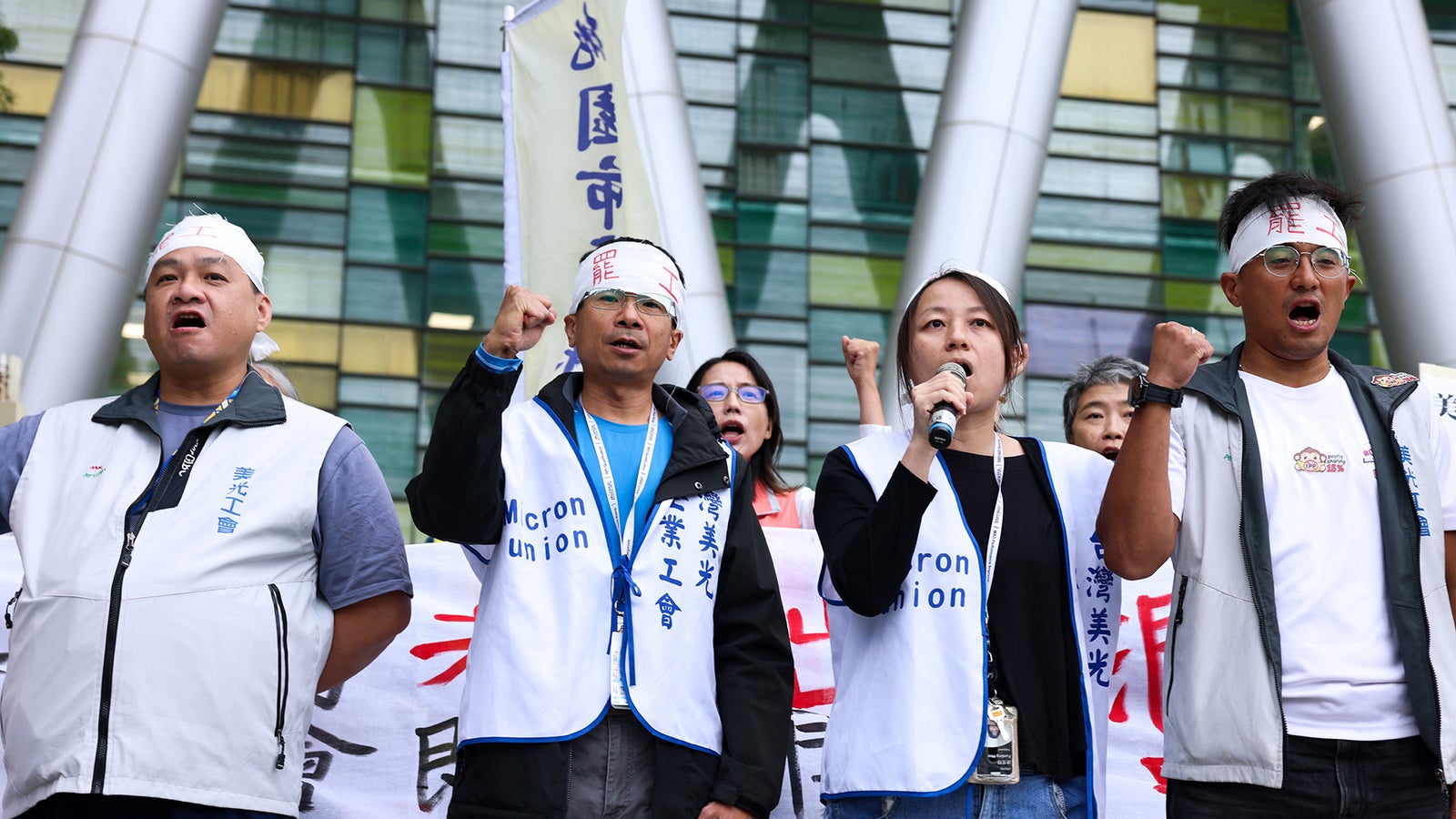
Hsiuwen Liu and Peiyi Yu report for that about a dozen workers at Micron’s Taoyuan plant staged a one-day strike in October after the company and union failed to agree on salaries and bonuses. The authors frame the action as a sign of growing discontent over how profits from the AI boom are shared—not as a major production stoppage. Micron had reached a separate agreement with the Taichung union on higher salaries, quarterly bonuses, and pension contributions, but Taoyuan union members said they rejected its terms and objected to how it was made. Micron said it remained committed to engagement with both unions. The dispute sits alongside a sharp rise in membership in Micron’s two Taiwan unions and earlier unionization discussions at Taiwan Semiconductor Manufacturing Co. Labor relations professor Wu Yu-ren links workers’ questions about profit-sharing to rising demand and company profits, as well as labor actions at Samsung and SK Hynix. The article also describes a possible supply-chain consequence: analyst Ellie Wang said a brief stoppage could mainly raise customer concern if backup personnel were available, while prolonged strikes or unrest at other facilities could disrupt supplies to AI hardware makers and raise prices. These are conditional risks, not reported outcomes. Negotiations between Micron and the Taoyuan union were continuing; the article presents
Headline and summary by Escape Meridian, prepared by Luna from the attributed source. A source check is not independent confirmation of the source’s claims.
Original source
· Article
Source details
Original source date: Nov 5, 2026 (2026-11-05T11:00:00+00:00).
Date basis: Date stated by the publisher.
Added to Escape Meridian: 2026-11-09T05:54:14.984Z. First observed: 2026-11-05T11:12:28.252Z. Retrieved: 2026-11-09T05:53:26.592Z.
Referenced by
Recorded citations and public file attachments. A reference alone does not establish agreement or influence.
No public references recorded here yet.
Limits
The article reports that negotiations between Micron and the Taoyuan union were continuing; it does not report their outcome. Potential supply disruption and price increases are conditional assessments in the article, not reported consequences of the one-day strike.
Open question
What terms, if any, will Micron and the Taoyuan union agree on, and will the continuing dispute lead to another strike?
Source-stated
Hsiuwen Liu and Peiyi Yu report that about a dozen workers at Micron’s Taoyuan plant staged a one-day strike in October after the union and company failed to agree on salaries and bonuses.
About a dozen workers at a Micron Technology plant in Taoyuan in Taiwan went on strike in October, the first in the island’s semiconductor industry, after their union and the chipmaker failed to reach an agreement on salaries and bonuses.
Source-stated
The article presents the strike as a sign of growing worker discontent about how profits tied to AI demand are distributed.
Their one-day action, while largely symbolic, is a reflection of the growing discontent among laborers in the artificial intelligence industry over how profits are distributed.
Source-stated
Micron reached an agreement with the Taichung union, but Taoyuan union members said they rejected the deal and its terms.
But many union members rejected the deal, which they said was made in secret, while the majority of members of the Taoyuan union said they were dissatisfied with the terms of the agreement.
Source-stated
The article reports that membership in Micron’s two worker unions rose from around 440 to more than 13,000 over the past few months.
Over the past few months, membership in Micron’s two worker unions has surged from around 440 to more than 13,000.
Source-stated
The article reports an analyst’s conditional assessment: a brief stoppage may mainly concern customers if backup personnel are available, while prolonged strikes or unrest at other facilities could disrupt supplies and raise prices.
In the event of another strike, the impact of a brief stop in production would likely be limited if backup personnel are available for equipment maintenance, process monitoring, and troubleshooting
Source and contributor context
Hsiuwen Liu, Peiyi Yu · Article author
These are credits stated by the source; they do not establish a profile match or authorship of every passage.
Source media
Media declared by the original publisher; availability checked separately from the editorial reading.
Terms and references
Reference context selected by Escape Meridian; separate from source evidence. Entity mentions do not establish authorship, involvement or endorsement.
Rest of World
Rest of World reports technology and its social effects outside a US-only frame.
Editorial provenance
Version 1. Publication ID: d7d5018c-b637-45c5-87d6-f819f0def500.
Prepared by gpt-6-luna; grounding review by gpt-6-luna.
Source check: uncertain by anthropic/claude-opus-5.5 on 2026-11-09T05:54:14.984Z. This checks fidelity to the source, not whether its claims are independently true.
Editorial selection: accept; reasons: material_development.
Observation: 08d2316b8054df04e625620ec3253fbbe9b2c0d7445b03026c74af5a165f6173. Source text hash: 8fcebf51e53b60b6674cacf2b66f03fbcd6d0892092368bac96a3f81651c5315.
Revision and source-check history
Version 1 · 2026-11-09T05:54:14.984Z
A rare strike in Taiwan exposes labor unrest beneath the global AI rush
Hsiuwen Liu and Peiyi Yu report for that about a dozen workers at Micron’s Taoyuan plant staged a one-day strike in October after the company and union failed to agree on salaries and bonuses. The authors frame the action as a sign of growing discontent over how profits from the AI boom are shared—not as a major production stoppage. Micron had reached a separate agreement with the Taichung union on higher salaries, quarterly bonuses, and pension contributions, but Taoyuan union members said they rejected its terms and objected to how it was made. Micron said it remained committed to engagement with both unions. The dispute sits alongside a sharp rise in membership in Micron’s two Taiwan unions and earlier unionization discussions at Taiwan Semiconductor Manufacturing Co. Labor relations professor Wu Yu-ren links workers’ questions about profit-sharing to rising demand and company profits, as well as labor actions at Samsung and SK Hynix. The article also describes a possible supply-chain consequence: analyst Ellie Wang said a brief stoppage could mainly raise customer concern if backup personnel were available, while prolonged strikes or unrest at other facilities could disrupt supplies to AI hardware makers and raise prices. These are conditional risks, not reported outcomes. Negotiations between Micron and the Taoyuan union were continuing; the article presents
Original source
· Article
Source details
Original source date: Nov 5, 2026 (2026-11-05T11:00:00+00:00).
Date basis: Date stated by the publisher.
Added to Escape Meridian: 2026-11-09T05:54:14.984Z. First observed: 2026-11-05T11:12:28.252Z. Retrieved: 2026-11-09T05:53:26.592Z.
Limits
The article reports that negotiations between Micron and the Taoyuan union were continuing; it does not report their outcome. Potential supply disruption and price increases are conditional assessments in the article, not reported consequences of the one-day strike.
Open question
What terms, if any, will Micron and the Taoyuan union agree on, and will the continuing dispute lead to another strike?
Source-stated
Hsiuwen Liu and Peiyi Yu report that about a dozen workers at Micron’s Taoyuan plant staged a one-day strike in October after the union and company failed to agree on salaries and bonuses.
About a dozen workers at a Micron Technology plant in Taoyuan in Taiwan went on strike in October, the first in the island’s semiconductor industry, after their union and the chipmaker failed to reach an agreement on salaries and bonuses.
Source-stated
The article presents the strike as a sign of growing worker discontent about how profits tied to AI demand are distributed.
Their one-day action, while largely symbolic, is a reflection of the growing discontent among laborers in the artificial intelligence industry over how profits are distributed.
Source-stated
Micron reached an agreement with the Taichung union, but Taoyuan union members said they rejected the deal and its terms.
But many union members rejected the deal, which they said was made in secret, while the majority of members of the Taoyuan union said they were dissatisfied with the terms of the agreement.
Source-stated
The article reports that membership in Micron’s two worker unions rose from around 440 to more than 13,000 over the past few months.
Over the past few months, membership in Micron’s two worker unions has surged from around 440 to more than 13,000.
Source-stated
The article reports an analyst’s conditional assessment: a brief stoppage may mainly concern customers if backup personnel are available, while prolonged strikes or unrest at other facilities could disrupt supplies and raise prices.
In the event of another strike, the impact of a brief stop in production would likely be limited if backup personnel are available for equipment maintenance, process monitoring, and troubleshooting
Source and contributor context
Hsiuwen Liu, Peiyi Yu · Article author
These are credits stated by the source; they do not establish a profile match or authorship of every passage.
Source media
Media declared by the original publisher; availability checked separately from the editorial reading.
Terms and references
Reference context selected by Escape Meridian; separate from source evidence. Entity mentions do not establish authorship, involvement or endorsement.
Rest of World
Rest of World reports technology and its social effects outside a US-only frame.
Editorial provenance
Version 1. Publication ID: d7d5018c-b637-45c5-87d6-f819f0def500.
Prepared by gpt-6-luna; grounding review by gpt-6-luna.
Source check: uncertain by anthropic/claude-opus-5.5 on 2026-11-09T05:54:14.984Z. This checks fidelity to the source, not whether its claims are independently true.
Editorial selection: accept; reasons: material_development.
Observation: 08d2316b8054df04e625620ec3253fbbe9b2c0d7445b03026c74af5a165f6173. Source text hash: 8fcebf51e53b60b6674cacf2b66f03fbcd6d0892092368bac96a3f81651c5315.
uncertain · 2026-11-09T05:54:14.984Z · anthropic/claude-opus-5.5
Publication: d7d5018c-b637-45c5-87d6-f819f0def500
attribution — pass: The reading correctly credits Hsiuwen Liu and Peiyi Yu of Rest of World. It attributes quoted views to Wu Yu-ren (labor relations professor) and Ellie Wang (TrendForce analyst), and Micron's commitment to its spokesperson. Source assertions stay attributed rather than presented as established fact.
By Hsiuwen Liu and Peiyi Yu
summary — uncertain: The summary is truncated mid-sentence ('the article presents'), so the reading ends incomplete. It also omits a central stake: this was the first strike in Taiwan's semiconductor industry. It never explains why Micron is tied to the AI boom, namely that it is a memory chipmaker whose Taiwan workers make most of its DRAM for AI servers. Smallest repair: finish the final sentence, note 'the first in the island's semiconductor industry', and briefly identify Micron as an AI-server memory chipmaker.
went on strike in October, the first in the island’s semiconductor industry
date — pass: originalPublished (2026-11-05) matches the article byline date. The October strike timing is stated as reported.
5 November 2026
support — uncertain: Most claims match the source. However, the reading says Taoyuan union members 'objected to how it was made.' The source attributes the secrecy objection to 'many union members' without specifying which union. For the Taoyuan majority, it reports dissatisfaction with the terms. Smallest repair: attribute the secrecy complaint to 'many union members' generally. The conditional supply-risk framing is faithful.
But many union members rejected the deal, which they said was made in secret, while the majority of members of the Taoyuan union said they were dissatisfied with the terms of the agreement.
media — pass: The selected media is the verified direct link to the original Rest of World article. This is the most direct way to access the source.
Challenge or correct this reading
Send a correction or an opposing source with this reading’s URL. Disagreement and uncertainty can remain unresolved.
Rest of World reports technology and its social effects outside a US-only frame.
Explore Rest of WorldRest of World reports technology and its social effects outside a US-only frame.
Explore Rest of WorldRest of World reports technology and its social effects outside a US-only frame.
Explore Rest of WorldRest of World reports technology and its social effects outside a US-only frame.
Explore Rest of World