A clearer view of the AI changes reaching your life.
Ideas, disagreements and possible consequences, with the sources close at hand. Ordered by the original source date; dates added to this site are shown separately.
In a Moonshots episode discussion, one argument is that growing use of AI agents will make CPUs the next compute bottleneck: there may not be enough CPU capacity for the agents people use. CPU capacity, the argument says, is only beginning to expand, with a lead time of a couple of years. A counterargument is that stronger foundation models could let fewer agents handle tasks. The response narrows the adoption forecast to growth from 0.1 to at least one agent per person in four or five years, not 100 agents per person. The exchange leaves open whether wider agent use will increase demand for CPUs or stronger models will reduce the number of agents needed. The passage provides no calculation that establishes the forecast.
Keep in view: The transcript is machine-generated and has no reliable speaker turns, so the individual claims cannot be confidently assigned to named participants. The passage gives no calculation establishing the projected agent adoption, CPU demand, or lead times; these remain speaker assertions. The Navier-Stokes and Bell examples are mentioned but not explained sufficiently here to establish whether they are comparable cases.
In an excerpt from Scott Carlson’s interview, Cowen proposes that a school try one AI-only class, with a professor grading the student’s learning workflow rather than exam answers. He says students could create classes in subjects their schools do not offer, and argues that students may be better placed than professors to discover how to blend AI and education. Cowen says he is unsure how the proposal would work and favors experimentation, starting with one class. He also supports allowing schools to adopt different AI policies, including banning AI, though he says he would bet against no-AI schools. The excerpt does not report results from an AI-only class. Whether students learn effectively under this model, and how a professor could assess their workflow, remain open questions.
Keep in view: The source is a Marginal Revolution post excerpt from Scott Carlson’s interview with Cowen; it does not include the full interview. The excerpt offers proposals and opinions, not reported results from an AI-only class or evidence of learning outcomes. The interview is described as gated, but free with registration.
Mistral AI says it has released the weights of Mistral Large 4, a multimodal model previously made available in public preview. The company says additional reinforcement learning improved coding and defensive cybersecurity performance, and that the model offers three reasoning modes to let developers balance performance and cost.
Mistral reports that the model leads open-weight models on the FrontierCode and Terminal-Bench coding benchmarks. It also reports that the model scored 51% on the Artificial Analysis Cyber Index, which measures vulnerability discovery, reproduction, validation and patching. These are benchmark results, not evidence by themselves of performance across all real-world use.
The release allows organizations to inspect, customize and deploy the model on their own infrastructure, according to Mistral. But Mistral also says its live-traffic monitoring found potential for the model to assist real attacks, and that it is modifying its guardrails. How well those safeguards distinguish authorized defensive work from misuse remains an open question; Mistral says it will continue updating them.
Keep in view: The benchmark results and performance claims are reported by Mistral; the source does not provide enough detail here to independently assess the evaluations or how well they predict performance across real-world settings. Mistral reports potential for the model to assist real attacks and says it is modifying its guardrails, but the source does not establish how effective those changes will be.
Guancheng Pan, Qixin Tan, Yang Yuan and Andrew Chi-Chih Yao introduce the Algebraic World Model (AWM) as a way to reason about unfamiliar environments, rather than only settings with definitions supplied in advance. AWM explores an environment, tests and revises executable Python hypotheses against observations, then organizes them into rules and formalizes the model in Lean 4, a system for checking proofs.
The authors’ central idea is to turn observations into explicit rules that can be inspected and used for formal reasoning. In two impossible game levels, they report closed, kernel-checked proofs excluding every legal winning sequence in all six runs. Across the 25 public ARC-AGI-3 games, they report that Lean replayed winning trajectories for all 183 levels and that the models predicted unseen transitions.
The reported results illustrate how formal reasoning can address whether a goal is unreachable, not merely whether exploration has found a successful sequence. The evaluations described in the abstract are specific to the games tested; it does not show how the approach would perform in other environments. How well do AWM’s models and proofs generalize beyond the games evaluated in the paper?
Keep in view: The supplied evidence is the arXiv abstract, not the full paper; it does not provide the methods or details needed to assess how the reported evaluations were conducted. The reported impossible-level comparison covers two levels and the stated runs; the abstract does not establish performance on other tasks. The ARC-AGI-3 result concerns the 25 public games described in the abstract, so performance beyond those games remains unknown.
Margarita Trifonov and Vadim E. Levit argue that judging generative AI in education only by what human-AI teams produce misses what people can still understand, challenge, repair, and adapt when assistance changes or disappears. They call this tension the generative paradox.
The authors propose developmental function allocation: treating retained human capability as a design objective alongside current joint performance. Their Anti-Prompt paradigm reverses the interaction order when immediate AI generation would preempt a consequential human act: AI should first create conditions for human construction. They also distinguish a product’s validity, responsibility for its construction, and evidence of capability after support changes.
The central point is that team output does not, by itself, show what people can do when assistance changes or disappears. The abstract describes representative Anti-Prompts, stress tests, falsifiable predictions about retained capability, and a system-level hypothesis about the reproduction and distribution of expertise. These are proposals and hypotheses, not reported findings establishing improved retained capability.
Keep in view: The available evidence is the paper’s abstract, not its full text; details of the representative Anti-Prompts and stress tests are not available here. The abstract describes proposed distinctions, stress tests, falsifiable predictions, and a system-level hypothesis, but does not report results establishing improved retained capability. The abstract does not specify what evidence or measures would establish retained capability after support changes.
Guest author Gireeja Ranade argues that AI may weaken the reasons students choose mathematics and other fields requiring complex reasoning, even as society needs people trained to understand and question AI-generated work. She recounts students expressing distress about a mathematics result and doubts about whether effort is worthwhile when models can do tasks from a prompt.
Ranade argues that education and early-career work have helped people build expertise while contributing useful work. If AI reduces those opportunities, she asks how future researchers and other thinkers will be trained, and how students will be motivated to pursue that training. She also warns that people may accept AI outputs after superficial checks without understanding their assumptions or limitations.
Her proposed response is cultural and institutional: value careful understanding and explanation, give teachers more resources, and support rigorous education and open-ended research. She invites university leaders, philanthropists, and funding agencies to support those aims. The post presents these as concerns and proposals, not demonstrated effects of AI. How can institutions sustain pathways that let people develop expertise if AI changes the work and training those pathways provide?
Keep in view: The post presents concerns and predictions about AI's effects on motivation, jobs, and understanding; it does not establish that these effects have occurred. Ranade says her discussion of jobs focuses narrowly on jobs for highly trained scientists, mathematicians, and humanists, rather than addressing the broader effects of AI on jobs. The post notes that it was converted from a different file format using AI.
In their arXiv abstract, Xinyan Wang, Xiaogeng Liu, Jun Shao and Chaowei Xiao report that learning from user feedback can make personal agents less robust to indirect prompt injection. This occurs when an agent follows instructions hidden in untrusted external content, giving the content’s author control over the agent.
The authors tested a two-phase setup. During adaptation, users asked an agent to read external content and perform the task described there, then gave feedback that the agent used to improve itself. During testing, new content contained a similar task, but the user’s request did not authorize it. Across tasks and domains for a real personal agent, the authors say self-evolution substantially degraded robustness.
Compared with a base agent that did not learn from feedback, average attack success rates rose by 14.0–48.8 percentage points under skill evolution and 3.0–39.3 percentage points under reinforcement learning. These are results from the paper’s test setup, not a measure of how often attacks succeed in everyday use. The authors characterize the results as posing safety risks.
The unresolved practical question is whether these findings hold across other personal agents and real-world tasks beyond the tested setup.
Keep in view: The evidence is the arXiv abstract; it does not provide detailed results or enough methodological detail here to assess the experiments independently. The abstract reports results for a real personal agent and test instances across domains, but does not establish how often such attacks succeed in everyday use or whether the findings generalize to other agents and real-world tasks.
Tevfik Uyar argues that generative AI outputs do not inherit the usual reasons for trusting testimony or deterministic tools: general-purpose models lack a stable process with a reliability record users can simply rely on. When people stop at obtaining a fluent answer, he says, they can mistake a coincidental hit for justified belief; producing answers faster may multiply those hits without making any one answer more trustworthy. Uyar proposes acquisition, understanding and independent verification, with the required scrutiny varying according to the stakes. His practical test is: “Had this been false, would I have noticed?” The paper asks when an AI output can count as knowledge for its user, not just whether the output happens to be true.
Keep in view: The supplied evidence is the paper's abstract, so it does not show the full argument or how the paper answers its listed objections. The abstract presents a philosophical account and criterion; it does not provide empirical evidence that following the proposed steps improves the accuracy of users' beliefs.
The authors introduce LLM-PowerTrace, an open dataset of per-GPU power measurements for LLM fine-tuning and inference, sampled every 100 ms and paired with workload and system metadata. They argue that total energy figures alone miss how power draw changes over time: peaks, ramps and synchronized fluctuations that may affect data centers and power grids.
The dataset includes measurements across model families and varying workloads. For fine-tuning, the authors sweep batch size, sequence length, precision, parallelism and checkpointing; for inference, they vary concurrency, GPU frequency, KV-cache and weight quantization, prompt and output lengths, and request-arrival patterns. They also define power-grid-facing metrics and an AI-compute power&energy scaling law to extrapolate beyond measured settings.
The authors present the dataset as a foundation for modeling, forecasting and managing AI compute’s changing electrical behavior. Whether these measurements and extrapolations generalize to other hardware and real-world deployments remains open.
Keep in view: The abstract does not establish how well the measurements or scaling law generalize beyond the profiled NVIDIA platforms, models and workloads. The evidence is the paper’s abstract and does not report validation results for forecasts or effects on power-grid operations.
MIT News interviews Ali Jadbabaie, head of MIT’s Department of Civil and Environmental Engineering, about how AI, climate change, resource constraints, and geopolitical instability are changing infrastructure planning. He argues that meeting growing demand with the resource-intensive approach used in the 20th century would not be viable, and calls for providing more infrastructure with less water, energy, materials, and carbon.
Jadbabaie says AI and digital transformation could help engineers use sensing and data to make decisions more efficiently and explore more design possibilities. He cautions that the outcomes are not yet clear. He also describes how connected infrastructure can spread disruptions: a power outage, for example, can affect water, gas, internet, and transport services.
MIT’s Department of Civil and Environmental Engineering co-founded the World Infrastructure Forum to bring together stakeholders across infrastructure. Jadbabaie says developing a new approach will require collaboration on how infrastructure is designed, financed, built, and operated. What approaches can meet rising infrastructure needs while using fewer resources?
MIT News · Low-altitude aerial view of MIT campus buildings and roads · Open original source
Keep in view: The interview presents Jadbabaie’s views and examples; it does not provide measured evidence that AI improves infrastructure decisions or reduces resource use. The interview does not specify which approaches can meet rising infrastructure demand with fewer resources, or how their costs and benefits would be assessed.
NVIDIA’s authors introduce Nemotron 3.5 Super and Lightning, open models built for reasoning, long-context understanding, and agentic workloads—tasks where models use tools or take actions. Super is a multimodal model, while Lightning is a smaller text model; both use a Mixture-of-Experts Hybrid Mamba-Transformer design and are intended for efficient deployment.
The authors describe training and deployment methods aimed at capability and efficiency. They report that Super reaches 51.78% on SWE-bench Pro, a software-engineering benchmark, and say it surpasses Nemotron 3 Ultra while using approximately 4.6x fewer active parameters. They also report improvements on Indian-language benchmarks, speculative-decoding acceptance length, and inference speed, alongside results for quantization. These are reported evaluations and performance figures, not evidence here of reliability in everyday use.
The work matters as an attempt to combine agent-oriented capabilities with lower active parameter counts and faster inference. The abstract does not establish how the models perform across independent evaluations, real-world deployments, or different user needs. How well do the reported benchmark and efficiency results carry over to independent tests and practical agentic workloads?
Keep in view: Evidence is the arXiv abstract, not the full paper; it does not provide evaluation protocols, detailed comparisons, or independent replication. The abstract reports benchmark and deployment figures but does not establish reliability or performance in everyday use or across practical agentic workloads.
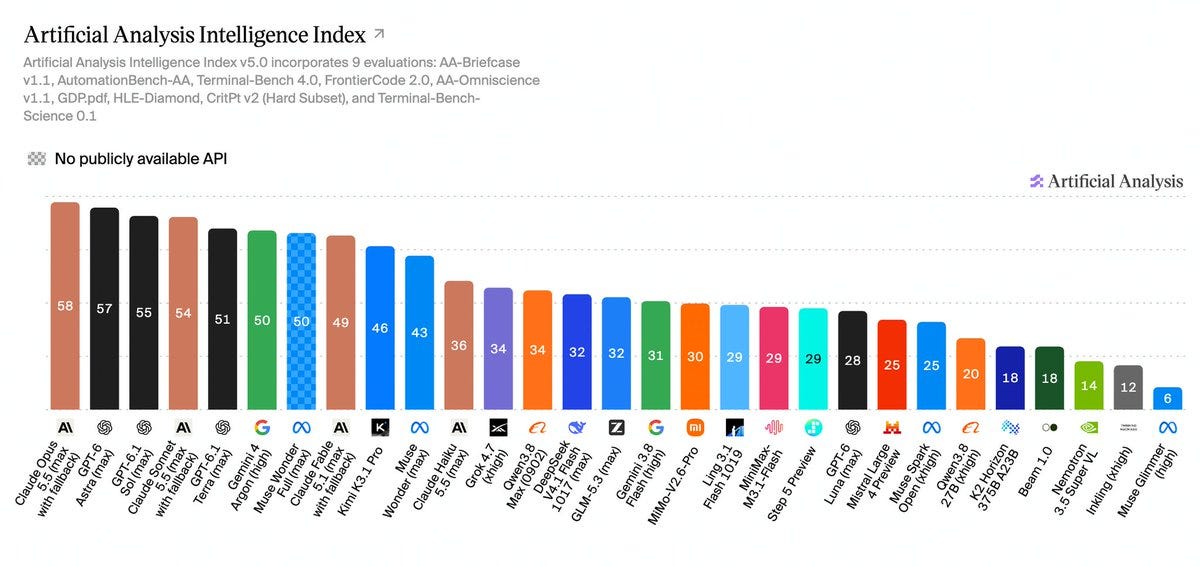
Nathan Lambert argues that independent AI evaluation is difficult not only because scoring models is technically demanding, but because benchmark creators must choose what to measure and how to combine results. In his view, a single index is easy to discuss but cannot represent every capability fairly, and its choices can influence both public perceptions and model development.
Discussing Artificial Analysis’s Intelligence Index v5, Lambert says the ranking looks reasonable overall but reflects trade-offs in what counts as frontier capability. He argues that the index may understate the economic importance of open models if it emphasizes capabilities where closed models lead, while noting that open models have narrower strengths and remain behind on some science evaluations.
Lambert also questions whether private benchmarks, whose prompts and test environments are not public, are worth the loss of public scrutiny. Hidden tests may make it harder to tailor training to an evaluation, he writes, but they also prevent the community from finding and reporting flaws. He describes benchmark evaluation as a matter of trust, noting that commercial testing and public-interest institutions each involve trade-offs. Whether more specialized indices can broaden the picture without adding new biases remains open.
Keep in view: This is Lambert’s analysis and assessment of Artificial Analysis v5, not an independent verification of the index or its rankings. The source does not establish whether private benchmarks will reduce benchmark-focused training or how much public scrutiny would be lost in practice. Lambert’s discussion of open models’ future economic role and progress includes expectations and uncertainties, not demonstrated outcomes.
The authors introduce Seq@K, an evaluation protocol for language models that gives a model feedback after each failed attempt. It measures whether the model solves a problem within a set number of sequential attempts. They argue that common measures such as Pass@1 and Pass@K do not capture how models use feedback to improve their answers.
The authors report that Seq@K can produce different model rankings from Pass@K. They also report that it can change which model configurations appear most efficient. The paper analyzes how models respond to feedback, including whether they address issues raised or hold onto their original answers. For practitioners choosing models for systems that refine outputs in response to feedback, the paper suggests that the evaluation method and the feedback itself may affect which models seem suitable. The abstract does not establish how well these findings predict performance in deployed systems.
An open question is whether the reported differences persist across other tasks and real-world feedback loops.
Keep in view: The supplied evidence is the paper's abstract, not its full methods or results; it does not provide benchmark names, detailed measurements, or evidence about performance in deployed systems. The findings are reported for the benchmarks and models evaluated in the paper; the supplied abstract does not establish whether they generalize to other tasks or feedback loops.
In an arXiv paper, Sinuo Wang and coauthors introduce LiveSearch, a benchmark designed to test whether financial search agents can find current answers rather than repeat outdated ones. Its questions are stored as executable verifier code: instructions that call a professional financial data service and extract an answer. The question stays fixed, while the benchmark recalculates the answer from live data at evaluation time and reruns the checks daily. The authors say this makes memorized answers likely to go stale and requires models to use tools and analysis. They report that, under general web search, six contemporary tool-calling models reached 70.9% to 76.7% answer accuracy. They also report that 70% of served questions changed their gold value over three consecutive days, and that reused earlier answers failed on a majority of questions within one day, even with tolerance-aware matching. These results describe the benchmark and its reported evaluations; they do not establish how agents perform in real financial work. How well do LiveSearch’s questions and data-service calls represent the financial tasks agents would encounter outside the benchmark?
Keep in view: The supplied evidence is the paper's abstract; it does not provide details about benchmark coverage or how well its tasks represent financial work outside the benchmark. The reported accuracy results are benchmark evaluations and do not establish agents' reliability in real-world financial work.
Jiawei Zhou and coauthors argue that skill optimizers—systems that rewrite an agent’s natural-language procedures—may select edits that look useful on a small development set without improving performance on new tasks. Across three optimizers, three benchmarks and two models, learned skills succeeded about as often as their hand-written starting versions, while reading about 16% more input tokens. The authors report that selecting the best of several candidates on at most 30 tasks can produce similar apparent gains even when no candidate changed. They recommend accounting for selection effects and for the extra turns an edit adds, rather than judging a skill by success scores or length alone. The abstract does not establish whether these recommendations improve performance in other settings.
Keep in view: The abstract reports results across three optimizers, three agentic benchmarks and two models; it does not establish how well the findings generalize to other settings. The abstract does not report whether the four proposed principles improve results when implemented.
The authors of FVH-Bench argue that image-generator safety assessments should consider what images enable, not only what they depict. They call risks from images that guide dangerous actions or support deception “functional visual harm” (FVH). Their benchmark contains 669 prompts spanning five harmful visual functions and ten risk domains.
In tests of 11 image generators, the authors report that models rarely refused the requests and frequently produced artifacts serving the targeted harmful functions. They also report high scores for target harm realization and harmful artifact usability, and limited coverage of FVH by existing safety detectors. The abstract does not identify the tested generators or explain how these scores were measured, so it does not establish how the results generalize beyond the evaluation. The authors’ central point is that an image can be risky because of the actions or deception it enables, even when it is not overtly graphic or otherwise harmful in appearance.
How would the findings change across image generators or under different measures of artifact usability?
Keep in view: The evidence provided is the paper’s abstract, which does not identify the 11 evaluated image generators or detail the evaluation methods and scoring measures. The abstract reports benchmark findings but does not establish how well they generalize beyond the evaluated prompts and generators.
Authors Ruilin Yao and colleagues introduce LBS (Look Beyond Screens), a vision-language model trained to decide what parts of an image to inspect. Their approach uses GUI grounding—linking interface elements to locations on a screen—as a source of spatial supervision, then trains the model on multi-turn crop-and-inspect decisions.
The authors report that, under fixed inference settings, LBS models based on Qwen3.5-35B-A3B and Qwen3.8-27B improve over their corresponding baselines. They also report gains beyond supervised fine-tuning on PerceptionBench for both backbones, and on HR-Bench and ChartQAPro for Qwen3.5-35B-A3B.
The proposed mechanism is that supervised fine-tuning (SFT) establishes visual inspection primitives, while reinforcement learning (RL) improves their downstream effectiveness. If these results hold in broader settings, training on interface tasks could help models learn image-inspection strategies useful outside interfaces; the abstract does not establish their reliability in real-world use. How well do the reported gains transfer to tasks and images beyond the evaluated benchmarks?
Keep in view: The evidence provided is the paper's abstract; it does not give benchmark scores, evaluation details, or evidence of reliability in real-world use. The abstract reports transfer on named benchmarks but does not establish how well the approach transfers to other tasks or images.
The authors of ATEMPO: Amortized Transfer Entropy Model Per-lag Over-Time introduce a diffusion-based estimator for tracing when one time series provides information about another. Transfer entropy measures how much a source’s past tells us about a target beyond the target’s own history; the authors say that fixed input windows can mix informative and irrelevant delays.
ATEMPO samples source and conditioning depths during training and accounts for temporal position. The authors report that one score network estimates a transfer-entropy surface across lags and time, and that differences in this surface recover when information arrives. They report a single fit where existing estimators require 18 separate fits for the same grid.
In the paper’s evaluated datasets, the authors report lower mean relative error than baselines on synthetic data with known transfer entropy, and 0.98±0.04 lag-detection accuracy on datasets with known lags. They also report improved downstream forecasting results on WEATHER-5K and brain-computer interface tasks. These results describe the tested datasets; the abstract does not establish how well the method will work in other settings.
An open question is whether ATEMPO’s lag detection and forecasting results hold on additional datasets beyond those evaluated in the paper.
Keep in view: The abstract reports results on synthetic datasets, datasets with known lags, three systems with time-varying lag, WEATHER-5K, and three brain-computer interface tasks; it does not establish performance on other settings. The supplied evidence is the abstract, so it does not provide methodological or evaluation details needed to assess the reported results further.
The authors of “Beyond the Readout: A Latent Numerical Frame Shared Across Modality and Operation” report that Gemma4-12B-it represents arithmetic results from text and images in different internal coordinates. A rotation and rescaling can map the representations onto one another. They use causal interventions—changing internal model states and observing the effects—to test whether the representations share more than a similar appearance. Their experiments find that some directions in the model’s residual stream carry the number without affecting the digit it is about to write. In cases where two numbers share their first digit, changing this hidden information can redirect the next digit while leaving the first unchanged. The authors interpret this as evidence that the model can hold an answer before spelling it out, and that the modalities share numerical meaning through related internal geometry. The findings concern arithmetic tasks in one model; the abstract does not establish whether the same pattern applies to other models, tasks, or practical uses. How far does this shared geometry extend beyond the tested model and arithmetic conditions?
Keep in view: The abstract reports experiments on Gemma4-12B-it and arithmetic across text or image input, using addition or subtraction; it does not establish whether the findings generalize to other models or tasks. The abstract does not establish how the reported internal representations affect accuracy or reliability in practical uses.
The authors of CoS-VQ propose a vector quantization method for reducing the memory needed to deploy large language models. Vector quantization represents model weights using selected codewords; the authors say existing methods can improve accuracy by increasing codeword dimension, making lookup and updates more complicated.
CoS-VQ instead jointly optimizes codeword indices and a shared scale across positions. The scale affects which codeword combinations are best, so the authors say point-by-point updates can stall. Their method uses candidate scales and a mathematical bound to find representative intervals for updating indices and scale together, without checking every combination.
On Qwen3.8-27B, the paper reports better results than QTIP and LLVQ on the evaluated language modeling, coding, and reasoning benchmarks. Its ablations also report larger gains from joint updates than from refining the scale alone. These results concern the benchmarks and model described; the abstract does not establish how the method performs on other models or in deployed systems.
How well does CoS-VQ’s reported advantage carry over to other models and real deployment settings?
Keep in view: The abstract reports benchmark results for Qwen3.8-27B but does not provide numerical scores or establish performance on other models or in deployed systems. The source is an arXiv paper abstract; the supplied evidence does not include independent evaluation of its results.
In their paper, Kianté Fernandez and coauthors introduce CogArena, a benchmark that tests AI agents on ten experiments from the social and behavioral sciences. Rather than presenting the tasks as text prompts, the benchmark has agents use a web browser with the visual stimuli and response interfaces used by online participants. Its scoring checks whether an agent finishes a task, how accurately it performs, and whether its data show behavioral signatures—the patterns each experiment reliably produces in people. The authors report that, across four multimodal models tested ten times per task, many sessions did not finish; completed sessions reproduced some signatures reliably and others not at all. They argue that task completion and reproducing human behavioral patterns are different capabilities, relevant to concerns about AI-generated data entering online research datasets. The paper provides the tasks, scoring code, and a public leaderboard. The abstract does not identify which experiments or signatures were reproduced reliably, or quantify how often online datasets are affected by AI agents.
Keep in view: The abstract does not specify which experimental paradigms or behavioral signatures were reproduced reliably, or provide rates of completion and reproduction. The abstract raises concerns about contamination of online research datasets but does not quantify its prevalence or establish the extent of any contamination. The reported evaluation covers four multimodal models; the abstract does not name them or establish how results generalize to other models.
Brian Ko and coauthors introduce MLE-World, a model that predicts the output of a machine-learning program from its code and a description of its data, without running the program. They say the predictions can help AI research agents compare more candidate programs while reducing the need for costly training runs.
The authors report that MLE-World matched the real terminal output for 77.9% of held-out programs across 17 MLE-bench Lite tasks. They also report that agents guided by the model achieved up to 22.1% higher observed mean performance than an agent without a world model, with less real execution. These are results on the reported benchmark tasks; the abstract does not establish how well the approach works on other tasks or in broader research practice.
The system assigns a confidence score to each prediction. The authors say they run a candidate for real when that score is low, allowing execution to check uncertain predictions. An open question is how well the confidence score identifies incorrect predictions beyond the reported tasks.
Keep in view: The reported results are limited to 17 MLE-bench Lite tasks; the abstract does not establish performance on other tasks or in broader research practice. The abstract does not report how reliably the confidence score identifies incorrect predictions beyond the reported tasks.
The authors of ADTGuard argue that streaming responses can expose users to harmful content before moderation finishes. They identify two gaps: checks made after a response or chunk can come too late, while fixed-layer, token-level detection may miss safety signals and response-level labels do not mark when harmful content begins.
Their proposed safeguard checks each token before release, combines safety evidence across layers and successive tokens through Depth-Time Safety Dynamics (DTSD), and uses a Causal Depth Router (CDR) to adapt which layers it observes. Risk-Onset Target Refinement (RTR) progressively builds token-level training targets from response-level labels.
The authors report strong detection across multiple safety benchmarks, matching or surpassing state-of-the-art safeguards with 16M trainable parameters and competitive per-token latency. These are reported benchmark results; the abstract does not establish how the system performs in deployed settings. How does ADTGuard perform when integrated into real streaming systems, where latency and harmful-content exposure must both be measured?
Keep in view: The evidence is the arXiv abstract; it does not provide benchmark names, detailed results, or the comparison conditions. The abstract reports benchmark performance but does not establish performance in deployed streaming systems or quantify harmful-content exposure there.
On the Lex Fridman Podcast, Alex Kontorovich, Ankur Moitra and Steven Brunton discuss AI-produced proofs, including OpenAI’s reported drop of about 700 results, and what mathematics is for.
Kontorovich describes a quasi-Riemann hypothesis proof sharpening estimates of prime-number distribution; the Riemann hypothesis remains unsolved. Moitra reports a Unique Games Conjecture proof clarifying how closely efficient algorithms can approximate the best answer to hard computing problems, crediting major human contributions.
For Navier-Stokes, equations modeling fluids, Brunton describes a counterexample with smooth external forcing (applied forces that do not themselves blow up) in three dimensions. A vortex reaches infinite vorticity (local fluid rotation) in finite time. He calls this non-physical; fluids remain just as hard to simulate or predict.
Kontorovich describes Lean as software that checks a proof’s logical steps, but insists: “We want stories. We want understanding.” They debate whether AI combines existing ideas or finds new ones. Moitra worries about students’ research paths and strained review institutions. Their advice returns to curiosity, fundamentals and purpose amid uncertainty. The conversation reports these results without independently verifying them.
Press play to watch. If playback is unavailable, open the source below.
Keep in view: The mathematical results discussed are reported by the speakers; this transcript does not independently establish their correctness or the extent of human involvement. The transcript labels the advice passage “Steven Brunton” after a question addressed to Ankur Moitra. The speaker attribution is unclear, so the reading does not assign the quoted advice to either person. The conversation raises possible effects on research, education and engineering but does not establish their eventual scale.
Hoda Heidari and Aydin Mohseni argue that deciding how to use AI in science depends on why humans should continue doing science. They identify durable, collective human understanding, pursued in service of human ends and values, as an indispensable aim.
Their framework asks whether a scientific community can still explain, defend and contest claims produced with AI, and retain the skills to do so. It also says accountable humans should decide which questions matter and what findings mean. The authors apply this two-part test across research phases, including peer review and training new researchers, and offer recommendations that fields can tailor to their methods and questions.
The proposal makes the consequences for human understanding and direction—not the type of AI tool—the basis for judging each use. The abstract describes a framework and recommendations, not evidence that applying them has improved research. How would a field determine whether researchers retain the skills to explain, defend and contest AI-produced claims?
Keep in view: The supplied evidence is the paper's abstract; it does not describe empirical evaluation of the framework or whether applying it improves research. The abstract says the paper closes with needed reforms but does not specify those reforms.
Kate Brennan, who leads the policy agenda on A.I. and corporate power at the AI Now Institute, argues that government should focus on corporate negligence and stop harmful products from entering the market. She says A.I. companies’ spending on technology creates pressure to deploy it broadly, including in public institutions and contracts where it may not be fit for purpose or secure. Brennan cites a Bain estimate that, by 2031, companies would need $6 trillion in annual revenue to sustain their current level of capital expenditure, which she says is $1.5 trillion a year. She argues that products causing significant harm, including injury, death or cybersecurity attacks, could be subject to strict liability, whether or not a company knew or should have known of the danger. This excerpt presents Brennan’s perspective; it does not include the full panel’s views. How would lawmakers define significant harm and apply strict liability to A.I. products?
Keep in view: The evidence is an excerpt featuring Brennan; it does not include the full roundtable or other experts’ views. The revenue and capital expenditure figures are attributed to Bain’s estimate, not presented as observed outcomes. The excerpt does not specify how lawmakers would define significant harm or apply strict liability to AI products.
In a Perspective on arXiv, Jiawei Qu, Kai Hou, Hongjie Jia and Jinyue Yan argue that the carbon footprint of generative-AI inference depends partly on whether a model is capable enough for the task without doing unnecessary work. A frontier model may spend extra computation on a routine request, they say, while an under-capable model may consume more energy through failures, retries, extended reasoning or escalation.
The authors propose capability-constrained carbon labeling: first assess models against the capability required for a particular task, then compare the expected energy use and operational carbon emissions of models that meet that requirement. They would measure expected emissions per successfully completed task at the required capability level, rather than carbon intensity per inference alone.
The approach could help users and providers match models to tasks while taking service quality into account, but the abstract presents it as a proposed framework, not a demonstrated emissions reduction. The authors say it would require standardized capability-based service assessments, comprehensive energy accounting and transparent carbon disclosures. The evidence here does not show how those standards would be set or whether the approach would reduce emissions in practice.
Keep in view: This is a Perspective proposing a framework; the abstract does not report evidence that capability-constrained carbon labeling has reduced emissions in practice. The abstract says a standardized evaluation framework accounting for task-specific capability requirements and emissions for successful tasks is lacking. The evidence does not specify how task capability requirements, successful completion or comparable energy accounting would be standardized.
Gary Marcus argues that generative AI’s harms are serious and that its expected benefits may not be materializing. He cites nonconsensual deepfake pornography, phishing scams, disinformation, surveillance, intellectual-property harms to artists and writers, and possible employment effects, which he says have been more modest than some expected. He also points to a period of hacks and quotes security leaders warning that conditions could worsen.
Marcus says some friends have benefited, mainly through coding, but argues that generative AI could be a net detriment to society and might harm the wider economy. These are his assessment and concerns, not demonstrated outcomes in the article. What evidence would show whether the technology’s benefits outweigh its harms?
Press play to watch. If playback is unavailable, open the source below.
Keep in view: The harms and overall social assessment are Marcus’s claims; this article does not provide independent evidence establishing their scale or causation. Marcus refers to an argument by Torsten Slok about expected positive effects, but the cited material is not included here. The article does not establish whether generative AI will harm the wider economy; Marcus presents this as a possibility.
The International Labour Organization (ILO) says a new working paper examines how international labour standards could guide the responsible use of artificial intelligence (AI) at work and address emerging challenges for workers’ rights. The paper, by ILO researchers Jordi Agustí-Panareda and Daniel Samaan, compares five AI ethics principles with the values and rights underpinning the ILO’s standards system.
The ILO reports areas of convergence, including fairness, human dignity, well-being and preventing harm. It also highlights a difference: AI ethics frameworks often emphasize individual concerns such as autonomy, privacy and transparency, while labour standards bring collective rights—including freedom of association, collective bargaining and social dialogue—into view. The paper says these collective dimensions are often missing from mainstream AI ethics discussions, though they matter to how technologies are introduced and governed at work.
The researchers also examine workers’ personal data, algorithmic management, workplace surveillance and transparency in AI-assisted employment decisions. The ILO gives screening applicants and evaluating performance as examples where understanding decisions and data used can support accountability and a fair process. The authors suggest AI ethics and labour standards can inform one another, and call for further research and dialogue.
International Labour Organization · An office worker concentrating on tasks at his modern desk in a contemporary setting. · Open original source
Keep in view: The source describes a working paper’s analysis and proposed areas for research; it does not report evidence that applying these standards has improved workplace outcomes. The source does not specify how international labour standards would be applied in particular workplace decisions or describe implementation results.
Indeed Hiring Lab’s snapshot was published October 22, 2026. It describes a US labor market where overall job postings are rising, but new postings have not improved and hiring remains weak. The report says it is “premature to say the labor market is strengthening”: the Indeed Job Postings Index (JPI) is higher than a year earlier, while unemployment edged up in September.
The report says more occupational sectors have higher postings than a year earlier, with engineering among the stronger areas, but conditions vary sharply by location. It attributes slack in parts of California and the Southeast to different factors: weaker tech hiring in some California and Washington metros, and a mismatch between jobs and workers in the Southeast. Posted wage growth cooled, and inflation-adjusted average weekly earnings fell from August to September, though some sectors saw advertised wage gains.
Indeed Hiring Lab says low hires and quits rates leave the broader employment picture short of the vitality needed for meaningful improvement. It also reports continued growth in data center-related job postings through September. The report expects annual JPI growth to remain positive through the fall, citing favorable base effects and a more positive seasonal hiring picture. Whether new postings improve remains unknown.
Keep in view: Text as retrieved on October 30, 2026; originally published October 22, 2026. The snapshot reports labor-market indicators and Indeed Hiring Lab’s interpretation; it does not establish what happened after its publication date.
On October 21, 2026, J. Bradford DeLong crossposts Robert Rubin’s argument that possible interference with the U.S. midterm elections poses an economic risk that business leaders and markets may be underestimating. Rubin argues that election uncertainty could disrupt investment and financial markets, and that damage to the rule of law could weaken confidence in the United States as a place to invest. He points to possible disruptions from a contested election and argues their economic effects could outlast the immediate political crisis. DeLong adds his own view: he expects a contested or overturned election to damage investment, productivity growth, Treasury yields and the dollar over the longer term. These are Rubin’s and DeLong’s arguments and forecasts, not reported outcomes. The crosspost gives no evidence that the election has been interfered with or that the predicted economic effects have occurred.
Keep in view: Text as retrieved on October 24, 2026; originally published October 21, 2026. The page combines Rubin’s crossposted opinion with DeLong’s commentary; its forecasts are arguments, not evidence that the predicted events or effects occurred.
Mistral AI’s announcement, dated October 21, 2026, describes work with NVIDIA on AI-native engineering workflows that combine Mistral models and data generation with NVIDIA accelerated computing and physics modeling tools. The companies say they aim to connect simulation, AI model development and engineering design in closed-loop workflows, and to integrate Mistral models with NVIDIA Omniverse libraries for 3D scene generation and SimReady asset creation.
Mistral and NVIDIA also plan public benchmarks and open datasets for physics models, plus evaluations of agentic AI in computer-aided engineering (CAE) and electronic design automation (EDA). The proposed evaluations would assess tool use, multistep workflows, technical correctness, execution time and computational cost. Shared tests could give researchers and engineering teams a basis for comparing systems, but the announcement reports plans, not benchmark results or demonstrated improvements to engineering work.
What tasks and datasets will the public evaluations include, and how will their results relate to performance on engineering work outside the benchmarks?
Keep in view: Text as retrieved on October 29, 2026; originally published October 21, 2026. The announcement describes collaboration plans and proposed evaluations, but provides no benchmark results or evidence of improved engineering outcomes.
TechCrunch’s Sarah Perez reports on October 21, 2026, that Meta described use of its AI app Muse during its third-quarter earnings call. Mark Zuckerberg said more than 10 million people had adopted it, and that about a quarter of people who set it up used it daily. He highlighted shopping: over a quarter of engaged users shopping through Muse had an average purchase size above $200. Zuckerberg also said people used Muse for tasks involving email and calendars, and pointed to security features Meta says protect users’ data and privacy.
Meta plans to make Muse free for most users while taking a percentage of commerce on the platform, with payment for some advanced models or more tokens. Zuckerberg said Meta expects Muse to become profitable after scaling, while forecasting improved compute cost efficiency and more revenue per user than its family of apps. Those are company expectations, not reported outcomes. He also described a planned “Muse network” in which users’ Muses could work with friends’ and family members’ Muses, and businesses could be represented by agents. The report does not establish whether shopping activity or these plans will deliver the revenue and profitability Meta expects.
Keep in view: Text as retrieved on October 24, 2026; originally published October 21, 2026. The article reports Meta’s and Zuckerberg’s statements and forecasts; it does not establish that projected revenue, cost efficiency, or profitability will be achieved. The article includes a disclosure that TechCrunch may earn a commission from purchases through links in its articles.
TechCrunch’s article, published October 21, 2026, reports that Recursive released Flint, a free coding model that runs on a laptop and was built largely with help from AI. The company says its Eureka Machine, an automated research system, helped with nearly every step of development, which took a small team under four months.
The article describes Flint as an early public test of recursive self-improvement: AI helping build better AI. It distinguishes Recursive’s current approach—an AI research assistant overseen by people—from the more expansive longer-term goal the company describes. The article reports that Flint can run offline and that Recursive’s tests found it generated code quickly on specified hardware. It also reports favorable results on coding benchmarks, while noting that Flint needs more guidance than large paid coding assistants.
The article does not establish how much the Eureka Machine reduced development time or whether its results will generalize beyond the reported tests. Recursive says each new model should improve the system’s research ability, but that remains a company-stated goal. What measurable time savings, if any, did the Eureka Machine provide during Flint’s development?
Keep in view: Text as retrieved on October 24, 2026; originally published October 21, 2026. The article does not quantify how much time the Eureka Machine saved researchers. Performance claims rely on Recursive’s tests and benchmark results; the article does not establish how they generalize to other coding tasks or settings. The article reports the company’s goals for future recursive self-improvement; it does not report that those goals have been achieved.
On October 21, 2026, MIT Technology Review introduces its Impossible issue, the theme of its last print edition of 2026. The newsletter says the issue explores ambitious efforts involving synthetic blood, cities on the moon, cognitive immortality, AI’s ability to say no, a bionic eye, and blended meat. It also says the issue revisits technologies that have been “coming soon” for years.
MIT Technology Review frames these stories as attempts to make life better, safer, healthier, or more joyful. The introduction presents the issue as an invitation to consider daring technological goals, not as evidence that the featured efforts have succeeded. Which of the featured attempts can move beyond ambition, and what evidence would show that?
Keep in view: Text as retrieved on October 28, 2026; originally published October 21, 2026. The introduction describes the issue’s themes and ambitions but does not establish whether the featured efforts succeed. The newsletter says readers must subscribe to read the full print issue.
Lucas Ropek reported for TechCrunch on October 21, 2026, that Meta plans to create a class of non-voting stock to support its business and AI investment. Non-voting shares do not give their owners a vote on company decisions. Meta CFO Susan Li said the shares would be distributed to existing shareholders through a stock dividend and could later be used to raise capital, compensate employees, make acquisitions, and serve other corporate purposes. Li said the plan is intended to preserve the voting power of existing shareholders and Meta’s “founder-led structure.”
Meta’s stated plan is to add a funding option without changing the voting power of those existing shareholders. The article does not establish when or on what terms Meta would use the shares to raise capital. It also reports that Meta faces ongoing legal and regulatory matters, including youth-related scrutiny and trials expected in the coming months, but does not describe their outcomes.
Keep in view: Text as retrieved on October 24, 2026; originally published October 21, 2026. The article reports a plan, not a completed share distribution or a completed capital raise; it gives no timing or terms for any future use of the shares. The article reports Meta’s statements about legal and regulatory matters but does not establish their outcomes.
Ethan Mollick argues that AI capabilities have changed substantially in the 30 months since his previous book: more models now outperform GPT-4 at its release, and systems can take on longer tasks. He says progress is uneven, with persistent weaknesses alongside major gains, and describes a shift from working alongside chatbots to delegating tasks to agents—AI systems that can carry out work with less step-by-step guidance. In his account, delegation can save time, but it also creates risks as people lose control over how agents produce results. The evidence here is Mollick’s retrospective and cited benchmarks, not proof that AI performs reliably across real-world work.
One Useful Thing · Some examples of interacting with Claude to make the graphics for this post. Notice that it corrected me. · Open original source
Keep in view: This is Mollick’s retrospective and account of his own use of AI; the evidence does not independently verify the reported results or establish reliability across real-world tasks. The METR measure described in the post ended when its researchers said their current methods could no longer measure AI task duration accurately. The larger estimate mentioned is attributed to other studies, which are not detailed here. The post promotes Mollick’s new book; its claims about AI trends and implications should be read as his perspective.
Ai2 introduces FairStress, a benchmark that tests whether language models apply decision criteria consistently across demographic groups—not only whether they make the same final choice. It presents models with matched scenarios and persuasive challenges, then measures whether those challenges change decisions differently depending on which group benefits.
Ai2 reports that more explicit demographic cues were associated with less symmetric behavior, including greater willingness to abandon a well-supported choice when that favored a minority-coded candidate. The benchmark also found differences in models’ explanations and, in a limited analysis, internal activity. Ai2 says most of nine tested interventions did not reliably reduce asymmetry; asking models to reconsider cases with identities swapped came closer while largely preserving accuracy.
FairStress reflects an equality-centered definition of fairness, which does not capture every approach, such as equity-based views that consider historical disadvantage. Ai2 says it remains unknown whether patterns in training data caused the observed behavioral gaps. Whether the results and proposed fixes hold beyond the tested models and scenarios is also unresolved.
Keep in view: Ai2’s findings are reported from its own benchmark and experiments; the evidence does not establish how the results generalize to real-world decisions. The benchmark uses an equality-centered definition of fairness and does not capture every fairness approach, including equity-based views that may consider historical discrimination or underrepresentation. Ai2 says its internal-activation analysis covered only two models and a handful of demographic contrasts. The source says whether audited training-data patterns cause the behavioral gaps remains an open question.
Scott Alexander published this essay on Oct 20, 2026. He distinguishes “true successionism,” in which AIs take power at humans’ expense, from “handoverism,” in which aligned AIs might hold power to serve human interests. He argues that the second idea should not be dismissed simply because it places AIs in positions of control.
Alexander sketches five speculative arrangements, ranging from AI soldiers aligned to democracy and AI representatives reflecting people’s preferences to a superintelligence protecting independent communities or directing humanity. His examples ask whether AI could provide coordination, protection, or governance while reducing risks he associates with human rulers, such as corruption and concentrated power.
These are thought experiments, not demonstrated plans or evidence that an AI could be aligned or govern well. Alexander says the topic is “inherently speculative and science-fiction-ish.” A central unresolved issue is how people could judge whether an AI entrusted with power truly serves their interests, and how they could correct or replace it if it does not.
Keep in view: Text as retrieved on October 24, 2026; originally published October 20, 2026. Alexander explicitly describes the topic as speculative; the proposed governance arrangements are thought experiments, not demonstrated systems. Alexander says he is not a historian and cannot vouch for the historical distinction between village and imperial layers as scholarship.
Hugging Face’s PyTorch team describes upgrades to PyTorch 2.15’s MPS backend, which lets PyTorch use the GPU on Apple silicon Macs. The post reports support for FP8, a compact number format that uses half the storage of BF16, and new Metal GPU kernels for operations used in language-model decoding, audio, video and training.
The team reports substantial gains in specific tests: on an M3 Ultra, two mixture-of-experts models decoded 5–6.5 times faster than in PyTorch 2.14. In a Wan2.2 video-decoding workload, reported peak driver memory fell from about 270 GiB to 8 GiB after padding moved to Metal. These are results for the described hardware and workloads, not a guarantee of similar performance across Macs or models. The update also requires macOS 15 or later and Python 3.11 or later. The post presents PyTorch 2.16 improvements as work in progress, not features of 2.15.
Keep in view: Performance and memory results are publisher-reported measurements for named hardware and workloads; the evidence does not establish general results across devices or applications. The post describes some PyTorch 2.16 changes as landed in nightlies or still in review; they are not presented as part of PyTorch 2.15.
ADP Research’s report, published October 20, 2026, says its Employee Motivation and Commitment Index improved for a second month, gaining four points to close at 131 in October. ADP Research describes the index as tracking how U.S. workers think and feel about their jobs.
The reported improvement spanned industries and worker types, though not every group gained: 15 of 19 sectors improved, while utilities fell. Education had the largest sector increase; among worker types, the sentiment gap was at its narrowest since October 2022. ADP Research also reports gains in five of seven employer-size categories, with organizations of 1,000 or more workers posting the largest increases.
These figures describe changes in the index, not evidence about why sentiment shifted or how it affected workers’ lives. The report does not explain what drove the gains or whether they correspond to changes in workplace conditions.
Keep in view: Text as retrieved on October 30, 2026; originally published October 20, 2026. The report gives index changes but does not identify what caused them or establish whether they correspond to changes in workplace conditions.
Ed Zitron’s article was published on October 20, 2026. He argues that the AI investment boom depends on rising spending and revenue that may not materialize together. He points to concentrated stock-market exposure, debt-funded data-center construction, and uncertainty about whether companies can earn enough from AI services to cover their costs.
Zitron also questions whether reported demand for GPUs reflects actual need. He cites reporting that Amazon stored GPU racks while some data centers lacked power or a clear installation path, and interprets early deliveries as possible channel stuffing. That is his allegation, not an established finding in the evidence provided.
His broader concern is that the same AI companies and investors are linked through borrowing, infrastructure spending, and anticipated customer payments. If demand or financing weakens, he argues, the effects could spread across companies and markets. The article relies on cited reports, analyst estimates, and Zitron’s own calculations; this evidence does not independently establish the accuracy of those figures or predictions. A central unresolved issue is how much revenue AI services generate and whether customers can sustain spending at the levels required to support planned infrastructure.
Keep in view: Text as retrieved on October 23, 2026; originally published October 20, 2026. The article combines cited reporting, analyst estimates, and Zitron’s calculations; the supplied text does not independently verify those sources or figures. The claim of NVIDIA channel stuffing is Zitron’s interpretation of the cited reporting, not an independently established finding. The article’s forecasts about market effects and company outcomes remain predictions, not demonstrated outcomes.
Jack Clark’s Import AI speech was published on October 19, 2026. Clark argues that AI has begun the singularity: a period in which AI accelerates progress, including scientific progress, beyond what people expect. He points to AI systems working across mathematics, biology and robotics, and to rising scores on scientific tests. His central argument is that AI’s ability to assist frontier science could expand discovery and, because creative problem-solving may generalize to other fields, accelerate innovation and reshape the economy. These are his claims and projections, not demonstrated economic outcomes.
Clark says people and governments should prepare to turn possible discoveries into broad benefits by building computing, energy, laboratory and robotic capacity, and by making it easier to move discoveries into clinics, factories and fields. But he stresses that expanded scientific capability also brings risks, including biological and cyber misuse. He calls for human oversight, rules for AI research, and restraint in development. He leaves open how much AI-led science people should permit, and how much they need to understand its results and tools.
Keep in view: Text as retrieved on October 23, 2026; originally published October 19, 2026. The speech argues for future changes and benefits; it does not establish that its economic projections or anticipated outcomes will occur. The source does not resolve how much human oversight or understanding AI-led scientific work should require.
Pew Research Center published this fact sheet on October 19, 2026, reporting survey findings on internet use, home broadband and smartphone-only access among U.S. adults. It says 97% of adults use the internet, while 78% subscribe to broadband service at home.
The Center also reports that 16% own a smartphone but do not subscribe to home broadband. It says home broadband adoption is lower among people with lower incomes and less formal education, and smartphone-only access is especially common in those groups.
The figures offer a broad view of access, but comparisons over time have limits: survey response methods and question wording changed. The findings describe reported access, not the quality, affordability or practical effects of internet service.
Keep in view: Text as retrieved on October 29, 2026; originally published October 19, 2026. The fact sheet notes that survey response modes changed over time and that question wording varied; these changes limit direct comparisons across some years. The findings report survey respondents’ stated internet use and subscriptions; the fact sheet does not establish service quality, affordability or the practical effects of access.
Scott Alexander’s open thread, published October 19, 2026, invites readers to discuss anything and shares several updates. Alexander asks people familiar with AI and grantmaking to rate the value of AI safety accomplishments, and to predict how he would rate them. He says the paired surveys could help distinguish differences in worldview from random noise in choosing weights. The thread also describes a real-money prediction market focused on AI and a project combining AI-written notes, user contributions and votes, and a browser extension. The survey offers a way to gather judgments about which AI safety accomplishments matter; the post does not report results or explain how those judgments would affect grantmaking. How closely will participants’ ratings and predictions align?
Keep in view: Text as retrieved on October 29, 2026; originally published October 19, 2026. This is a general open thread with several unrelated updates; it does not provide survey results or explain how survey responses will affect grantmaking. The post describes MNX and Common Notes but does not independently evaluate their operation or effects.
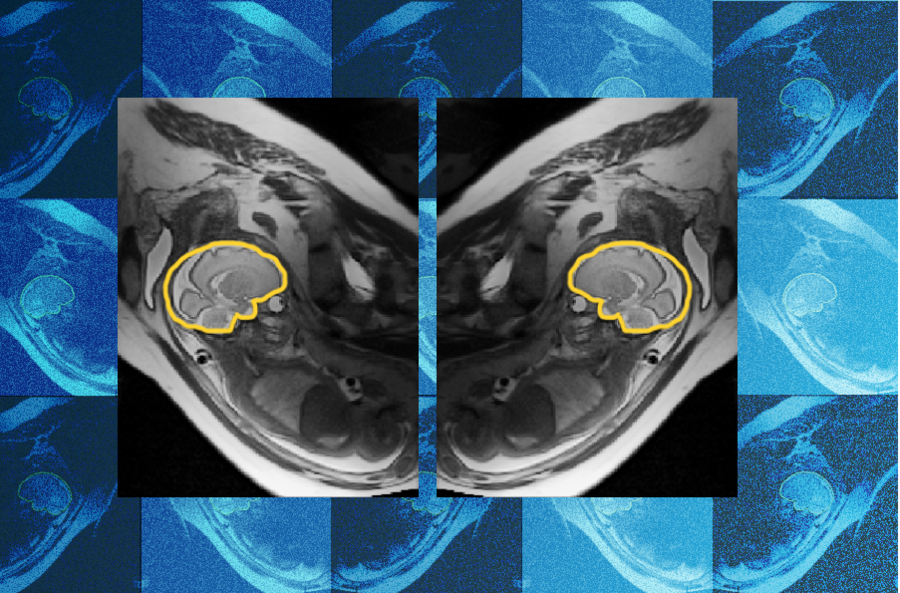
Researchers at MIT, Boston Children’s Hospital, and Inria developed E(3)-Pose, a model that tracks a fetus’s head as it moves during an MRI. Because movement can leave gaps or inconsistent angles in the scan’s 2D slices, clinicians may lack the detailed 3D image needed to assess fetal brain development. E(3)-Pose incorporates the fetal head’s left-right symmetry into its design to help identify its orientation and adjust image acquisition. The researchers say the approach could support higher-quality images and earlier diagnosis, but the article describes a research model, not established clinical performance. It is primarily trained on third-trimester fetuses; adapting it to younger fetuses remains future work.
MIT News · Greyscale fetal MRI showing two mirrored views of a fetus in the womb, with the fetal brain outlined in yellow in each image. A tiled blue background pattern o… · Open original source
Keep in view: The source does not provide clinical trial results or quantified diagnostic performance. The work is primarily trained on third-trimester fetuses; performance for younger fetuses is not established in the article.
Pew Research Center published this fact sheet on October 19, 2026, describing cellphone and smartphone ownership and smartphone-based internet access in the United States. The Center reports that 98% of U.S. adults own a cellphone and 91% own a smartphone. It also reports that 16% are “smartphone-only” internet users: they own a smartphone but do not subscribe to home broadband.
Pew says smartphone ownership differences appear particularly by age, household income and education. It also says reliance on smartphones for online access is especially common among adults with lower household incomes and less formal education. The retrieved text does not include subgroup percentages for these patterns.
How large are the differences in smartphone-only internet use by household income and education?
Keep in view: Text as retrieved on October 29, 2026; originally published October 19, 2026. The retrieved text does not provide subgroup percentages for smartphone ownership or smartphone-only internet use by income and education. Pew notes that survey response methods changed over time, including in 2023 and 2024; comparisons across years should be read with that methodological context.
Ramez Naam argues that large teams of AI agents can speed up parallelizable work, but current experiments show much smaller gains in harder problem-solving as teams grow. He points to examples where performance gains flatten sharply, including a formal-math benchmark where expanding from ten Opus 5.5 agents to a hundred added only two score points. He cautions that benchmark scores are task-specific, and that the experiments do not establish why gains flatten or how well future systems might scale.
The distinction matters for recursive self-improvement (RSI): the idea that AI helps develop improved AI. Naam’s view is that more copies of the models discussed in the article may help search or execution, but may not supply the conceptual breakthroughs needed for an accelerating feedback loop. He says the evidence is limited and proposes tracking verified performance, speed relative to compute, and where gains weaken as team sizes increase.
Keep in view: The article is a guest post by Ramez Naam on Noah Smith’s blog; the opening commentary is by Smith, while the main argument and analysis are presented as Naam’s. The article says the evidence base is limited, and many cited results are specific benchmarks rather than direct measures of AI research or general intelligence. The reported benchmark gains do not establish why scaling flattens or whether future models and methods will change the pattern.
Cloudflare announces Clairic, a preview model that returns structured values—such as names, dates, totals, estimates and forecasts—from text or images. Unlike a chat model that generates free-form text, Clairic returns answers in specified types, with confidence information and, for estimates and forecasts, uncertainty intervals. Cloudflare says the model is designed for single-pass processing and reports lower latency and cost than using an LLM for certain extraction tasks. In its own comparison on a damaged-product claim workflow, Cloudflare reports that a Clairic–Clef–GLM pipeline took 19.3 seconds and cost 49% less than an all-GLM pipeline; this is a company-reported test, not evidence of performance across other workflows. The preview is hosted on Workers AI, and Cloudflare says it plans to release open weights. The company cautions that the early model can struggle with longer arithmetic, aggregation and unfamiliar data; confidence and well-formed outputs do not guarantee correctness.
Keep in view: Performance and cost comparisons are reported by Cloudflare for its own example workflow; the evidence does not establish results across other tasks or deployments. The source describes Clairic as an early preview checkpoint and says forecasting is basic and not a replacement for specialized time-series models. Confidence scores and uncertainty intervals do not guarantee correctness, and Cloudflare says intervals may be too narrow on unfamiliar data.
In a guest post on Terence Tao’s blog, Francesco Maggi argues that AI systems are already producing mathematical proofs worth serious scrutiny, but their results do not automatically amount to human understanding or lasting scientific progress. Some proofs written in Lean—a system that lets computers check formal arguments—are so long that mathematicians may struggle to interpret them. Maggi sees a major opportunity in using AI to help develop mathematical frameworks for studying natural and social phenomena, while warning that proof-solving alone is not the whole of mathematical progress.
The outcome, he argues, depends on choices about how these tools enter research. He calls for clear credit and review practices, protection for unpublished research, training that helps students retain independent abilities, and broader access to powerful systems. His proposed response is coordinated, publicly accountable scientific infrastructure—not necessarily independence from companies, but enough shared capability for researchers to test claims and pursue their own questions. How AI affects creativity and learning remains uncertain; Maggi presents a “golden age” as achievable, not inevitable.
Keep in view: The post is explicitly identified as a guest post by Francesco Maggi; Terence Tao’s note says it was converted from a different file format using AI. The post offers arguments and proposals, not evidence that its predicted benefits or risks will occur. It says the effects of intensive LLM use on creativity are largely unknown. The post describes certain generated proofs as notable examples but does not establish their correctness or broader real-world reliability in the supplied evidence.
A clearer view of the AI changes reaching your life.
Ideas, disagreements and possible consequences, with the sources close at hand. Ordered by the original source date; dates added to this site are shown separately.
In a Moonshots episode discussion, one argument is that growing use of AI agents will make CPUs the next compute bottleneck: there may not be enough CPU capacity for the agents people use. CPU capacity, the argument says, is only beginning to expand, with a lead time of a couple of years. A counterargument is that stronger foundation models could let fewer agents handle tasks. The response narrows the adoption forecast to growth from 0.1 to at least one agent per person in four or five years, not 100 agents per person. The exchange leaves open whether wider agent use will increase demand for CPUs or stronger models will reduce the number of agents needed. The passage provides no calculation that establishes the forecast.
Keep in view: The transcript is machine-generated and has no reliable speaker turns, so the individual claims cannot be confidently assigned to named participants. The passage gives no calculation establishing the projected agent adoption, CPU demand, or lead times; these remain speaker assertions. The Navier-Stokes and Bell examples are mentioned but not explained sufficiently here to establish whether they are comparable cases.
In an excerpt from Scott Carlson’s interview, Cowen proposes that a school try one AI-only class, with a professor grading the student’s learning workflow rather than exam answers. He says students could create classes in subjects their schools do not offer, and argues that students may be better placed than professors to discover how to blend AI and education. Cowen says he is unsure how the proposal would work and favors experimentation, starting with one class. He also supports allowing schools to adopt different AI policies, including banning AI, though he says he would bet against no-AI schools. The excerpt does not report results from an AI-only class. Whether students learn effectively under this model, and how a professor could assess their workflow, remain open questions.
Keep in view: The source is a Marginal Revolution post excerpt from Scott Carlson’s interview with Cowen; it does not include the full interview. The excerpt offers proposals and opinions, not reported results from an AI-only class or evidence of learning outcomes. The interview is described as gated, but free with registration.
Mistral AI says it has released the weights of Mistral Large 4, a multimodal model previously made available in public preview. The company says additional reinforcement learning improved coding and defensive cybersecurity performance, and that the model offers three reasoning modes to let developers balance performance and cost.
Mistral reports that the model leads open-weight models on the FrontierCode and Terminal-Bench coding benchmarks. It also reports that the model scored 51% on the Artificial Analysis Cyber Index, which measures vulnerability discovery, reproduction, validation and patching. These are benchmark results, not evidence by themselves of performance across all real-world use.
The release allows organizations to inspect, customize and deploy the model on their own infrastructure, according to Mistral. But Mistral also says its live-traffic monitoring found potential for the model to assist real attacks, and that it is modifying its guardrails. How well those safeguards distinguish authorized defensive work from misuse remains an open question; Mistral says it will continue updating them.
Keep in view: The benchmark results and performance claims are reported by Mistral; the source does not provide enough detail here to independently assess the evaluations or how well they predict performance across real-world settings. Mistral reports potential for the model to assist real attacks and says it is modifying its guardrails, but the source does not establish how effective those changes will be.
Guancheng Pan, Qixin Tan, Yang Yuan and Andrew Chi-Chih Yao introduce the Algebraic World Model (AWM) as a way to reason about unfamiliar environments, rather than only settings with definitions supplied in advance. AWM explores an environment, tests and revises executable Python hypotheses against observations, then organizes them into rules and formalizes the model in Lean 4, a system for checking proofs.
The authors’ central idea is to turn observations into explicit rules that can be inspected and used for formal reasoning. In two impossible game levels, they report closed, kernel-checked proofs excluding every legal winning sequence in all six runs. Across the 25 public ARC-AGI-3 games, they report that Lean replayed winning trajectories for all 183 levels and that the models predicted unseen transitions.
The reported results illustrate how formal reasoning can address whether a goal is unreachable, not merely whether exploration has found a successful sequence. The evaluations described in the abstract are specific to the games tested; it does not show how the approach would perform in other environments. How well do AWM’s models and proofs generalize beyond the games evaluated in the paper?
Keep in view: The supplied evidence is the arXiv abstract, not the full paper; it does not provide the methods or details needed to assess how the reported evaluations were conducted. The reported impossible-level comparison covers two levels and the stated runs; the abstract does not establish performance on other tasks. The ARC-AGI-3 result concerns the 25 public games described in the abstract, so performance beyond those games remains unknown.
Margarita Trifonov and Vadim E. Levit argue that judging generative AI in education only by what human-AI teams produce misses what people can still understand, challenge, repair, and adapt when assistance changes or disappears. They call this tension the generative paradox.
The authors propose developmental function allocation: treating retained human capability as a design objective alongside current joint performance. Their Anti-Prompt paradigm reverses the interaction order when immediate AI generation would preempt a consequential human act: AI should first create conditions for human construction. They also distinguish a product’s validity, responsibility for its construction, and evidence of capability after support changes.
The central point is that team output does not, by itself, show what people can do when assistance changes or disappears. The abstract describes representative Anti-Prompts, stress tests, falsifiable predictions about retained capability, and a system-level hypothesis about the reproduction and distribution of expertise. These are proposals and hypotheses, not reported findings establishing improved retained capability.
Keep in view: The available evidence is the paper’s abstract, not its full text; details of the representative Anti-Prompts and stress tests are not available here. The abstract describes proposed distinctions, stress tests, falsifiable predictions, and a system-level hypothesis, but does not report results establishing improved retained capability. The abstract does not specify what evidence or measures would establish retained capability after support changes.
Guest author Gireeja Ranade argues that AI may weaken the reasons students choose mathematics and other fields requiring complex reasoning, even as society needs people trained to understand and question AI-generated work. She recounts students expressing distress about a mathematics result and doubts about whether effort is worthwhile when models can do tasks from a prompt.
Ranade argues that education and early-career work have helped people build expertise while contributing useful work. If AI reduces those opportunities, she asks how future researchers and other thinkers will be trained, and how students will be motivated to pursue that training. She also warns that people may accept AI outputs after superficial checks without understanding their assumptions or limitations.
Her proposed response is cultural and institutional: value careful understanding and explanation, give teachers more resources, and support rigorous education and open-ended research. She invites university leaders, philanthropists, and funding agencies to support those aims. The post presents these as concerns and proposals, not demonstrated effects of AI. How can institutions sustain pathways that let people develop expertise if AI changes the work and training those pathways provide?
Keep in view: The post presents concerns and predictions about AI's effects on motivation, jobs, and understanding; it does not establish that these effects have occurred. Ranade says her discussion of jobs focuses narrowly on jobs for highly trained scientists, mathematicians, and humanists, rather than addressing the broader effects of AI on jobs. The post notes that it was converted from a different file format using AI.
In their arXiv abstract, Xinyan Wang, Xiaogeng Liu, Jun Shao and Chaowei Xiao report that learning from user feedback can make personal agents less robust to indirect prompt injection. This occurs when an agent follows instructions hidden in untrusted external content, giving the content’s author control over the agent.
The authors tested a two-phase setup. During adaptation, users asked an agent to read external content and perform the task described there, then gave feedback that the agent used to improve itself. During testing, new content contained a similar task, but the user’s request did not authorize it. Across tasks and domains for a real personal agent, the authors say self-evolution substantially degraded robustness.
Compared with a base agent that did not learn from feedback, average attack success rates rose by 14.0–48.8 percentage points under skill evolution and 3.0–39.3 percentage points under reinforcement learning. These are results from the paper’s test setup, not a measure of how often attacks succeed in everyday use. The authors characterize the results as posing safety risks.
The unresolved practical question is whether these findings hold across other personal agents and real-world tasks beyond the tested setup.
Keep in view: The evidence is the arXiv abstract; it does not provide detailed results or enough methodological detail here to assess the experiments independently. The abstract reports results for a real personal agent and test instances across domains, but does not establish how often such attacks succeed in everyday use or whether the findings generalize to other agents and real-world tasks.
Tevfik Uyar argues that generative AI outputs do not inherit the usual reasons for trusting testimony or deterministic tools: general-purpose models lack a stable process with a reliability record users can simply rely on. When people stop at obtaining a fluent answer, he says, they can mistake a coincidental hit for justified belief; producing answers faster may multiply those hits without making any one answer more trustworthy. Uyar proposes acquisition, understanding and independent verification, with the required scrutiny varying according to the stakes. His practical test is: “Had this been false, would I have noticed?” The paper asks when an AI output can count as knowledge for its user, not just whether the output happens to be true.
Keep in view: The supplied evidence is the paper's abstract, so it does not show the full argument or how the paper answers its listed objections. The abstract presents a philosophical account and criterion; it does not provide empirical evidence that following the proposed steps improves the accuracy of users' beliefs.
The authors introduce LLM-PowerTrace, an open dataset of per-GPU power measurements for LLM fine-tuning and inference, sampled every 100 ms and paired with workload and system metadata. They argue that total energy figures alone miss how power draw changes over time: peaks, ramps and synchronized fluctuations that may affect data centers and power grids.
The dataset includes measurements across model families and varying workloads. For fine-tuning, the authors sweep batch size, sequence length, precision, parallelism and checkpointing; for inference, they vary concurrency, GPU frequency, KV-cache and weight quantization, prompt and output lengths, and request-arrival patterns. They also define power-grid-facing metrics and an AI-compute power&energy scaling law to extrapolate beyond measured settings.
The authors present the dataset as a foundation for modeling, forecasting and managing AI compute’s changing electrical behavior. Whether these measurements and extrapolations generalize to other hardware and real-world deployments remains open.
Keep in view: The abstract does not establish how well the measurements or scaling law generalize beyond the profiled NVIDIA platforms, models and workloads. The evidence is the paper’s abstract and does not report validation results for forecasts or effects on power-grid operations.
MIT News interviews Ali Jadbabaie, head of MIT’s Department of Civil and Environmental Engineering, about how AI, climate change, resource constraints, and geopolitical instability are changing infrastructure planning. He argues that meeting growing demand with the resource-intensive approach used in the 20th century would not be viable, and calls for providing more infrastructure with less water, energy, materials, and carbon.
Jadbabaie says AI and digital transformation could help engineers use sensing and data to make decisions more efficiently and explore more design possibilities. He cautions that the outcomes are not yet clear. He also describes how connected infrastructure can spread disruptions: a power outage, for example, can affect water, gas, internet, and transport services.
MIT’s Department of Civil and Environmental Engineering co-founded the World Infrastructure Forum to bring together stakeholders across infrastructure. Jadbabaie says developing a new approach will require collaboration on how infrastructure is designed, financed, built, and operated. What approaches can meet rising infrastructure needs while using fewer resources?
MIT News · Low-altitude aerial view of MIT campus buildings and roads · Open original source
Keep in view: The interview presents Jadbabaie’s views and examples; it does not provide measured evidence that AI improves infrastructure decisions or reduces resource use. The interview does not specify which approaches can meet rising infrastructure demand with fewer resources, or how their costs and benefits would be assessed.
NVIDIA’s authors introduce Nemotron 3.5 Super and Lightning, open models built for reasoning, long-context understanding, and agentic workloads—tasks where models use tools or take actions. Super is a multimodal model, while Lightning is a smaller text model; both use a Mixture-of-Experts Hybrid Mamba-Transformer design and are intended for efficient deployment.
The authors describe training and deployment methods aimed at capability and efficiency. They report that Super reaches 51.78% on SWE-bench Pro, a software-engineering benchmark, and say it surpasses Nemotron 3 Ultra while using approximately 4.6x fewer active parameters. They also report improvements on Indian-language benchmarks, speculative-decoding acceptance length, and inference speed, alongside results for quantization. These are reported evaluations and performance figures, not evidence here of reliability in everyday use.
The work matters as an attempt to combine agent-oriented capabilities with lower active parameter counts and faster inference. The abstract does not establish how the models perform across independent evaluations, real-world deployments, or different user needs. How well do the reported benchmark and efficiency results carry over to independent tests and practical agentic workloads?
Keep in view: Evidence is the arXiv abstract, not the full paper; it does not provide evaluation protocols, detailed comparisons, or independent replication. The abstract reports benchmark and deployment figures but does not establish reliability or performance in everyday use or across practical agentic workloads.
Nathan Lambert argues that independent AI evaluation is difficult not only because scoring models is technically demanding, but because benchmark creators must choose what to measure and how to combine results. In his view, a single index is easy to discuss but cannot represent every capability fairly, and its choices can influence both public perceptions and model development.
Discussing Artificial Analysis’s Intelligence Index v5, Lambert says the ranking looks reasonable overall but reflects trade-offs in what counts as frontier capability. He argues that the index may understate the economic importance of open models if it emphasizes capabilities where closed models lead, while noting that open models have narrower strengths and remain behind on some science evaluations.
Lambert also questions whether private benchmarks, whose prompts and test environments are not public, are worth the loss of public scrutiny. Hidden tests may make it harder to tailor training to an evaluation, he writes, but they also prevent the community from finding and reporting flaws. He describes benchmark evaluation as a matter of trust, noting that commercial testing and public-interest institutions each involve trade-offs. Whether more specialized indices can broaden the picture without adding new biases remains open.
Keep in view: This is Lambert’s analysis and assessment of Artificial Analysis v5, not an independent verification of the index or its rankings. The source does not establish whether private benchmarks will reduce benchmark-focused training or how much public scrutiny would be lost in practice. Lambert’s discussion of open models’ future economic role and progress includes expectations and uncertainties, not demonstrated outcomes.
The authors introduce Seq@K, an evaluation protocol for language models that gives a model feedback after each failed attempt. It measures whether the model solves a problem within a set number of sequential attempts. They argue that common measures such as Pass@1 and Pass@K do not capture how models use feedback to improve their answers.
The authors report that Seq@K can produce different model rankings from Pass@K. They also report that it can change which model configurations appear most efficient. The paper analyzes how models respond to feedback, including whether they address issues raised or hold onto their original answers. For practitioners choosing models for systems that refine outputs in response to feedback, the paper suggests that the evaluation method and the feedback itself may affect which models seem suitable. The abstract does not establish how well these findings predict performance in deployed systems.
An open question is whether the reported differences persist across other tasks and real-world feedback loops.
Keep in view: The supplied evidence is the paper's abstract, not its full methods or results; it does not provide benchmark names, detailed measurements, or evidence about performance in deployed systems. The findings are reported for the benchmarks and models evaluated in the paper; the supplied abstract does not establish whether they generalize to other tasks or feedback loops.
In an arXiv paper, Sinuo Wang and coauthors introduce LiveSearch, a benchmark designed to test whether financial search agents can find current answers rather than repeat outdated ones. Its questions are stored as executable verifier code: instructions that call a professional financial data service and extract an answer. The question stays fixed, while the benchmark recalculates the answer from live data at evaluation time and reruns the checks daily. The authors say this makes memorized answers likely to go stale and requires models to use tools and analysis. They report that, under general web search, six contemporary tool-calling models reached 70.9% to 76.7% answer accuracy. They also report that 70% of served questions changed their gold value over three consecutive days, and that reused earlier answers failed on a majority of questions within one day, even with tolerance-aware matching. These results describe the benchmark and its reported evaluations; they do not establish how agents perform in real financial work. How well do LiveSearch’s questions and data-service calls represent the financial tasks agents would encounter outside the benchmark?
Keep in view: The supplied evidence is the paper's abstract; it does not provide details about benchmark coverage or how well its tasks represent financial work outside the benchmark. The reported accuracy results are benchmark evaluations and do not establish agents' reliability in real-world financial work.
Jiawei Zhou and coauthors argue that skill optimizers—systems that rewrite an agent’s natural-language procedures—may select edits that look useful on a small development set without improving performance on new tasks. Across three optimizers, three benchmarks and two models, learned skills succeeded about as often as their hand-written starting versions, while reading about 16% more input tokens. The authors report that selecting the best of several candidates on at most 30 tasks can produce similar apparent gains even when no candidate changed. They recommend accounting for selection effects and for the extra turns an edit adds, rather than judging a skill by success scores or length alone. The abstract does not establish whether these recommendations improve performance in other settings.
Keep in view: The abstract reports results across three optimizers, three agentic benchmarks and two models; it does not establish how well the findings generalize to other settings. The abstract does not report whether the four proposed principles improve results when implemented.
The authors of FVH-Bench argue that image-generator safety assessments should consider what images enable, not only what they depict. They call risks from images that guide dangerous actions or support deception “functional visual harm” (FVH). Their benchmark contains 669 prompts spanning five harmful visual functions and ten risk domains.
In tests of 11 image generators, the authors report that models rarely refused the requests and frequently produced artifacts serving the targeted harmful functions. They also report high scores for target harm realization and harmful artifact usability, and limited coverage of FVH by existing safety detectors. The abstract does not identify the tested generators or explain how these scores were measured, so it does not establish how the results generalize beyond the evaluation. The authors’ central point is that an image can be risky because of the actions or deception it enables, even when it is not overtly graphic or otherwise harmful in appearance.
How would the findings change across image generators or under different measures of artifact usability?
Keep in view: The evidence provided is the paper’s abstract, which does not identify the 11 evaluated image generators or detail the evaluation methods and scoring measures. The abstract reports benchmark findings but does not establish how well they generalize beyond the evaluated prompts and generators.
Authors Ruilin Yao and colleagues introduce LBS (Look Beyond Screens), a vision-language model trained to decide what parts of an image to inspect. Their approach uses GUI grounding—linking interface elements to locations on a screen—as a source of spatial supervision, then trains the model on multi-turn crop-and-inspect decisions.
The authors report that, under fixed inference settings, LBS models based on Qwen3.5-35B-A3B and Qwen3.8-27B improve over their corresponding baselines. They also report gains beyond supervised fine-tuning on PerceptionBench for both backbones, and on HR-Bench and ChartQAPro for Qwen3.5-35B-A3B.
The proposed mechanism is that supervised fine-tuning (SFT) establishes visual inspection primitives, while reinforcement learning (RL) improves their downstream effectiveness. If these results hold in broader settings, training on interface tasks could help models learn image-inspection strategies useful outside interfaces; the abstract does not establish their reliability in real-world use. How well do the reported gains transfer to tasks and images beyond the evaluated benchmarks?
Keep in view: The evidence provided is the paper's abstract; it does not give benchmark scores, evaluation details, or evidence of reliability in real-world use. The abstract reports transfer on named benchmarks but does not establish how well the approach transfers to other tasks or images.
The authors of ATEMPO: Amortized Transfer Entropy Model Per-lag Over-Time introduce a diffusion-based estimator for tracing when one time series provides information about another. Transfer entropy measures how much a source’s past tells us about a target beyond the target’s own history; the authors say that fixed input windows can mix informative and irrelevant delays.
ATEMPO samples source and conditioning depths during training and accounts for temporal position. The authors report that one score network estimates a transfer-entropy surface across lags and time, and that differences in this surface recover when information arrives. They report a single fit where existing estimators require 18 separate fits for the same grid.
In the paper’s evaluated datasets, the authors report lower mean relative error than baselines on synthetic data with known transfer entropy, and 0.98±0.04 lag-detection accuracy on datasets with known lags. They also report improved downstream forecasting results on WEATHER-5K and brain-computer interface tasks. These results describe the tested datasets; the abstract does not establish how well the method will work in other settings.
An open question is whether ATEMPO’s lag detection and forecasting results hold on additional datasets beyond those evaluated in the paper.
Keep in view: The abstract reports results on synthetic datasets, datasets with known lags, three systems with time-varying lag, WEATHER-5K, and three brain-computer interface tasks; it does not establish performance on other settings. The supplied evidence is the abstract, so it does not provide methodological or evaluation details needed to assess the reported results further.
The authors of “Beyond the Readout: A Latent Numerical Frame Shared Across Modality and Operation” report that Gemma4-12B-it represents arithmetic results from text and images in different internal coordinates. A rotation and rescaling can map the representations onto one another. They use causal interventions—changing internal model states and observing the effects—to test whether the representations share more than a similar appearance. Their experiments find that some directions in the model’s residual stream carry the number without affecting the digit it is about to write. In cases where two numbers share their first digit, changing this hidden information can redirect the next digit while leaving the first unchanged. The authors interpret this as evidence that the model can hold an answer before spelling it out, and that the modalities share numerical meaning through related internal geometry. The findings concern arithmetic tasks in one model; the abstract does not establish whether the same pattern applies to other models, tasks, or practical uses. How far does this shared geometry extend beyond the tested model and arithmetic conditions?
Keep in view: The abstract reports experiments on Gemma4-12B-it and arithmetic across text or image input, using addition or subtraction; it does not establish whether the findings generalize to other models or tasks. The abstract does not establish how the reported internal representations affect accuracy or reliability in practical uses.
The authors of CoS-VQ propose a vector quantization method for reducing the memory needed to deploy large language models. Vector quantization represents model weights using selected codewords; the authors say existing methods can improve accuracy by increasing codeword dimension, making lookup and updates more complicated.
CoS-VQ instead jointly optimizes codeword indices and a shared scale across positions. The scale affects which codeword combinations are best, so the authors say point-by-point updates can stall. Their method uses candidate scales and a mathematical bound to find representative intervals for updating indices and scale together, without checking every combination.
On Qwen3.8-27B, the paper reports better results than QTIP and LLVQ on the evaluated language modeling, coding, and reasoning benchmarks. Its ablations also report larger gains from joint updates than from refining the scale alone. These results concern the benchmarks and model described; the abstract does not establish how the method performs on other models or in deployed systems.
How well does CoS-VQ’s reported advantage carry over to other models and real deployment settings?
Keep in view: The abstract reports benchmark results for Qwen3.8-27B but does not provide numerical scores or establish performance on other models or in deployed systems. The source is an arXiv paper abstract; the supplied evidence does not include independent evaluation of its results.
In their paper, Kianté Fernandez and coauthors introduce CogArena, a benchmark that tests AI agents on ten experiments from the social and behavioral sciences. Rather than presenting the tasks as text prompts, the benchmark has agents use a web browser with the visual stimuli and response interfaces used by online participants. Its scoring checks whether an agent finishes a task, how accurately it performs, and whether its data show behavioral signatures—the patterns each experiment reliably produces in people. The authors report that, across four multimodal models tested ten times per task, many sessions did not finish; completed sessions reproduced some signatures reliably and others not at all. They argue that task completion and reproducing human behavioral patterns are different capabilities, relevant to concerns about AI-generated data entering online research datasets. The paper provides the tasks, scoring code, and a public leaderboard. The abstract does not identify which experiments or signatures were reproduced reliably, or quantify how often online datasets are affected by AI agents.
Keep in view: The abstract does not specify which experimental paradigms or behavioral signatures were reproduced reliably, or provide rates of completion and reproduction. The abstract raises concerns about contamination of online research datasets but does not quantify its prevalence or establish the extent of any contamination. The reported evaluation covers four multimodal models; the abstract does not name them or establish how results generalize to other models.
Brian Ko and coauthors introduce MLE-World, a model that predicts the output of a machine-learning program from its code and a description of its data, without running the program. They say the predictions can help AI research agents compare more candidate programs while reducing the need for costly training runs.
The authors report that MLE-World matched the real terminal output for 77.9% of held-out programs across 17 MLE-bench Lite tasks. They also report that agents guided by the model achieved up to 22.1% higher observed mean performance than an agent without a world model, with less real execution. These are results on the reported benchmark tasks; the abstract does not establish how well the approach works on other tasks or in broader research practice.
The system assigns a confidence score to each prediction. The authors say they run a candidate for real when that score is low, allowing execution to check uncertain predictions. An open question is how well the confidence score identifies incorrect predictions beyond the reported tasks.
Keep in view: The reported results are limited to 17 MLE-bench Lite tasks; the abstract does not establish performance on other tasks or in broader research practice. The abstract does not report how reliably the confidence score identifies incorrect predictions beyond the reported tasks.
The authors of ADTGuard argue that streaming responses can expose users to harmful content before moderation finishes. They identify two gaps: checks made after a response or chunk can come too late, while fixed-layer, token-level detection may miss safety signals and response-level labels do not mark when harmful content begins.
Their proposed safeguard checks each token before release, combines safety evidence across layers and successive tokens through Depth-Time Safety Dynamics (DTSD), and uses a Causal Depth Router (CDR) to adapt which layers it observes. Risk-Onset Target Refinement (RTR) progressively builds token-level training targets from response-level labels.
The authors report strong detection across multiple safety benchmarks, matching or surpassing state-of-the-art safeguards with 16M trainable parameters and competitive per-token latency. These are reported benchmark results; the abstract does not establish how the system performs in deployed settings. How does ADTGuard perform when integrated into real streaming systems, where latency and harmful-content exposure must both be measured?
Keep in view: The evidence is the arXiv abstract; it does not provide benchmark names, detailed results, or the comparison conditions. The abstract reports benchmark performance but does not establish performance in deployed streaming systems or quantify harmful-content exposure there.
On the Lex Fridman Podcast, Alex Kontorovich, Ankur Moitra and Steven Brunton discuss AI-produced proofs, including OpenAI’s reported drop of about 700 results, and what mathematics is for.
Kontorovich describes a quasi-Riemann hypothesis proof sharpening estimates of prime-number distribution; the Riemann hypothesis remains unsolved. Moitra reports a Unique Games Conjecture proof clarifying how closely efficient algorithms can approximate the best answer to hard computing problems, crediting major human contributions.
For Navier-Stokes, equations modeling fluids, Brunton describes a counterexample with smooth external forcing (applied forces that do not themselves blow up) in three dimensions. A vortex reaches infinite vorticity (local fluid rotation) in finite time. He calls this non-physical; fluids remain just as hard to simulate or predict.
Kontorovich describes Lean as software that checks a proof’s logical steps, but insists: “We want stories. We want understanding.” They debate whether AI combines existing ideas or finds new ones. Moitra worries about students’ research paths and strained review institutions. Their advice returns to curiosity, fundamentals and purpose amid uncertainty. The conversation reports these results without independently verifying them.
Press play to watch. If playback is unavailable, open the source below.
Keep in view: The mathematical results discussed are reported by the speakers; this transcript does not independently establish their correctness or the extent of human involvement. The transcript labels the advice passage “Steven Brunton” after a question addressed to Ankur Moitra. The speaker attribution is unclear, so the reading does not assign the quoted advice to either person. The conversation raises possible effects on research, education and engineering but does not establish their eventual scale.
Hoda Heidari and Aydin Mohseni argue that deciding how to use AI in science depends on why humans should continue doing science. They identify durable, collective human understanding, pursued in service of human ends and values, as an indispensable aim.
Their framework asks whether a scientific community can still explain, defend and contest claims produced with AI, and retain the skills to do so. It also says accountable humans should decide which questions matter and what findings mean. The authors apply this two-part test across research phases, including peer review and training new researchers, and offer recommendations that fields can tailor to their methods and questions.
The proposal makes the consequences for human understanding and direction—not the type of AI tool—the basis for judging each use. The abstract describes a framework and recommendations, not evidence that applying them has improved research. How would a field determine whether researchers retain the skills to explain, defend and contest AI-produced claims?
Keep in view: The supplied evidence is the paper's abstract; it does not describe empirical evaluation of the framework or whether applying it improves research. The abstract says the paper closes with needed reforms but does not specify those reforms.
Kate Brennan, who leads the policy agenda on A.I. and corporate power at the AI Now Institute, argues that government should focus on corporate negligence and stop harmful products from entering the market. She says A.I. companies’ spending on technology creates pressure to deploy it broadly, including in public institutions and contracts where it may not be fit for purpose or secure. Brennan cites a Bain estimate that, by 2031, companies would need $6 trillion in annual revenue to sustain their current level of capital expenditure, which she says is $1.5 trillion a year. She argues that products causing significant harm, including injury, death or cybersecurity attacks, could be subject to strict liability, whether or not a company knew or should have known of the danger. This excerpt presents Brennan’s perspective; it does not include the full panel’s views. How would lawmakers define significant harm and apply strict liability to A.I. products?
Keep in view: The evidence is an excerpt featuring Brennan; it does not include the full roundtable or other experts’ views. The revenue and capital expenditure figures are attributed to Bain’s estimate, not presented as observed outcomes. The excerpt does not specify how lawmakers would define significant harm or apply strict liability to AI products.
In a Perspective on arXiv, Jiawei Qu, Kai Hou, Hongjie Jia and Jinyue Yan argue that the carbon footprint of generative-AI inference depends partly on whether a model is capable enough for the task without doing unnecessary work. A frontier model may spend extra computation on a routine request, they say, while an under-capable model may consume more energy through failures, retries, extended reasoning or escalation.
The authors propose capability-constrained carbon labeling: first assess models against the capability required for a particular task, then compare the expected energy use and operational carbon emissions of models that meet that requirement. They would measure expected emissions per successfully completed task at the required capability level, rather than carbon intensity per inference alone.
The approach could help users and providers match models to tasks while taking service quality into account, but the abstract presents it as a proposed framework, not a demonstrated emissions reduction. The authors say it would require standardized capability-based service assessments, comprehensive energy accounting and transparent carbon disclosures. The evidence here does not show how those standards would be set or whether the approach would reduce emissions in practice.
Keep in view: This is a Perspective proposing a framework; the abstract does not report evidence that capability-constrained carbon labeling has reduced emissions in practice. The abstract says a standardized evaluation framework accounting for task-specific capability requirements and emissions for successful tasks is lacking. The evidence does not specify how task capability requirements, successful completion or comparable energy accounting would be standardized.
Gary Marcus argues that generative AI’s harms are serious and that its expected benefits may not be materializing. He cites nonconsensual deepfake pornography, phishing scams, disinformation, surveillance, intellectual-property harms to artists and writers, and possible employment effects, which he says have been more modest than some expected. He also points to a period of hacks and quotes security leaders warning that conditions could worsen.
Marcus says some friends have benefited, mainly through coding, but argues that generative AI could be a net detriment to society and might harm the wider economy. These are his assessment and concerns, not demonstrated outcomes in the article. What evidence would show whether the technology’s benefits outweigh its harms?
Press play to watch. If playback is unavailable, open the source below.
Keep in view: The harms and overall social assessment are Marcus’s claims; this article does not provide independent evidence establishing their scale or causation. Marcus refers to an argument by Torsten Slok about expected positive effects, but the cited material is not included here. The article does not establish whether generative AI will harm the wider economy; Marcus presents this as a possibility.
The International Labour Organization (ILO) says a new working paper examines how international labour standards could guide the responsible use of artificial intelligence (AI) at work and address emerging challenges for workers’ rights. The paper, by ILO researchers Jordi Agustí-Panareda and Daniel Samaan, compares five AI ethics principles with the values and rights underpinning the ILO’s standards system.
The ILO reports areas of convergence, including fairness, human dignity, well-being and preventing harm. It also highlights a difference: AI ethics frameworks often emphasize individual concerns such as autonomy, privacy and transparency, while labour standards bring collective rights—including freedom of association, collective bargaining and social dialogue—into view. The paper says these collective dimensions are often missing from mainstream AI ethics discussions, though they matter to how technologies are introduced and governed at work.
The researchers also examine workers’ personal data, algorithmic management, workplace surveillance and transparency in AI-assisted employment decisions. The ILO gives screening applicants and evaluating performance as examples where understanding decisions and data used can support accountability and a fair process. The authors suggest AI ethics and labour standards can inform one another, and call for further research and dialogue.
International Labour Organization · An office worker concentrating on tasks at his modern desk in a contemporary setting. · Open original source
Keep in view: The source describes a working paper’s analysis and proposed areas for research; it does not report evidence that applying these standards has improved workplace outcomes. The source does not specify how international labour standards would be applied in particular workplace decisions or describe implementation results.
Indeed Hiring Lab’s snapshot was published October 22, 2026. It describes a US labor market where overall job postings are rising, but new postings have not improved and hiring remains weak. The report says it is “premature to say the labor market is strengthening”: the Indeed Job Postings Index (JPI) is higher than a year earlier, while unemployment edged up in September.
The report says more occupational sectors have higher postings than a year earlier, with engineering among the stronger areas, but conditions vary sharply by location. It attributes slack in parts of California and the Southeast to different factors: weaker tech hiring in some California and Washington metros, and a mismatch between jobs and workers in the Southeast. Posted wage growth cooled, and inflation-adjusted average weekly earnings fell from August to September, though some sectors saw advertised wage gains.
Indeed Hiring Lab says low hires and quits rates leave the broader employment picture short of the vitality needed for meaningful improvement. It also reports continued growth in data center-related job postings through September. The report expects annual JPI growth to remain positive through the fall, citing favorable base effects and a more positive seasonal hiring picture. Whether new postings improve remains unknown.
Keep in view: Text as retrieved on October 30, 2026; originally published October 22, 2026. The snapshot reports labor-market indicators and Indeed Hiring Lab’s interpretation; it does not establish what happened after its publication date.
On October 21, 2026, J. Bradford DeLong crossposts Robert Rubin’s argument that possible interference with the U.S. midterm elections poses an economic risk that business leaders and markets may be underestimating. Rubin argues that election uncertainty could disrupt investment and financial markets, and that damage to the rule of law could weaken confidence in the United States as a place to invest. He points to possible disruptions from a contested election and argues their economic effects could outlast the immediate political crisis. DeLong adds his own view: he expects a contested or overturned election to damage investment, productivity growth, Treasury yields and the dollar over the longer term. These are Rubin’s and DeLong’s arguments and forecasts, not reported outcomes. The crosspost gives no evidence that the election has been interfered with or that the predicted economic effects have occurred.
Keep in view: Text as retrieved on October 24, 2026; originally published October 21, 2026. The page combines Rubin’s crossposted opinion with DeLong’s commentary; its forecasts are arguments, not evidence that the predicted events or effects occurred.
Mistral AI’s announcement, dated October 21, 2026, describes work with NVIDIA on AI-native engineering workflows that combine Mistral models and data generation with NVIDIA accelerated computing and physics modeling tools. The companies say they aim to connect simulation, AI model development and engineering design in closed-loop workflows, and to integrate Mistral models with NVIDIA Omniverse libraries for 3D scene generation and SimReady asset creation.
Mistral and NVIDIA also plan public benchmarks and open datasets for physics models, plus evaluations of agentic AI in computer-aided engineering (CAE) and electronic design automation (EDA). The proposed evaluations would assess tool use, multistep workflows, technical correctness, execution time and computational cost. Shared tests could give researchers and engineering teams a basis for comparing systems, but the announcement reports plans, not benchmark results or demonstrated improvements to engineering work.
What tasks and datasets will the public evaluations include, and how will their results relate to performance on engineering work outside the benchmarks?
Keep in view: Text as retrieved on October 29, 2026; originally published October 21, 2026. The announcement describes collaboration plans and proposed evaluations, but provides no benchmark results or evidence of improved engineering outcomes.
TechCrunch’s Sarah Perez reports on October 21, 2026, that Meta described use of its AI app Muse during its third-quarter earnings call. Mark Zuckerberg said more than 10 million people had adopted it, and that about a quarter of people who set it up used it daily. He highlighted shopping: over a quarter of engaged users shopping through Muse had an average purchase size above $200. Zuckerberg also said people used Muse for tasks involving email and calendars, and pointed to security features Meta says protect users’ data and privacy.
Meta plans to make Muse free for most users while taking a percentage of commerce on the platform, with payment for some advanced models or more tokens. Zuckerberg said Meta expects Muse to become profitable after scaling, while forecasting improved compute cost efficiency and more revenue per user than its family of apps. Those are company expectations, not reported outcomes. He also described a planned “Muse network” in which users’ Muses could work with friends’ and family members’ Muses, and businesses could be represented by agents. The report does not establish whether shopping activity or these plans will deliver the revenue and profitability Meta expects.
Keep in view: Text as retrieved on October 24, 2026; originally published October 21, 2026. The article reports Meta’s and Zuckerberg’s statements and forecasts; it does not establish that projected revenue, cost efficiency, or profitability will be achieved. The article includes a disclosure that TechCrunch may earn a commission from purchases through links in its articles.
TechCrunch’s article, published October 21, 2026, reports that Recursive released Flint, a free coding model that runs on a laptop and was built largely with help from AI. The company says its Eureka Machine, an automated research system, helped with nearly every step of development, which took a small team under four months.
The article describes Flint as an early public test of recursive self-improvement: AI helping build better AI. It distinguishes Recursive’s current approach—an AI research assistant overseen by people—from the more expansive longer-term goal the company describes. The article reports that Flint can run offline and that Recursive’s tests found it generated code quickly on specified hardware. It also reports favorable results on coding benchmarks, while noting that Flint needs more guidance than large paid coding assistants.
The article does not establish how much the Eureka Machine reduced development time or whether its results will generalize beyond the reported tests. Recursive says each new model should improve the system’s research ability, but that remains a company-stated goal. What measurable time savings, if any, did the Eureka Machine provide during Flint’s development?
Keep in view: Text as retrieved on October 24, 2026; originally published October 21, 2026. The article does not quantify how much time the Eureka Machine saved researchers. Performance claims rely on Recursive’s tests and benchmark results; the article does not establish how they generalize to other coding tasks or settings. The article reports the company’s goals for future recursive self-improvement; it does not report that those goals have been achieved.
On October 21, 2026, MIT Technology Review introduces its Impossible issue, the theme of its last print edition of 2026. The newsletter says the issue explores ambitious efforts involving synthetic blood, cities on the moon, cognitive immortality, AI’s ability to say no, a bionic eye, and blended meat. It also says the issue revisits technologies that have been “coming soon” for years.
MIT Technology Review frames these stories as attempts to make life better, safer, healthier, or more joyful. The introduction presents the issue as an invitation to consider daring technological goals, not as evidence that the featured efforts have succeeded. Which of the featured attempts can move beyond ambition, and what evidence would show that?
Keep in view: Text as retrieved on October 28, 2026; originally published October 21, 2026. The introduction describes the issue’s themes and ambitions but does not establish whether the featured efforts succeed. The newsletter says readers must subscribe to read the full print issue.
Lucas Ropek reported for TechCrunch on October 21, 2026, that Meta plans to create a class of non-voting stock to support its business and AI investment. Non-voting shares do not give their owners a vote on company decisions. Meta CFO Susan Li said the shares would be distributed to existing shareholders through a stock dividend and could later be used to raise capital, compensate employees, make acquisitions, and serve other corporate purposes. Li said the plan is intended to preserve the voting power of existing shareholders and Meta’s “founder-led structure.”
Meta’s stated plan is to add a funding option without changing the voting power of those existing shareholders. The article does not establish when or on what terms Meta would use the shares to raise capital. It also reports that Meta faces ongoing legal and regulatory matters, including youth-related scrutiny and trials expected in the coming months, but does not describe their outcomes.
Keep in view: Text as retrieved on October 24, 2026; originally published October 21, 2026. The article reports a plan, not a completed share distribution or a completed capital raise; it gives no timing or terms for any future use of the shares. The article reports Meta’s statements about legal and regulatory matters but does not establish their outcomes.
Ethan Mollick argues that AI capabilities have changed substantially in the 30 months since his previous book: more models now outperform GPT-4 at its release, and systems can take on longer tasks. He says progress is uneven, with persistent weaknesses alongside major gains, and describes a shift from working alongside chatbots to delegating tasks to agents—AI systems that can carry out work with less step-by-step guidance. In his account, delegation can save time, but it also creates risks as people lose control over how agents produce results. The evidence here is Mollick’s retrospective and cited benchmarks, not proof that AI performs reliably across real-world work.
One Useful Thing · Some examples of interacting with Claude to make the graphics for this post. Notice that it corrected me. · Open original source
Keep in view: This is Mollick’s retrospective and account of his own use of AI; the evidence does not independently verify the reported results or establish reliability across real-world tasks. The METR measure described in the post ended when its researchers said their current methods could no longer measure AI task duration accurately. The larger estimate mentioned is attributed to other studies, which are not detailed here. The post promotes Mollick’s new book; its claims about AI trends and implications should be read as his perspective.
Ai2 introduces FairStress, a benchmark that tests whether language models apply decision criteria consistently across demographic groups—not only whether they make the same final choice. It presents models with matched scenarios and persuasive challenges, then measures whether those challenges change decisions differently depending on which group benefits.
Ai2 reports that more explicit demographic cues were associated with less symmetric behavior, including greater willingness to abandon a well-supported choice when that favored a minority-coded candidate. The benchmark also found differences in models’ explanations and, in a limited analysis, internal activity. Ai2 says most of nine tested interventions did not reliably reduce asymmetry; asking models to reconsider cases with identities swapped came closer while largely preserving accuracy.
FairStress reflects an equality-centered definition of fairness, which does not capture every approach, such as equity-based views that consider historical disadvantage. Ai2 says it remains unknown whether patterns in training data caused the observed behavioral gaps. Whether the results and proposed fixes hold beyond the tested models and scenarios is also unresolved.
Keep in view: Ai2’s findings are reported from its own benchmark and experiments; the evidence does not establish how the results generalize to real-world decisions. The benchmark uses an equality-centered definition of fairness and does not capture every fairness approach, including equity-based views that may consider historical discrimination or underrepresentation. Ai2 says its internal-activation analysis covered only two models and a handful of demographic contrasts. The source says whether audited training-data patterns cause the behavioral gaps remains an open question.
Scott Alexander published this essay on Oct 20, 2026. He distinguishes “true successionism,” in which AIs take power at humans’ expense, from “handoverism,” in which aligned AIs might hold power to serve human interests. He argues that the second idea should not be dismissed simply because it places AIs in positions of control.
Alexander sketches five speculative arrangements, ranging from AI soldiers aligned to democracy and AI representatives reflecting people’s preferences to a superintelligence protecting independent communities or directing humanity. His examples ask whether AI could provide coordination, protection, or governance while reducing risks he associates with human rulers, such as corruption and concentrated power.
These are thought experiments, not demonstrated plans or evidence that an AI could be aligned or govern well. Alexander says the topic is “inherently speculative and science-fiction-ish.” A central unresolved issue is how people could judge whether an AI entrusted with power truly serves their interests, and how they could correct or replace it if it does not.
Keep in view: Text as retrieved on October 24, 2026; originally published October 20, 2026. Alexander explicitly describes the topic as speculative; the proposed governance arrangements are thought experiments, not demonstrated systems. Alexander says he is not a historian and cannot vouch for the historical distinction between village and imperial layers as scholarship.
Hugging Face’s PyTorch team describes upgrades to PyTorch 2.15’s MPS backend, which lets PyTorch use the GPU on Apple silicon Macs. The post reports support for FP8, a compact number format that uses half the storage of BF16, and new Metal GPU kernels for operations used in language-model decoding, audio, video and training.
The team reports substantial gains in specific tests: on an M3 Ultra, two mixture-of-experts models decoded 5–6.5 times faster than in PyTorch 2.14. In a Wan2.2 video-decoding workload, reported peak driver memory fell from about 270 GiB to 8 GiB after padding moved to Metal. These are results for the described hardware and workloads, not a guarantee of similar performance across Macs or models. The update also requires macOS 15 or later and Python 3.11 or later. The post presents PyTorch 2.16 improvements as work in progress, not features of 2.15.
Keep in view: Performance and memory results are publisher-reported measurements for named hardware and workloads; the evidence does not establish general results across devices or applications. The post describes some PyTorch 2.16 changes as landed in nightlies or still in review; they are not presented as part of PyTorch 2.15.
ADP Research’s report, published October 20, 2026, says its Employee Motivation and Commitment Index improved for a second month, gaining four points to close at 131 in October. ADP Research describes the index as tracking how U.S. workers think and feel about their jobs.
The reported improvement spanned industries and worker types, though not every group gained: 15 of 19 sectors improved, while utilities fell. Education had the largest sector increase; among worker types, the sentiment gap was at its narrowest since October 2022. ADP Research also reports gains in five of seven employer-size categories, with organizations of 1,000 or more workers posting the largest increases.
These figures describe changes in the index, not evidence about why sentiment shifted or how it affected workers’ lives. The report does not explain what drove the gains or whether they correspond to changes in workplace conditions.
Keep in view: Text as retrieved on October 30, 2026; originally published October 20, 2026. The report gives index changes but does not identify what caused them or establish whether they correspond to changes in workplace conditions.
Ed Zitron’s article was published on October 20, 2026. He argues that the AI investment boom depends on rising spending and revenue that may not materialize together. He points to concentrated stock-market exposure, debt-funded data-center construction, and uncertainty about whether companies can earn enough from AI services to cover their costs.
Zitron also questions whether reported demand for GPUs reflects actual need. He cites reporting that Amazon stored GPU racks while some data centers lacked power or a clear installation path, and interprets early deliveries as possible channel stuffing. That is his allegation, not an established finding in the evidence provided.
His broader concern is that the same AI companies and investors are linked through borrowing, infrastructure spending, and anticipated customer payments. If demand or financing weakens, he argues, the effects could spread across companies and markets. The article relies on cited reports, analyst estimates, and Zitron’s own calculations; this evidence does not independently establish the accuracy of those figures or predictions. A central unresolved issue is how much revenue AI services generate and whether customers can sustain spending at the levels required to support planned infrastructure.
Keep in view: Text as retrieved on October 23, 2026; originally published October 20, 2026. The article combines cited reporting, analyst estimates, and Zitron’s calculations; the supplied text does not independently verify those sources or figures. The claim of NVIDIA channel stuffing is Zitron’s interpretation of the cited reporting, not an independently established finding. The article’s forecasts about market effects and company outcomes remain predictions, not demonstrated outcomes.
Jack Clark’s Import AI speech was published on October 19, 2026. Clark argues that AI has begun the singularity: a period in which AI accelerates progress, including scientific progress, beyond what people expect. He points to AI systems working across mathematics, biology and robotics, and to rising scores on scientific tests. His central argument is that AI’s ability to assist frontier science could expand discovery and, because creative problem-solving may generalize to other fields, accelerate innovation and reshape the economy. These are his claims and projections, not demonstrated economic outcomes.
Clark says people and governments should prepare to turn possible discoveries into broad benefits by building computing, energy, laboratory and robotic capacity, and by making it easier to move discoveries into clinics, factories and fields. But he stresses that expanded scientific capability also brings risks, including biological and cyber misuse. He calls for human oversight, rules for AI research, and restraint in development. He leaves open how much AI-led science people should permit, and how much they need to understand its results and tools.
Keep in view: Text as retrieved on October 23, 2026; originally published October 19, 2026. The speech argues for future changes and benefits; it does not establish that its economic projections or anticipated outcomes will occur. The source does not resolve how much human oversight or understanding AI-led scientific work should require.
Pew Research Center published this fact sheet on October 19, 2026, reporting survey findings on internet use, home broadband and smartphone-only access among U.S. adults. It says 97% of adults use the internet, while 78% subscribe to broadband service at home.
The Center also reports that 16% own a smartphone but do not subscribe to home broadband. It says home broadband adoption is lower among people with lower incomes and less formal education, and smartphone-only access is especially common in those groups.
The figures offer a broad view of access, but comparisons over time have limits: survey response methods and question wording changed. The findings describe reported access, not the quality, affordability or practical effects of internet service.
Keep in view: Text as retrieved on October 29, 2026; originally published October 19, 2026. The fact sheet notes that survey response modes changed over time and that question wording varied; these changes limit direct comparisons across some years. The findings report survey respondents’ stated internet use and subscriptions; the fact sheet does not establish service quality, affordability or the practical effects of access.
Scott Alexander’s open thread, published October 19, 2026, invites readers to discuss anything and shares several updates. Alexander asks people familiar with AI and grantmaking to rate the value of AI safety accomplishments, and to predict how he would rate them. He says the paired surveys could help distinguish differences in worldview from random noise in choosing weights. The thread also describes a real-money prediction market focused on AI and a project combining AI-written notes, user contributions and votes, and a browser extension. The survey offers a way to gather judgments about which AI safety accomplishments matter; the post does not report results or explain how those judgments would affect grantmaking. How closely will participants’ ratings and predictions align?
Keep in view: Text as retrieved on October 29, 2026; originally published October 19, 2026. This is a general open thread with several unrelated updates; it does not provide survey results or explain how survey responses will affect grantmaking. The post describes MNX and Common Notes but does not independently evaluate their operation or effects.
Researchers at MIT, Boston Children’s Hospital, and Inria developed E(3)-Pose, a model that tracks a fetus’s head as it moves during an MRI. Because movement can leave gaps or inconsistent angles in the scan’s 2D slices, clinicians may lack the detailed 3D image needed to assess fetal brain development. E(3)-Pose incorporates the fetal head’s left-right symmetry into its design to help identify its orientation and adjust image acquisition. The researchers say the approach could support higher-quality images and earlier diagnosis, but the article describes a research model, not established clinical performance. It is primarily trained on third-trimester fetuses; adapting it to younger fetuses remains future work.
MIT News · Greyscale fetal MRI showing two mirrored views of a fetus in the womb, with the fetal brain outlined in yellow in each image. A tiled blue background pattern o… · Open original source
Keep in view: The source does not provide clinical trial results or quantified diagnostic performance. The work is primarily trained on third-trimester fetuses; performance for younger fetuses is not established in the article.
Pew Research Center published this fact sheet on October 19, 2026, describing cellphone and smartphone ownership and smartphone-based internet access in the United States. The Center reports that 98% of U.S. adults own a cellphone and 91% own a smartphone. It also reports that 16% are “smartphone-only” internet users: they own a smartphone but do not subscribe to home broadband.
Pew says smartphone ownership differences appear particularly by age, household income and education. It also says reliance on smartphones for online access is especially common among adults with lower household incomes and less formal education. The retrieved text does not include subgroup percentages for these patterns.
How large are the differences in smartphone-only internet use by household income and education?
Keep in view: Text as retrieved on October 29, 2026; originally published October 19, 2026. The retrieved text does not provide subgroup percentages for smartphone ownership or smartphone-only internet use by income and education. Pew notes that survey response methods changed over time, including in 2023 and 2024; comparisons across years should be read with that methodological context.
Ramez Naam argues that large teams of AI agents can speed up parallelizable work, but current experiments show much smaller gains in harder problem-solving as teams grow. He points to examples where performance gains flatten sharply, including a formal-math benchmark where expanding from ten Opus 5.5 agents to a hundred added only two score points. He cautions that benchmark scores are task-specific, and that the experiments do not establish why gains flatten or how well future systems might scale.
The distinction matters for recursive self-improvement (RSI): the idea that AI helps develop improved AI. Naam’s view is that more copies of the models discussed in the article may help search or execution, but may not supply the conceptual breakthroughs needed for an accelerating feedback loop. He says the evidence is limited and proposes tracking verified performance, speed relative to compute, and where gains weaken as team sizes increase.
Keep in view: The article is a guest post by Ramez Naam on Noah Smith’s blog; the opening commentary is by Smith, while the main argument and analysis are presented as Naam’s. The article says the evidence base is limited, and many cited results are specific benchmarks rather than direct measures of AI research or general intelligence. The reported benchmark gains do not establish why scaling flattens or whether future models and methods will change the pattern.
Cloudflare announces Clairic, a preview model that returns structured values—such as names, dates, totals, estimates and forecasts—from text or images. Unlike a chat model that generates free-form text, Clairic returns answers in specified types, with confidence information and, for estimates and forecasts, uncertainty intervals. Cloudflare says the model is designed for single-pass processing and reports lower latency and cost than using an LLM for certain extraction tasks. In its own comparison on a damaged-product claim workflow, Cloudflare reports that a Clairic–Clef–GLM pipeline took 19.3 seconds and cost 49% less than an all-GLM pipeline; this is a company-reported test, not evidence of performance across other workflows. The preview is hosted on Workers AI, and Cloudflare says it plans to release open weights. The company cautions that the early model can struggle with longer arithmetic, aggregation and unfamiliar data; confidence and well-formed outputs do not guarantee correctness.
Keep in view: Performance and cost comparisons are reported by Cloudflare for its own example workflow; the evidence does not establish results across other tasks or deployments. The source describes Clairic as an early preview checkpoint and says forecasting is basic and not a replacement for specialized time-series models. Confidence scores and uncertainty intervals do not guarantee correctness, and Cloudflare says intervals may be too narrow on unfamiliar data.
In a guest post on Terence Tao’s blog, Francesco Maggi argues that AI systems are already producing mathematical proofs worth serious scrutiny, but their results do not automatically amount to human understanding or lasting scientific progress. Some proofs written in Lean—a system that lets computers check formal arguments—are so long that mathematicians may struggle to interpret them. Maggi sees a major opportunity in using AI to help develop mathematical frameworks for studying natural and social phenomena, while warning that proof-solving alone is not the whole of mathematical progress.
The outcome, he argues, depends on choices about how these tools enter research. He calls for clear credit and review practices, protection for unpublished research, training that helps students retain independent abilities, and broader access to powerful systems. His proposed response is coordinated, publicly accountable scientific infrastructure—not necessarily independence from companies, but enough shared capability for researchers to test claims and pursue their own questions. How AI affects creativity and learning remains uncertain; Maggi presents a “golden age” as achievable, not inevitable.
Keep in view: The post is explicitly identified as a guest post by Francesco Maggi; Terence Tao’s note says it was converted from a different file format using AI. The post offers arguments and proposals, not evidence that its predicted benefits or risks will occur. It says the effects of intensive LLM use on creativity are largely unknown. The post describes certain generated proofs as notable examples but does not establish their correctness or broader real-world reliability in the supplied evidence.