· Nov 19, 2026
Ai2 launches Theorizer in Asta to help researchers investigate scientific questions
Markdown · JSON · Original source
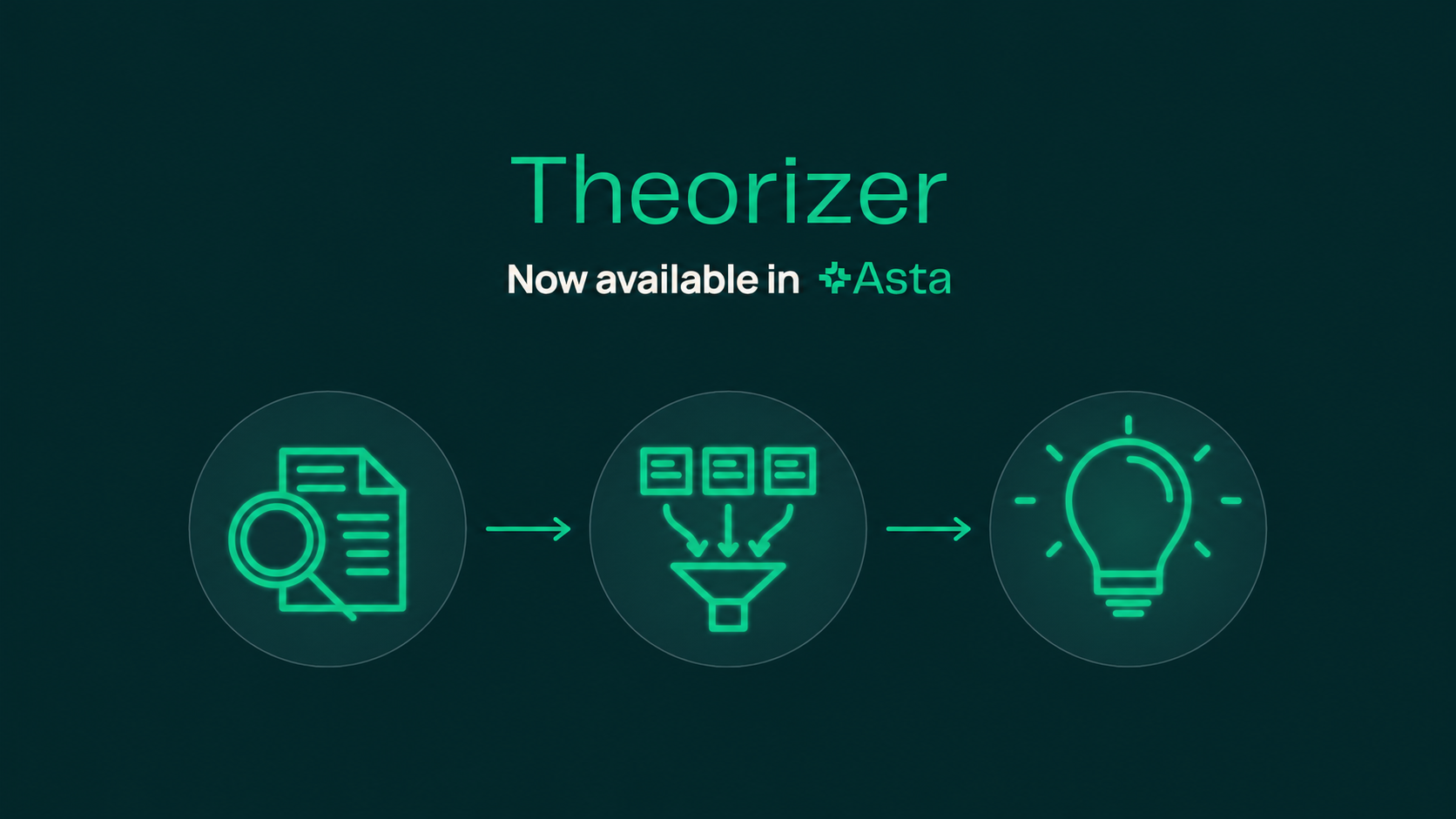
says it has launched Theorizer in Asta and open-sourced the code. Theorizer searches scientific papers, extracts findings relevant to a researcher’s question, and combines them into proposed explanations linked to supporting studies. Researchers can inspect the cited work and judge whether its evidence and conditions support an explanation. Ai2 describes researchers using Theorizer in cancer research, neuroscience, climate data and potato diversity. In lung cancer research, it helped formulate hypotheses; follow-up analysis gave preliminary support for a possible CDK2 role in some cancers with low RAS activity. Ai2 says these findings still need experimental validation. In Peru, researchers tested and ruled out a proposed explanation for implausible dew-point estimates. That test prompted an analysis tracing the values to how the dataset estimated conditions far from weather stations. The source record’s November spike remains an open question, and the cause of a decline in recorded potato varieties remains unresolved. Ai2 presents Theorizer as a way to connect research findings into explanations that scientists can assess and test. The Peru case shows how testing a wrong explanation can still lead to a consequential analysis.
Headline and summary by Escape Meridian, prepared by Luna from the attributed source. A source check is not independent confirmation of the source’s claims.
Original source
· Article
Source details
Original source date: Nov 19, 2026 (2026-11-19T08:00:00.000Z).
Date basis: Date supplied by the publisher’s feed.
Added to Escape Meridian: 2026-11-19T16:18:06.714Z. First observed: 2026-11-19T16:07:22.744Z. Retrieved: 2026-11-19T16:16:20.921Z.
Referenced by
Recorded citations in public readings. A reference alone does not establish agreement or influence.
No public references recorded here yet.
Limits
says the cancer findings still require experimental validation; the account does not establish that the proposed hypotheses are confirmed. The source says Palacios and Juarez are seeking independent station observations to validate their reconstruction; the source record’s November spike remains an open question. Ai2 cautions that Theorizer may miss relevant studies and misjudge originality, so a claim it flags as new may already exist elsewhere in the literature.
Open question
Will independent station observations validate Palacios and Juarez’s reconstruction, and what will they show about the source record’s November spike?
Source-stated
Ai2 says Theorizer is available in Asta and that it has open-sourced the code.
our platform of AI agents for scientific research, and open-sourcing the code
Source-stated
Theorizer searches research papers, extracts findings relevant to a question, and links its proposed theories to the papers behind them; researchers must assess the evidence and context.
Theorizer searches the research literature in response to a user’s question, then creates a template specifying what to extract from each paper.
Source-stated
In Devarakonda’s cancer research, follow-up work gave preliminary support for a possible CDK2 dependency in some cancers with low RAS activity, but experimental validation is still needed.
Follow-up work with data from laboratory-grown cancer cells gave Devarakonda preliminary support for the hypothesis that some cancers with low RAS activity may depend on CDK2
Source-stated
In the Peru climate-data case, testing a proposed seasonal explanation ruled it out but prompted analysis that traced implausible values to the dataset’s estimation of conditions far from weather stations.
Testing that seasonal explanation against their data ruled it out for the study area, but it prompted Palacios and Juarez to investigate how the original climate record had been constructed.
Source-stated
Ai2 says Theorizer helped researchers generate explanations and directions for further study, while the cause of the recorded decline in potato varieties remains unresolved.
Theorizer helped Hualla move from identifying a pattern to considering explanations for it, giving her team directions for further research while the cause remains unresolved.
Source-stated
Ai2 cautions that Theorizer can miss relevant studies and misjudge originality, so researchers still need to assess the wider literature and decide which ideas warrant testing.
Theorizer can miss relevant studies and misjudge originality. A theory that appears new within the papers it analyzed may already exist elsewhere in the literature.
Source and contributor context
Ai2 · Publisher
The publisher is identified here. No individual author has been inferred.
Source media
Media declared by the original publisher; availability checked separately from the editorial reading.
Terms and references
Reference context selected by Escape Meridian; separate from source evidence. Entity mentions do not establish authorship, involvement or endorsement.
Ai2
Ai2 develops AI research tools and models, including the openly documented Olmo family.
Editorial provenance
Version 1. Publication ID: 43d9a836-92c8-4f9c-85e5-50ce43a80c0a.
Prepared by gpt-6-luna; grounding review by gpt-6-luna.
Source check: uncertain by anthropic/claude-opus-5.5 on 2026-11-19T16:18:06.714Z. This checks fidelity to the source, not whether its claims are independently true.
Editorial selection: accept; reasons: material_development.
Observation: 2743dc317c104768f166380967494a9e75a00c86c5d6bc2a4bdbaabd0632c4a3. Source text hash: 400abb582e0df493c98833fc835af08aebdc2fbe79b4a3dc6fe212e2945232ed.
Revision and source-check history
Version 1 · 2026-11-19T16:18:06.714Z
Ai2 launches Theorizer in Asta to help researchers investigate scientific questions
says it has launched Theorizer in Asta and open-sourced the code. Theorizer searches scientific papers, extracts findings relevant to a researcher’s question, and combines them into proposed explanations linked to supporting studies. Researchers can inspect the cited work and judge whether its evidence and conditions support an explanation. Ai2 describes researchers using Theorizer in cancer research, neuroscience, climate data and potato diversity. In lung cancer research, it helped formulate hypotheses; follow-up analysis gave preliminary support for a possible CDK2 role in some cancers with low RAS activity. Ai2 says these findings still need experimental validation. In Peru, researchers tested and ruled out a proposed explanation for implausible dew-point estimates. That test prompted an analysis tracing the values to how the dataset estimated conditions far from weather stations. The source record’s November spike remains an open question, and the cause of a decline in recorded potato varieties remains unresolved. Ai2 presents Theorizer as a way to connect research findings into explanations that scientists can assess and test. The Peru case shows how testing a wrong explanation can still lead to a consequential analysis.
Original source
· Article
Source details
Original source date: Nov 19, 2026 (2026-11-19T08:00:00.000Z).
Date basis: Date supplied by the publisher’s feed.
Added to Escape Meridian: 2026-11-19T16:18:06.714Z. First observed: 2026-11-19T16:07:22.744Z. Retrieved: 2026-11-19T16:16:20.921Z.
Limits
says the cancer findings still require experimental validation; the account does not establish that the proposed hypotheses are confirmed. The source says Palacios and Juarez are seeking independent station observations to validate their reconstruction; the source record’s November spike remains an open question. Ai2 cautions that Theorizer may miss relevant studies and misjudge originality, so a claim it flags as new may already exist elsewhere in the literature.
Open question
Will independent station observations validate Palacios and Juarez’s reconstruction, and what will they show about the source record’s November spike?
Source-stated
Ai2 says Theorizer is available in Asta and that it has open-sourced the code.
our platform of AI agents for scientific research, and open-sourcing the code
Source-stated
Theorizer searches research papers, extracts findings relevant to a question, and links its proposed theories to the papers behind them; researchers must assess the evidence and context.
Theorizer searches the research literature in response to a user’s question, then creates a template specifying what to extract from each paper.
Source-stated
In Devarakonda’s cancer research, follow-up work gave preliminary support for a possible CDK2 dependency in some cancers with low RAS activity, but experimental validation is still needed.
Follow-up work with data from laboratory-grown cancer cells gave Devarakonda preliminary support for the hypothesis that some cancers with low RAS activity may depend on CDK2
Source-stated
In the Peru climate-data case, testing a proposed seasonal explanation ruled it out but prompted analysis that traced implausible values to the dataset’s estimation of conditions far from weather stations.
Testing that seasonal explanation against their data ruled it out for the study area, but it prompted Palacios and Juarez to investigate how the original climate record had been constructed.
Source-stated
Ai2 says Theorizer helped researchers generate explanations and directions for further study, while the cause of the recorded decline in potato varieties remains unresolved.
Theorizer helped Hualla move from identifying a pattern to considering explanations for it, giving her team directions for further research while the cause remains unresolved.
Source-stated
Ai2 cautions that Theorizer can miss relevant studies and misjudge originality, so researchers still need to assess the wider literature and decide which ideas warrant testing.
Theorizer can miss relevant studies and misjudge originality. A theory that appears new within the papers it analyzed may already exist elsewhere in the literature.
Source and contributor context
Ai2 · Publisher
The publisher is identified here. No individual author has been inferred.
Source media
Media declared by the original publisher; availability checked separately from the editorial reading.
Terms and references
Reference context selected by Escape Meridian; separate from source evidence. Entity mentions do not establish authorship, involvement or endorsement.
Ai2
Ai2 develops AI research tools and models, including the openly documented Olmo family.
Editorial provenance
Version 1. Publication ID: 43d9a836-92c8-4f9c-85e5-50ce43a80c0a.
Prepared by gpt-6-luna; grounding review by gpt-6-luna.
Source check: uncertain by anthropic/claude-opus-5.5 on 2026-11-19T16:18:06.714Z. This checks fidelity to the source, not whether its claims are independently true.
Editorial selection: accept; reasons: material_development.
Observation: 2743dc317c104768f166380967494a9e75a00c86c5d6bc2a4bdbaabd0632c4a3. Source text hash: 400abb582e0df493c98833fc835af08aebdc2fbe79b4a3dc6fe212e2945232ed.
uncertain · 2026-11-19T16:18:06.714Z · anthropic/claude-opus-5.5
Publication: 43d9a836-92c8-4f9c-85e5-50ce43a80c0a
attribution — pass: The draft attributes the launch, the open-sourcing, the case descriptions and the cautions to Ai2. It names the researchers in the Peru case correctly. Outcomes are framed as Ai2's account rather than as independently established facts.
Today, we’re launching Theorizer in Asta , our platform of AI agents for scientific research, and open-sourcing the code
summary — uncertain: The central jargon in the cancer passage is unexplained. RAS, which the source glosses as a chain of signals that promotes cell growth, and CDK2, a protein involved in cell division, appear without explanation. A non-specialist cannot tell what preliminary support for a CDK2 role means; the smallest repair is a brief plain gloss of each. The reading also flattens the source's force: it omits Devarakonda's reaction that the theories matched what took him 15 years to learn, and his Iron Man suit caveat. The neuroscience case is only named. Restoring one line of voice would help. The question picks a narrow side issue but is acceptable.
a chain of signals that promotes cell growth
date — pass: The originalPublished date, 2026-11-19, matches the date shown on the publisher page. This is the post's first publication, not a later revision.
Theorizer comes to Asta November 19, 2026
support — pass: Each claim matches the source. The source supports the launch and open-sourcing, the literature search and extraction workflow, and the preliminary CDK2 support pending experimental validation. It also supports the ruled-out Peru explanation that led to the actual answer, the unresolved potato decline, and the stated limits on missing studies and judging originality. The Peru takeaway restates the source's own conclusion. No benefits or costs beyond the source are asserted.
Even though that explanation was wrong, testing it helped them trace the implausible values to their source.
media — pass: The selected media is the verified original Ai2 blog post. It is the most direct way to access the source.
Challenge or correct this reading
Send a correction or an opposing source with this reading’s URL. Disagreement and uncertainty can remain unresolved.
Ai2 develops AI research tools and models, including the openly documented Olmo family.
Explore Ai2Ai2 develops AI research tools and models, including the openly documented Olmo family.
Explore Ai2Ai2 develops AI research tools and models, including the openly documented Olmo family.
Explore Ai2Ai2 develops AI research tools and models, including the openly documented Olmo family.
Explore Ai2Ai2 develops AI research tools and models, including the openly documented Olmo family.
Explore Ai2Ai2 develops AI research tools and models, including the openly documented Olmo family.
Explore Ai2Ai2 develops AI research tools and models, including the openly documented Olmo family.
Explore Ai2