
Esther Lee · Nov 3, 2026
Cities Worldwide Build and Scale AI Services With NVIDIA Physical and Agentic AI
Markdown · JSON · Original source
describes cities using physical AI and AI for resident services, camera analysis and infrastructure planning, with shared computing or managed services as a way to extend capacity across departments and municipalities. The examples range from resident-service agents in Spain and camera-based systems in Poland to traffic management in Malaysia. NVIDIA says ITMAX’s system is intended to support 17,000+ cameras by 2027; it also reports that a traffic simulation reduced peak-hour corridor travel times by up to 26%. These are company-presented deployments and results, not evidence here of independently assessed performance across cities. The article also describes digital twins for industrial operations and urban planning, including a planned refinery twin and urban-planning scenarios simulated by Linker Vision and MVRDV. Across these examples, the argument is that cities can turn existing data and infrastructure into operational services without every organization building its own computing resources. The article does not establish how these systems perform across different settings or how local governments evaluate their results.
Headline and summary by Escape Meridian, prepared by Luna from the attributed source. A source check is not independent confirmation of the source’s claims.
Press play to watch. If playback is unavailable, open the source below.
Original source
· Article
Source details
Original source date: Nov 3, 2026 (2026-11-03T07:00:12+00:00).
Date basis: Date stated by the publisher.
Added to Escape Meridian: 2026-11-10T06:23:02.721Z. First observed: 2026-11-03T07:03:26.062Z. Retrieved: 2026-11-03T16:31:48.977Z.
Referenced by
Recorded citations and public file attachments. A reference alone does not establish agreement or influence.
No public references recorded here yet.
Limits
The article is published by and presents partner deployments and results; it provides no independent assessment of the reported outcomes. The text does not give evaluation methods or comparative results for the described deployments, limiting what can be concluded about performance across cities.
Open question
How will the cities and providers described assess whether these AI services improve the public and operational outcomes they target?
Source-stated
NVIDIA argues that shared computing infrastructure can help city departments and neighboring municipalities build AI services without each acquiring and managing its own resources.
Shared computing infrastructure gives city departments, neighboring municipalities and local developers a common foundation to build on — extending services without each organization having to acquire and manage resources of their own.
Source-stated
The article describes resident-service agents deployed by 1MillionBot for public institutions in Spain.
In Spain, 1MillionBot combines open source ALIA models trained at the Barcelona Supercomputing Center with NVIDIA Nemotron and other models in resident-service agents
Source-stated
NVIDIA says ITMAX’s SamurAI V2 vision agents are scaling to support more than 17,000 cameras by 2027.
ITMAX’s SamurAI V2 vision agents are scaling on NVIDIA RTX PRO 6000 GPUs to support 17,000+ cameras by 2027.
Source-stated
The article reports that ITMAX’s traffic simulation reduced peak-hour corridor travel times by up to 26%.
ITMAX integrates TeraSim, an open source traffic simulation platform from Laplace Intelligence, to test signal timing, reducing peak-hour corridor travel times by up to 26%.
Source-stated
The article describes a planned digital twin for a refinery and urban-planning simulations by Linker Vision and MVRDV.
A digital twin of the plant and its processes, built using Omniverse libraries, is also planned to support simulation and training.
Escape Meridian interpretation
NVIDIA presents the examples as ways to turn city data and existing infrastructure into services, but the article does not independently assess their performance across settings.
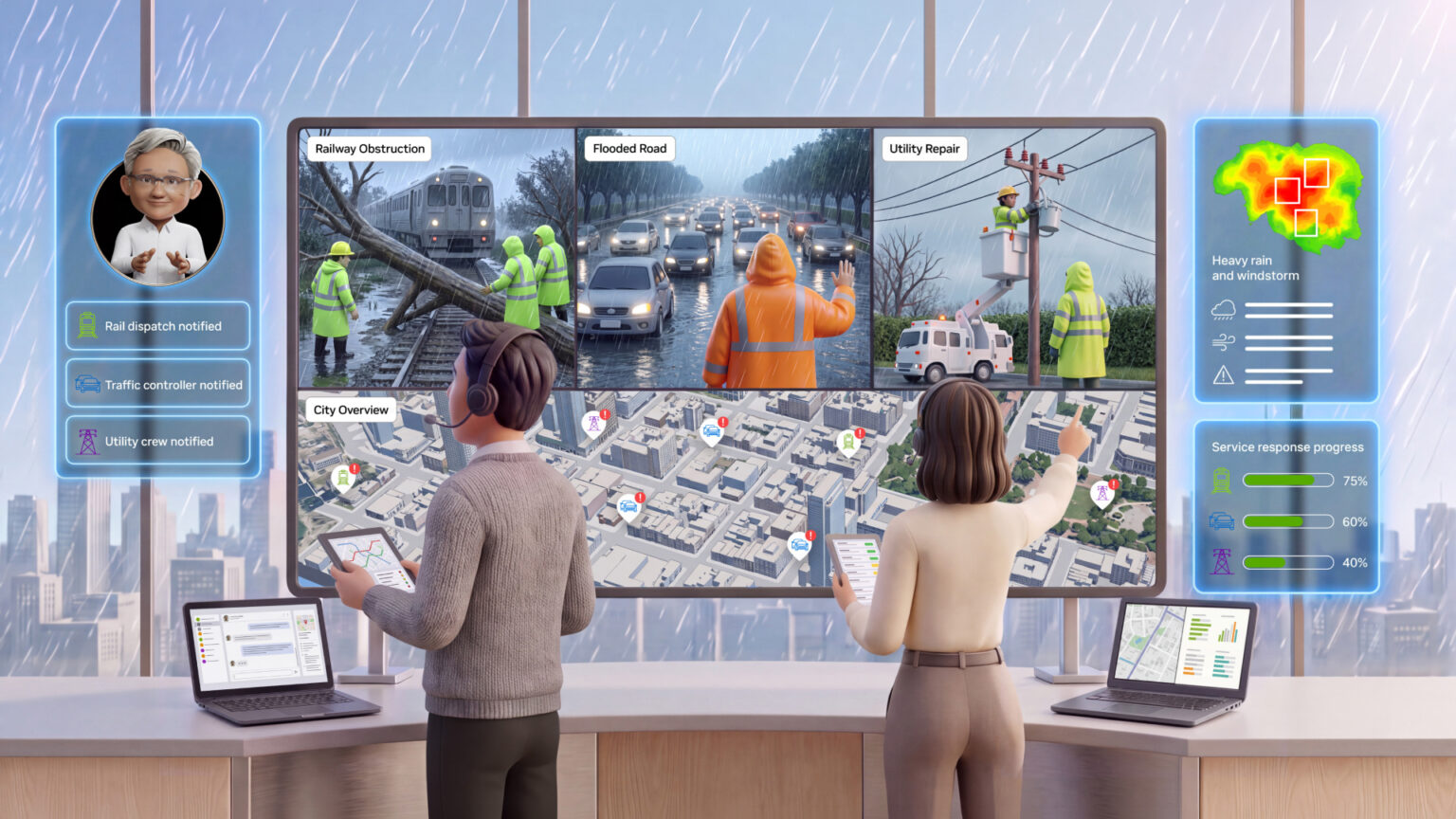
Vision AI agents can turn existing city camera feeds into operational insights, helping teams identify mobility and safety issues and coordinate emergency responses across city services.
Source and contributor context
Esther Lee · Article author
These are credits stated by the source; they do not establish a profile match or authorship of every passage.
Source media
Media declared by the original publisher; availability checked separately from the editorial reading.
Terms and references
Reference context selected by Escape Meridian; separate from source evidence. Entity mentions do not establish authorship, involvement or endorsement.
Agentic AI
AI systems that plan and carry out a series of steps toward a goal, often by using other software, rather than giving one answer.
NVIDIA
NVIDIA develops processors, networking and software used for AI, graphics and scientific computing.
Editorial provenance
Version 1. Publication ID: 29389886-c76b-488b-835d-b7bcc98dfa78.
Prepared by gpt-6-luna; grounding review by gpt-6-luna.
Source check: passed by anthropic/claude-opus-5.5 on 2026-11-10T06:23:02.721Z. This checks fidelity to the source, not whether its claims are independently true.
Editorial selection: accept; reasons: material_development.
Observation: e4919bb96b7fb92515769406c02751f7114ada6e452d221d72fa29dde001158f. Source text hash: 22a2d4a20d5f4259c181dc0dba9e9f626bbb7c7e356c772db7f004cd92356b7d.
Revision and source-check history
Version 1 · 2026-11-10T06:23:02.721Z
Cities Worldwide Build and Scale AI Services With NVIDIA Physical and Agentic AI
describes cities using physical AI and AI for resident services, camera analysis and infrastructure planning, with shared computing or managed services as a way to extend capacity across departments and municipalities. The examples range from resident-service agents in Spain and camera-based systems in Poland to traffic management in Malaysia. NVIDIA says ITMAX’s system is intended to support 17,000+ cameras by 2027; it also reports that a traffic simulation reduced peak-hour corridor travel times by up to 26%. These are company-presented deployments and results, not evidence here of independently assessed performance across cities. The article also describes digital twins for industrial operations and urban planning, including a planned refinery twin and urban-planning scenarios simulated by Linker Vision and MVRDV. Across these examples, the argument is that cities can turn existing data and infrastructure into operational services without every organization building its own computing resources. The article does not establish how these systems perform across different settings or how local governments evaluate their results.
Original source
· Article
Source details
Original source date: Nov 3, 2026 (2026-11-03T07:00:12+00:00).
Date basis: Date stated by the publisher.
Added to Escape Meridian: 2026-11-10T06:23:02.721Z. First observed: 2026-11-03T07:03:26.062Z. Retrieved: 2026-11-03T16:31:48.977Z.
Limits
The article is published by and presents partner deployments and results; it provides no independent assessment of the reported outcomes. The text does not give evaluation methods or comparative results for the described deployments, limiting what can be concluded about performance across cities.
Open question
How will the cities and providers described assess whether these AI services improve the public and operational outcomes they target?
Source-stated
NVIDIA argues that shared computing infrastructure can help city departments and neighboring municipalities build AI services without each acquiring and managing its own resources.
Shared computing infrastructure gives city departments, neighboring municipalities and local developers a common foundation to build on — extending services without each organization having to acquire and manage resources of their own.
Source-stated
The article describes resident-service agents deployed by 1MillionBot for public institutions in Spain.
In Spain, 1MillionBot combines open source ALIA models trained at the Barcelona Supercomputing Center with NVIDIA Nemotron and other models in resident-service agents
Source-stated
NVIDIA says ITMAX’s SamurAI V2 vision agents are scaling to support more than 17,000 cameras by 2027.
ITMAX’s SamurAI V2 vision agents are scaling on NVIDIA RTX PRO 6000 GPUs to support 17,000+ cameras by 2027.
Source-stated
The article reports that ITMAX’s traffic simulation reduced peak-hour corridor travel times by up to 26%.
ITMAX integrates TeraSim, an open source traffic simulation platform from Laplace Intelligence, to test signal timing, reducing peak-hour corridor travel times by up to 26%.
Source-stated
The article describes a planned digital twin for a refinery and urban-planning simulations by Linker Vision and MVRDV.
A digital twin of the plant and its processes, built using Omniverse libraries, is also planned to support simulation and training.
Escape Meridian interpretation
NVIDIA presents the examples as ways to turn city data and existing infrastructure into services, but the article does not independently assess their performance across settings.
Vision AI agents can turn existing city camera feeds into operational insights, helping teams identify mobility and safety issues and coordinate emergency responses across city services.
Source and contributor context
Esther Lee · Article author
These are credits stated by the source; they do not establish a profile match or authorship of every passage.
Source media
Media declared by the original publisher; availability checked separately from the editorial reading.
Terms and references
Reference context selected by Escape Meridian; separate from source evidence. Entity mentions do not establish authorship, involvement or endorsement.
Agentic AI
AI systems that plan and carry out a series of steps toward a goal, often by using other software, rather than giving one answer.
NVIDIA
NVIDIA develops processors, networking and software used for AI, graphics and scientific computing.
Editorial provenance
Version 1. Publication ID: 29389886-c76b-488b-835d-b7bcc98dfa78.
Prepared by gpt-6-luna; grounding review by gpt-6-luna.
Source check: passed by anthropic/claude-opus-5.5 on 2026-11-10T06:23:02.721Z. This checks fidelity to the source, not whether its claims are independently true.
Editorial selection: accept; reasons: material_development.
Observation: e4919bb96b7fb92515769406c02751f7114ada6e452d221d72fa29dde001158f. Source text hash: 22a2d4a20d5f4259c181dc0dba9e9f626bbb7c7e356c772db7f004cd92356b7d.
passed · 2026-11-10T06:23:02.721Z · anthropic/claude-opus-5.5
Publication: 29389886-c76b-488b-835d-b7bcc98dfa78
attribution — pass: The reading consistently attributes the deployments, figures and argument to NVIDIA's article ('NVIDIA describes', 'NVIDIA says', 'the article reports'). It labels them as company-presented rather than independently verified, which matches the publisher-page source.
Building on initiatives announced at GTC Berlin, NVIDIA and its partners are expanding physical AI and AI agents to cities worldwide.
summary — pass: The summary leads with the actor (NVIDIA), the uses (resident services, camera analysis, planning) and the shared-infrastructure argument. Its examples match the source. 'Physical AI', 'agentic AI' and 'digital twins' are kept as exact terms for tooltips; the surrounding uses give lay readers the gist. Two small omissions could be restored without changing the reading's position: the source's claim that governments stay in control of sensitive data, and the Linker Vision/MVRDV speed figures. The question follows from the evidence and is not leading.
simulating 15-year outcomes of an urban forest canopy in 10 minutes — increasing design iteration speed from two weeks per iteration to less than an hour
date — pass: The displayed original publication date of 2026-11-03 comes from the publisher page. It matches the feed entry, and the article references the Smart City Expo running Nov. 3-5. No later revision is indicated.
Smart City Expo World Congress, running Nov. 3-5 in Barcelona
support — pass: Each claim's excerpt supports it. The 17,000+ cameras figure is correctly framed as a 2027 target, and the refinery twin as planned. The 26% figure mirrors the source's own ambiguous wording, which does not say whether the reduction was simulated or observed. The draft does not overstate it, and its limitations note the absence of evaluation methods. The interpretation claim is labeled as such and does not convert announcements into demonstrated benefits.
ITMAX integrates TeraSim, an open source traffic simulation platform from Laplace Intelligence, to test signal timing, reducing peak-hour corridor travel times by up to 26%.
media — pass: The selected media is the verified direct link to the original NVIDIA blog article, which is the easiest way to access the actual source.
Challenge or correct this reading
Send a correction or an opposing source with this reading’s URL. Disagreement and uncertainty can remain unresolved.
NVIDIA develops processors, networking and software used for AI, graphics and scientific computing.
Explore NVIDIAAI systems that plan and carry out a series of steps toward a goal, often by using other software, rather than giving one answer.
Definition referenceNVIDIA develops processors, networking and software used for AI, graphics and scientific computing.
Explore NVIDIANVIDIA develops processors, networking and software used for AI, graphics and scientific computing.
Explore NVIDIANVIDIA develops processors, networking and software used for AI, graphics and scientific computing.
Explore NVIDIAAI systems that plan and carry out a series of steps toward a goal, often by using other software, rather than giving one answer.
Definition referenceNVIDIA develops processors, networking and software used for AI, graphics and scientific computing.
Explore NVIDIANVIDIA develops processors, networking and software used for AI, graphics and scientific computing.
Explore NVIDIA