
Richard Millington · Jun 8, 2026
FeverBee: Is Community a Dead-End Career?
Markdown · JSON · Original source
The article argues that community work can become a career dead end, especially for people who stay in roles without room to advance. Drawing on industry reports, broader labour-market data and an 11-year study of 86 people from a 2015 event, it says community roles are contracting and senior positions are scarce. In the study, 8% reached senior leadership within community, while 41% moved laterally to another function. The article reports that 28% of those who stayed in community reached Director or VP level, compared with 60% of those who moved to another function. It cautions that this is not a clean causal story: more ambitious people may be more likely to switch roles. Its advice is not simply to leave. It identifies three routes to progression: manage a team in a large organisation, work where community is central to the business, or build a consultancy or independent practice. The last route is difficult, the article says, because clients are scarce and attracting them is harder than doing the work. For people who want to advance, its central argument is that community experience alone may not be enough; they need a role connected to a function where progression is possible. It also stresses that staying in the core work is a valid choice for some.
Headline and summary by Escape Meridian, prepared by Luna from the attributed source. A source check is not independent confirmation of the source’s claims.
Original source
· Article
Source details
Original source date: Jun 8, 2026 (2026-06-08T17:04:23+00:00).
Date basis: Date stated by the publisher.
Added to Escape Meridian: 2026-11-14T10:32:41.337Z. First observed: 2026-11-05T15:41:56.887Z. Retrieved: 2026-11-06T16:00:46.480Z.
Referenced by
Recorded citations and public file attachments. A reference alone does not establish agreement or influence.
No public references recorded here yet.
Limits
The 11-year study covers 86 people whose career outcomes the article says could be verified on LinkedIn; the author says a larger sample would be desirable. The article cautions that the comparison between people who stayed in community and those who moved out is not a clean causal story, since more ambitious people may also be more likely to switch roles. The article says survey results are snapshots with different respondents in different years, so apparent trends may reflect sampling variation. The article says the CMX 2026 report was due soon and had not yet been reviewed in this analysis.
Open question
Would a larger cohort, tracked beyond LinkedIn profiles, show a similar difference in advancement between people who stay in community and those who move to another function?
Source-stated
The article says community roles are contracting, and reports that senior roles are scarce relative to manager roles.
The picture is consistent: the community industry is contracting.
Source-stated
In the 11-year study of 86 people, 8% reached senior leadership within community and 41% moved laterally to another function.
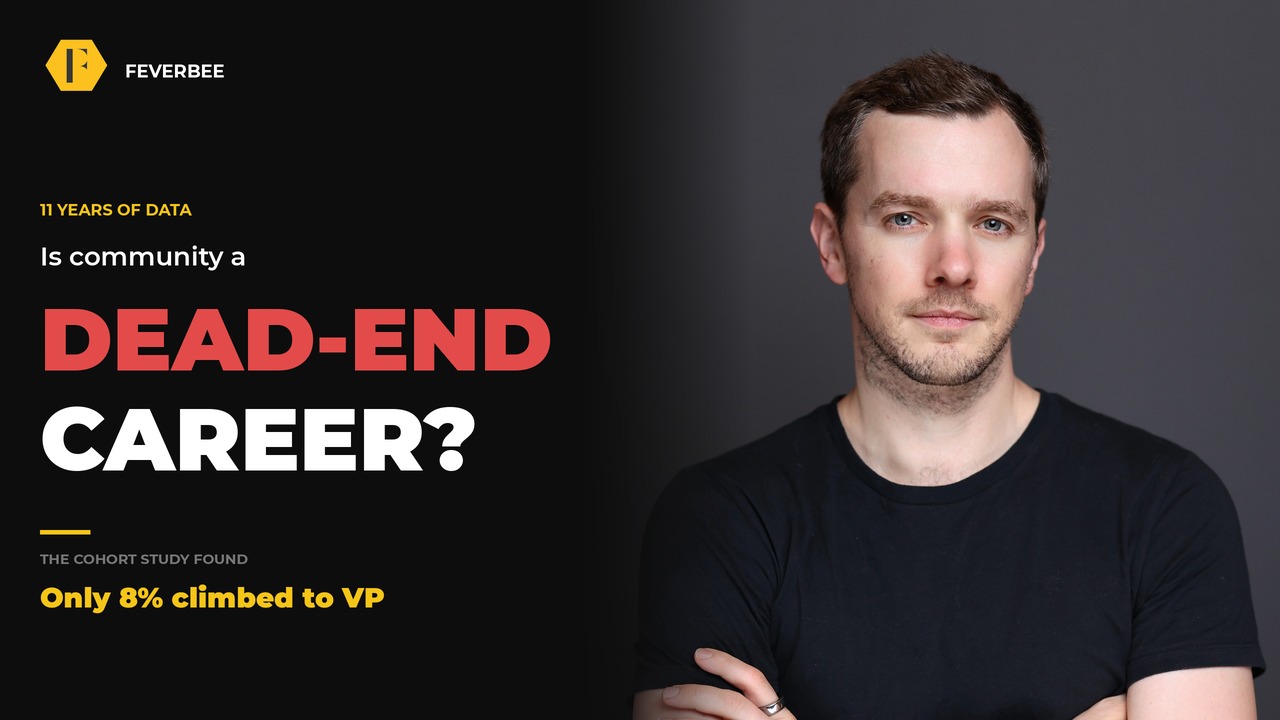
8% climbed within community to a Sr Director or VP role 1% became senior at a community-as-product company 24% are still in the same role today (this one absolutely shocked me) 41% moved laterally out of community into a different function
Source-stated
The article reports a higher rate of reaching Director or VP level among those who moved out of community than among those who stayed, while cautioning that the comparison does not establish causation.
If you stayed in community, there is a 28% chance you reached Director or VP level after 11 years. If you moved out to another function, there is a 60% chance you did. Twice as likely to climb if you leave.
Source-stated
The article identifies three possible paths to progress: managing a team in a large organisation, working where community is central to the business, or consulting independently.
If community is your career, three paths genuinely work.
Source-stated
The article argues that advancing may require moving into a function where progression is possible, while acknowledging that some people may choose to stay in community work.
Some people enjoy the core work and stay in it forever. No shame in that.
Source and contributor context
Richard Millington · Article author
These are credits stated by the source; they do not establish a profile match or authorship of every passage.
Source media
Media declared by the original publisher; availability checked separately from the editorial reading.
Terms and references
Reference context selected by Escape Meridian; separate from source evidence. Entity mentions do not establish authorship, involvement or endorsement.
FeverBee
FeverBee is Richard Millington's community-management consultancy, publishing analysis of online community strategy and engagement.
CMX
CMX publishes reports and guidance on community management, including industry employment and salary trends.
Editorial provenance
Version 1. Publication ID: 4150fec5-6705-4184-8a85-a97baa83390d.
Prepared by gpt-6-luna; grounding review by gpt-6-luna.
Source check: uncertain by anthropic/claude-opus-5.5 on 2026-11-14T10:32:41.337Z. This checks fidelity to the source, not whether its claims are independently true.
Editorial selection: accept; reasons: useful_perspective.
Observation: 91977185a5ab63bf259b27d0994a4b17d7c8129612d586bf8b48c54e237b4528. Source text hash: 3ca5611b449d651633f5e55d6ad7d87662e2ab88d736834c74de953388ba010d.
Revision and source-check history
Version 1 · 2026-11-14T10:32:41.337Z
FeverBee: Is Community a Dead-End Career?
The article argues that community work can become a career dead end, especially for people who stay in roles without room to advance. Drawing on industry reports, broader labour-market data and an 11-year study of 86 people from a 2015 event, it says community roles are contracting and senior positions are scarce. In the study, 8% reached senior leadership within community, while 41% moved laterally to another function. The article reports that 28% of those who stayed in community reached Director or VP level, compared with 60% of those who moved to another function. It cautions that this is not a clean causal story: more ambitious people may be more likely to switch roles. Its advice is not simply to leave. It identifies three routes to progression: manage a team in a large organisation, work where community is central to the business, or build a consultancy or independent practice. The last route is difficult, the article says, because clients are scarce and attracting them is harder than doing the work. For people who want to advance, its central argument is that community experience alone may not be enough; they need a role connected to a function where progression is possible. It also stresses that staying in the core work is a valid choice for some.
Original source
· Article
Source details
Original source date: Jun 8, 2026 (2026-06-08T17:04:23+00:00).
Date basis: Date stated by the publisher.
Added to Escape Meridian: 2026-11-14T10:32:41.337Z. First observed: 2026-11-05T15:41:56.887Z. Retrieved: 2026-11-06T16:00:46.480Z.
Limits
The 11-year study covers 86 people whose career outcomes the article says could be verified on LinkedIn; the author says a larger sample would be desirable. The article cautions that the comparison between people who stayed in community and those who moved out is not a clean causal story, since more ambitious people may also be more likely to switch roles. The article says survey results are snapshots with different respondents in different years, so apparent trends may reflect sampling variation. The article says the CMX 2026 report was due soon and had not yet been reviewed in this analysis.
Open question
Would a larger cohort, tracked beyond LinkedIn profiles, show a similar difference in advancement between people who stay in community and those who move to another function?
Source-stated
The article says community roles are contracting, and reports that senior roles are scarce relative to manager roles.
The picture is consistent: the community industry is contracting.
Source-stated
In the 11-year study of 86 people, 8% reached senior leadership within community and 41% moved laterally to another function.
8% climbed within community to a Sr Director or VP role 1% became senior at a community-as-product company 24% are still in the same role today (this one absolutely shocked me) 41% moved laterally out of community into a different function
Source-stated
The article reports a higher rate of reaching Director or VP level among those who moved out of community than among those who stayed, while cautioning that the comparison does not establish causation.
If you stayed in community, there is a 28% chance you reached Director or VP level after 11 years. If you moved out to another function, there is a 60% chance you did. Twice as likely to climb if you leave.
Source-stated
The article identifies three possible paths to progress: managing a team in a large organisation, working where community is central to the business, or consulting independently.
If community is your career, three paths genuinely work.
Source-stated
The article argues that advancing may require moving into a function where progression is possible, while acknowledging that some people may choose to stay in community work.
Some people enjoy the core work and stay in it forever. No shame in that.
Source and contributor context
Richard Millington · Article author
These are credits stated by the source; they do not establish a profile match or authorship of every passage.
Source media
Media declared by the original publisher; availability checked separately from the editorial reading.
Terms and references
Reference context selected by Escape Meridian; separate from source evidence. Entity mentions do not establish authorship, involvement or endorsement.
FeverBee
FeverBee is Richard Millington's community-management consultancy, publishing analysis of online community strategy and engagement.
CMX
CMX publishes reports and guidance on community management, including industry employment and salary trends.
Editorial provenance
Version 1. Publication ID: 4150fec5-6705-4184-8a85-a97baa83390d.
Prepared by gpt-6-luna; grounding review by gpt-6-luna.
Source check: uncertain by anthropic/claude-opus-5.5 on 2026-11-14T10:32:41.337Z. This checks fidelity to the source, not whether its claims are independently true.
Editorial selection: accept; reasons: useful_perspective.
Observation: 91977185a5ab63bf259b27d0994a4b17d7c8129612d586bf8b48c54e237b4528. Source text hash: 3ca5611b449d651633f5e55d6ad7d87662e2ab88d736834c74de953388ba010d.
uncertain · 2026-11-14T10:32:41.337Z · anthropic/claude-opus-5.5
Publication: 4150fec5-6705-4184-8a85-a97baa83390d
attribution — pass: The reading consistently attributes its claims to the FeverBee article ("the article argues/says/reports"). It presents CMX data and the cohort figures as the source's findings rather than as established fact.
I spent some time pulling together all the CMX industry reports from the last four or five years.
summary — uncertain: The summary is faithful. It keeps the stay-versus-leave figures, the causal caveat, the three paths, the consulting difficulty and the 'no shame' in staying. However, it never says what 'community work' is (managing company or brand communities, often B2B enterprise and online support communities) and never explains CMX. A general reader could mistake this for community organizing. Smallest repair: one plain clause defining community roles and CMX. Optionally note the source's brief claim that AI changed the entry rung.
especially for the B2B enterprise communities we typically work with
date — pass: The originalPublished value of 2026-06-08 comes from the publisher page. It is consistent with the June 2026 media upload path and the article's reference to an upcoming 2026 CMX report. No conflicting earlier date appears in the source.
Their 2026 report is due soon and I’ll take a look at it when it lands.
support — pass: Each claim and limitation matches the source text: contraction, the 21:1 pyramid framed as scarce senior roles, the 8%/41% and 28%/60% figures, the causal caveat, the three paths, LinkedIn verification, the desire for a larger sample, snapshot sampling variation and the pending 2026 report. The question follows from the stated limitations and is not leading.
You could argue that more ambitious people are also more likely to switch roles, so this is not a clean causal story. Fair point.
media — pass: The selected media is the verified direct link to the original FeverBee article. It is the most direct way for a reader to access the source.
Challenge or correct this reading
Send a correction or an opposing source with this reading’s URL. Disagreement and uncertainty can remain unresolved.
FeverBee is Richard Millington's community-management consultancy, publishing analysis of online community strategy and engagement.
Explore FeverBeeCMX publishes reports and guidance on community management, including industry employment and salary trends.
Explore CMXFeverBee is Richard Millington's community-management consultancy, publishing analysis of online community strategy and engagement.
Explore FeverBeeCMX publishes reports and guidance on community management, including industry employment and salary trends.
Explore CMXFeverBee is Richard Millington's community-management consultancy, publishing analysis of online community strategy and engagement.
Explore FeverBeeCMX publishes reports and guidance on community management, including industry employment and salary trends.
Explore CMXFeverBee is Richard Millington's community-management consultancy, publishing analysis of online community strategy and engagement.
Explore FeverBeeCMX publishes reports and guidance on community management, including industry employment and salary trends.
Explore CMX