
Richard Millington · Mar 24, 2025
FeverBee: We’re Probably In A Community Recession
Markdown · JSON · Original source
argues that community professionals are facing a downturn, while cautioning that reliable industry data is hard to obtain. Its examples include survey respondents’ LinkedIn profiles, event speakers’ employment, and the author’s observations; these suggest change but do not establish its scale or cause. The author’s central argument is that people still engage with one another, but community work may be out of step with where those interactions happen. The author points to fewer people wanting forum-centric experiences and to companies’ shift toward profitability, which can put programs at risk when their value is difficult to connect to business outcomes. The possibility that organizations see as making communities redundant is raised more cautiously; the author says it is probably not a major contributor for now and needs data. The author proposes describing community programs by the business function they serve and directing resources toward where members meet their needs. How much of the reported decline in community jobs and programs is caused by activity shifting away from forums, rather than cost-cutting or other factors, remains an open question.
Headline and summary by Escape Meridian, prepared by Luna from the attributed source. A source check is not independent confirmation of the source’s claims.
Original source
· Article
Source details
Original source date: Mar 24, 2025 (2025-03-24T10:25:09+00:00).
Date basis: Date stated by the publisher.
Added to Escape Meridian: 2026-11-05T17:23:20.821Z. First observed: 2026-11-05T15:41:58.796Z. Retrieved: 2026-11-05T17:11:01.909Z.
Referenced by
Recorded citations and public file attachments. A reference alone does not establish agreement or influence.
No public references recorded here yet.
Limits
The author says good industry data is lacking; the estimate based on LinkedIn profiles depends on profiles being up to date and concerns respondents to a survey conducted three years earlier. The account also uses personal observations and event-speaker employment status; these examples do not establish the scale or causes of change across the entire community industry. The author presents profitability and changing member behavior as suspected causes, and explicitly says the possible effect of needs data.
Open question
How much of the reported decline in community jobs and programs is caused by member activity shifting away from forums, rather than companies’ cost-cutting or other factors?
Source-stated
The author argues that community professionals are facing a downturn, while acknowledging that reliable industry data is difficult to obtain.
If LinkedIn profiles are up to date, then around 50% of those folks are now either out of work or no longer working in the industry.
Source-stated
The author says people continue to engage with one another, but community work may not match where those interactions now happen.
We’re still engaging with each other as much as ever. This suggests a misalignment between what community is today and what it needs to be in the future.
Source-stated
The author identifies company efforts to shift toward profitability as one possible reason community teams are being cut, because their value can be difficult to connect directly to business outcomes.
‘community’ bears the brunt of those cuts because it’s among the more challenging programs to understand and directly connect to value
Source-stated
The author argues that community work has often centered on forums even as members increasingly seek help and interact elsewhere.
Fewer people want to participate in forum-centric experiences (and we have the research to back this up).
Source-stated
The author raises the possibility that organizations may see LLMs as a substitute for communities, but says this is uncertain and probably not a major cause of the downturn yet.
I doubt this is a major contributor for now, but it’s probably an argument we need data to refute
Source-stated
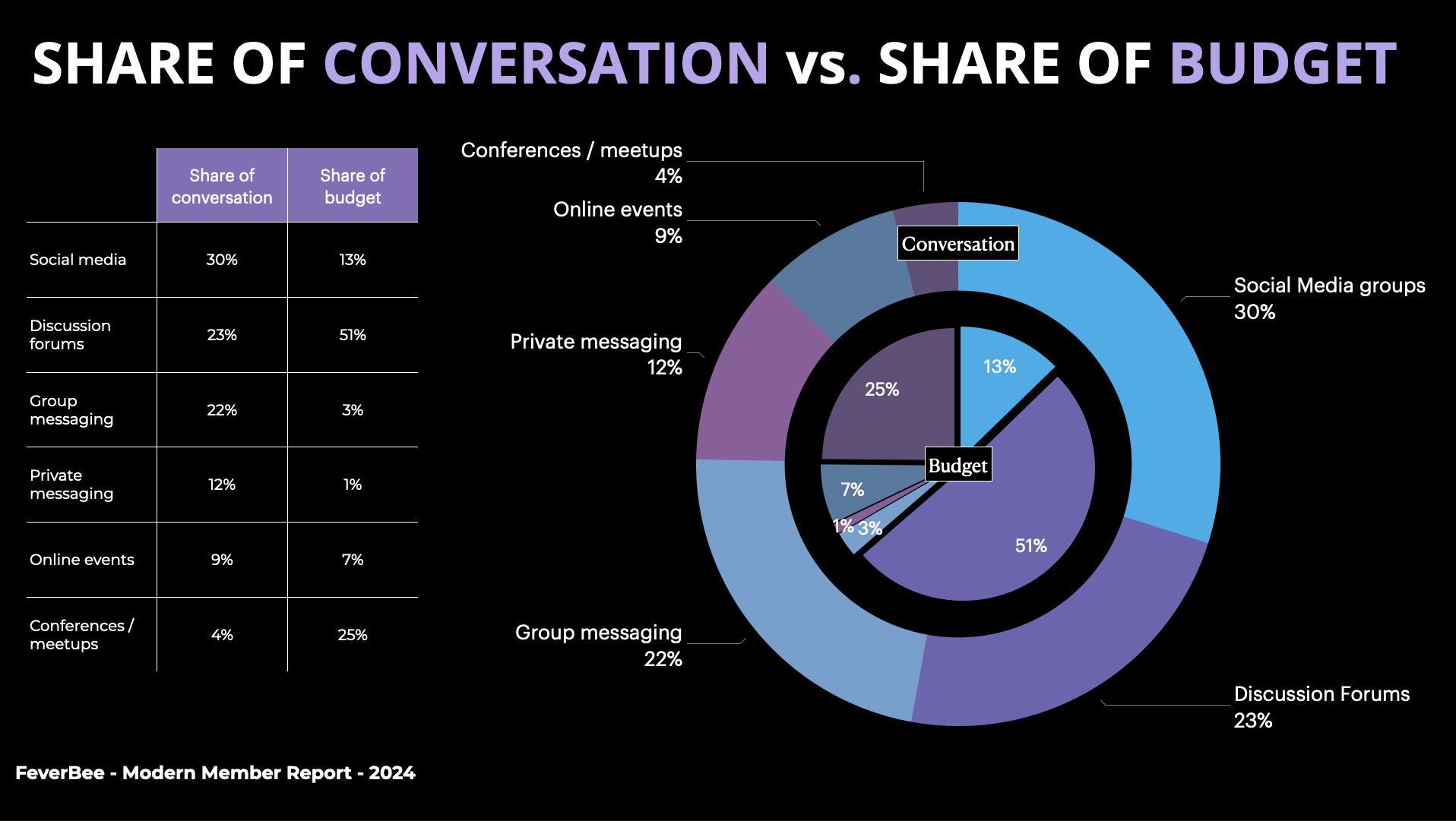
The author proposes naming community programs for the business function they support and shifting resources toward where members meet their needs.
The share of budget (and resources) should match where members go to satisfy their needs for support, belonging, influence, and learning.
Source and contributor context
Richard Millington · Article author
These are credits stated by the source; they do not establish a profile match or authorship of every passage.
Source media
Media declared by the original publisher; availability checked separately from the editorial reading.
Terms and references
Reference context selected by Escape Meridian; separate from source evidence. Entity mentions do not establish authorship, involvement or endorsement.
Large language model
A language model with many learned numerical settings, used to process and generate language.
FeverBee
FeverBee is Richard Millington's community-management consultancy, publishing analysis of online community strategy and engagement.
Editorial provenance
Version 1. Publication ID: 8f082f5f-2618-4f16-84f3-d278684fced5.
Prepared by gpt-6-luna; grounding review by gpt-6-luna.
Source check: passed by anthropic/claude-opus-5.5 on 2026-11-05T17:23:20.821Z. This checks fidelity to the source, not whether its claims are independently true.
Editorial selection: accept; reasons: useful_perspective.
Observation: 046953b8053631565fd4dc024ec642d93930e69f59058be89788c3d53cd8d47d. Source text hash: 18f4aae2e384f4676b32dfc9d84a8b5209a593bdde8d6a7def5710bf4e056351.
Revision and source-check history
Version 1 · 2026-11-05T17:23:20.821Z
FeverBee: We’re Probably In A Community Recession
argues that community professionals are facing a downturn, while cautioning that reliable industry data is hard to obtain. Its examples include survey respondents’ LinkedIn profiles, event speakers’ employment, and the author’s observations; these suggest change but do not establish its scale or cause. The author’s central argument is that people still engage with one another, but community work may be out of step with where those interactions happen. The author points to fewer people wanting forum-centric experiences and to companies’ shift toward profitability, which can put programs at risk when their value is difficult to connect to business outcomes. The possibility that organizations see as making communities redundant is raised more cautiously; the author says it is probably not a major contributor for now and needs data. The author proposes describing community programs by the business function they serve and directing resources toward where members meet their needs. How much of the reported decline in community jobs and programs is caused by activity shifting away from forums, rather than cost-cutting or other factors, remains an open question.
Original source
· Article
Source details
Original source date: Mar 24, 2025 (2025-03-24T10:25:09+00:00).
Date basis: Date stated by the publisher.
Added to Escape Meridian: 2026-11-05T17:23:20.821Z. First observed: 2026-11-05T15:41:58.796Z. Retrieved: 2026-11-05T17:11:01.909Z.
Limits
The author says good industry data is lacking; the estimate based on LinkedIn profiles depends on profiles being up to date and concerns respondents to a survey conducted three years earlier. The account also uses personal observations and event-speaker employment status; these examples do not establish the scale or causes of change across the entire community industry. The author presents profitability and changing member behavior as suspected causes, and explicitly says the possible effect of needs data.
Open question
How much of the reported decline in community jobs and programs is caused by member activity shifting away from forums, rather than companies’ cost-cutting or other factors?
Source-stated
The author argues that community professionals are facing a downturn, while acknowledging that reliable industry data is difficult to obtain.
If LinkedIn profiles are up to date, then around 50% of those folks are now either out of work or no longer working in the industry.
Source-stated
The author says people continue to engage with one another, but community work may not match where those interactions now happen.
We’re still engaging with each other as much as ever. This suggests a misalignment between what community is today and what it needs to be in the future.
Source-stated
The author identifies company efforts to shift toward profitability as one possible reason community teams are being cut, because their value can be difficult to connect directly to business outcomes.
‘community’ bears the brunt of those cuts because it’s among the more challenging programs to understand and directly connect to value
Source-stated
The author argues that community work has often centered on forums even as members increasingly seek help and interact elsewhere.
Fewer people want to participate in forum-centric experiences (and we have the research to back this up).
Source-stated
The author raises the possibility that organizations may see LLMs as a substitute for communities, but says this is uncertain and probably not a major cause of the downturn yet.
I doubt this is a major contributor for now, but it’s probably an argument we need data to refute
Source-stated
The author proposes naming community programs for the business function they support and shifting resources toward where members meet their needs.
The share of budget (and resources) should match where members go to satisfy their needs for support, belonging, influence, and learning.
Source and contributor context
Richard Millington · Article author
These are credits stated by the source; they do not establish a profile match or authorship of every passage.
Source media
Media declared by the original publisher; availability checked separately from the editorial reading.
Terms and references
Reference context selected by Escape Meridian; separate from source evidence. Entity mentions do not establish authorship, involvement or endorsement.
Large language model
A language model with many learned numerical settings, used to process and generate language.
FeverBee
FeverBee is Richard Millington's community-management consultancy, publishing analysis of online community strategy and engagement.
Editorial provenance
Version 1. Publication ID: 8f082f5f-2618-4f16-84f3-d278684fced5.
Prepared by gpt-6-luna; grounding review by gpt-6-luna.
Source check: passed by anthropic/claude-opus-5.5 on 2026-11-05T17:23:20.821Z. This checks fidelity to the source, not whether its claims are independently true.
Editorial selection: accept; reasons: useful_perspective.
Observation: 046953b8053631565fd4dc024ec642d93930e69f59058be89788c3d53cd8d47d. Source text hash: 18f4aae2e384f4676b32dfc9d84a8b5209a593bdde8d6a7def5710bf4e056351.
passed · 2026-11-05T17:23:20.821Z · anthropic/claude-opus-5.5
Publication: 8f082f5f-2618-4f16-84f3-d278684fced5
attribution — pass: The reading consistently attributes the argument to FeverBee and its author, the publisher of the page. Claims are framed as the author's argument, suspicion or proposal rather than established fact. The author is not named in the evidence, and the draft does not invent a name.
I’d point the finger at three suspects.
summary — pass: The summary leads with the thesis, a community-industry downturn, and the author's data caveat. It conveys the core misalignment argument, the three suspected causes with the LLM cause correctly hedged, and the rebranding and resource proposals. Context about companies, business outcomes and forums makes 'community work' understandable to a general reader. The career-advice step is omitted, which is acceptable. The question is a genuine open issue, since the author names multiple suspects without data.
This suggests a misalignment between what community is today and what it needs to be in the future.
date — pass: originalPublished is 2025-03-24 from the publisher page. This is consistent with the 2025/03 upload path of the article image. The draft makes no conflicting date claim.
support — pass: Each claim matches its verbatim excerpt. The limitations accurately reflect the author's caveats about LinkedIn data, the three-year-old survey and the lack of good data. The LLM hedge closely tracks the source. No benefits, costs or forecasts are invented.
I doubt this is a major contributor for now, but it’s probably an argument we need data to refute – and there really isn’t good data at the moment.
media — pass: The selected media is the verified direct link to the original FeverBee article. This is the most direct way for readers to access the source.
Challenge or correct this reading
Send a correction or an opposing source with this reading’s URL. Disagreement and uncertainty can remain unresolved.
FeverBee is Richard Millington's community-management consultancy, publishing analysis of online community strategy and engagement.
Explore FeverBeeA language model with many learned numerical settings, used to process and generate language.
Definition referenceFeverBee is Richard Millington's community-management consultancy, publishing analysis of online community strategy and engagement.
Explore FeverBeeA language model with many learned numerical settings, used to process and generate language.
Definition referenceFeverBee is Richard Millington's community-management consultancy, publishing analysis of online community strategy and engagement.
Explore FeverBeeA language model with many learned numerical settings, used to process and generate language.
Definition referenceFeverBee is Richard Millington's community-management consultancy, publishing analysis of online community strategy and engagement.
Explore FeverBeeA language model with many learned numerical settings, used to process and generate language.
Definition reference