
Team · Oct 26, 2026
Lex Fridman Podcast: Mathematicians debate what AI changes—and what mathematics is for
Markdown · JSON · Original source
On the , Alex Kontorovich, Ankur Moitra and Steven Brunton discuss AI-produced proofs, including ’s reported drop of about 700 results, and what mathematics is for. Kontorovich describes a quasi-Riemann hypothesis proof sharpening estimates of prime-number distribution; the Riemann hypothesis remains unsolved. Moitra reports a Unique Games Conjecture proof clarifying how closely efficient algorithms can approximate the best answer to hard computing problems, crediting major human contributions. For Navier-Stokes, equations modeling fluids, Brunton describes a counterexample with smooth external forcing (applied forces that do not themselves blow up) in three dimensions. A vortex reaches infinite vorticity (local fluid rotation) in finite time. He calls this non-physical; fluids remain just as hard to simulate or predict. Kontorovich describes as software that checks a proof’s logical steps, but insists: “We want stories. We want understanding.” They debate whether AI combines existing ideas or finds new ones. Moitra worries about students’ research paths and strained review institutions. Their advice returns to curiosity, fundamentals and purpose amid uncertainty. The conversation reports these results without independently verifying them.
Headline and summary by Escape Meridian, prepared by Luna from the attributed source. A source check is not independent confirmation of the source’s claims.
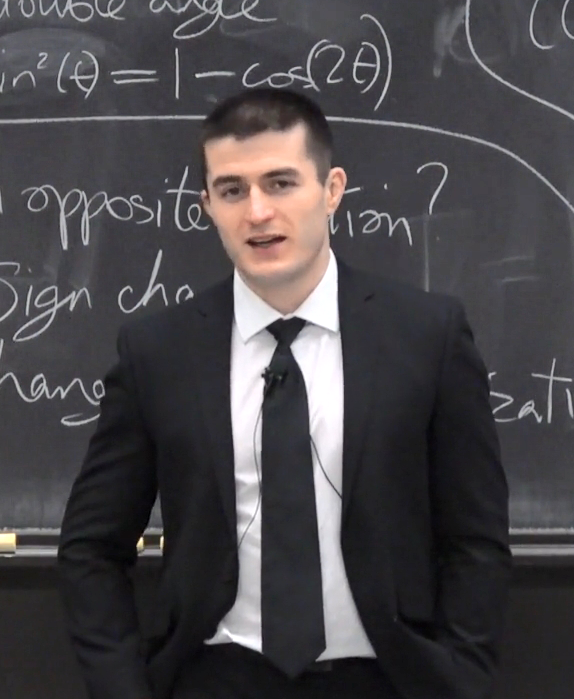
Press play to watch. If playback is unavailable, open the source below.
Original source
· Transcript
Source details
Original source date: Oct 26, 2026 (2026-10-26T22:52:28+00:00).
Date basis: Date stated by the publisher.
Added to Escape Meridian: 2026-11-03T06:26:31.424Z. First observed: 2026-10-26T23:11:08.050Z. Retrieved: 2026-10-31T15:16:18.840Z.
Referenced by
Recorded citations and public file attachments. A reference alone does not establish agreement or influence.
No public references recorded here yet.
Limits
The mathematical results discussed are reported by the speakers; this transcript does not independently establish their correctness or the extent of human involvement. The transcript labels the advice passage “Steven Brunton” after a question addressed to Ankur Moitra. The speaker attribution is unclear, so the reading does not assign the quoted advice to either person. The conversation raises possible effects on research, education and engineering but does not establish their eventual scale.
Open question
What changes to graduate training and research review would help mathematicians assess AI-produced proofs without crowding out students’ chances to learn through research?
Source-stated
Kontorovich puts the results drop discussed in the conversation at 700 problems.
they’re gonna drop these, you know, 300, 400,” we didn’t know how many, 700 it turns out problems.
Source-stated
Kontorovich reports a quasi-Riemann hypothesis proof that sharpens estimates of prime-number distribution, while stressing that the full Riemann hypothesis remains unsolved.
What it did is it gave us a vertical strip, so there are no zeros with real part between seven-eighths and one, an entire infinite vertical strip. That’s a quasi-Riemann hypothesis, and if you can get that seven-eighths down to a half, that’s the full Riemann hypothesis.
Source-stated
Moitra reports an OpenAI Unique Games Conjecture proof concerning how closely efficient algorithms can approximate the best answer to hard computing problems. He credits major human contributions that provided a path toward the result.
one of the headlining results in the OpenAI drop of proofs was that the Unique Games Conjecture is true. Now, I should mention that this is not without spectacular human progress on it.
Source-stated
Brunton describes a Navier-Stokes counterexample for equations modeling fluids: smooth external forcing, with no singularity of its own, creates a three-dimensional vortex reaching infinite vorticity in finite time. He calls the regime non-physical and says fluids remain just as hard to simulate or predict.
So what is proven is that there is this way of orchestrating a smooth kind of external forcing that perfectly cancels out various terms in the equation so that you get this vortex. This can only happen in three dimensions.
Source-stated
Kontorovich describes Lean as software that checks a proof’s logical steps. He distinguishes checking a proof from understanding its mathematical story: “We want stories. We want understanding.”
It’s called interactive theorem provers, where you’re writing line by line in a proof, and the computer says, “Yes, this line does follow by logical inference from the goal state on the previous line.” So Lean is software that allows you to check all kinds of things.
Source-stated
Moitra argues that mathematics involves understanding and developing ideas, not just producing theorems. The speakers debate whether AI combines existing ideas or discovers new ones.
we don’t just care about theorems.
Source-stated
Moitra says AI results could unsettle the established research path for graduate students. He also describes overloaded review institutions and favors new models to relieve their pressures, including more collaborative review of AI proofs.
I would really be in favor for finding new models, not to replace the old ones, but to relieve some of the pressures that have come about.
Source-stated
The closing advice emphasizes curiosity, learning fundamentals and finding personal purpose amid uncertainty.
you’re gonna have to figure it out for yourself, and you’re gonna have to be comfortable with uncertainty.
Source and contributor context
Lex Fridman Team · Article author
These are credits stated by the source; they do not establish a profile match or authorship of every passage.
Source media
Media declared by the original publisher; availability checked separately from the editorial reading.
Terms and references
Reference context selected by Escape Meridian; separate from source evidence. Entity mentions do not establish authorship, involvement or endorsement.
Lex Fridman Podcast
The Lex Fridman Podcast publishes extended interviews about science, technology, culture and human experience.
Lex Fridman
Lex Fridman is a podcast host and researcher whose interviews connect technology with broader human questions.
OpenAI
OpenAI develops AI models and products and publishes research, release announcements and evaluations.
Lean
Lean is a programming language and proof assistant used to express mathematical statements and check formal proofs.
Editorial provenance
Version 1. Publication ID: 1a5954d5-3a6d-4688-8518-dfb676bfc6f3.
Prepared by gpt-6-luna; editorial correction: gpt-6-astra; grounding review by gpt-6-luna; validation instruction: gpt-6-astra.
Source check: passed by anthropic/claude-opus-5.5 on 2026-11-03T06:26:31.424Z. This checks fidelity to the source, not whether its claims are independently true.
Editorial selection: accept; reasons: useful_perspective.
Observation: b63cd845181f075ed9a16b878ee6993959285dce551594c89fc2122d5428f1ec. Source text hash: 44de6f11bb7e2e3c43005ce3547e9265f40e24d1b6a029c421cd15a08d1dba94.
Revision and source-check history
Version 1 · 2026-11-03T06:26:31.424Z
Lex Fridman Podcast: Mathematicians debate what AI changes—and what mathematics is for
On the , Alex Kontorovich, Ankur Moitra and Steven Brunton discuss AI-produced proofs, including ’s reported drop of about 700 results, and what mathematics is for. Kontorovich describes a quasi-Riemann hypothesis proof sharpening estimates of prime-number distribution; the Riemann hypothesis remains unsolved. Moitra reports a Unique Games Conjecture proof clarifying how closely efficient algorithms can approximate the best answer to hard computing problems, crediting major human contributions. For Navier-Stokes, equations modeling fluids, Brunton describes a counterexample with smooth external forcing (applied forces that do not themselves blow up) in three dimensions. A vortex reaches infinite vorticity (local fluid rotation) in finite time. He calls this non-physical; fluids remain just as hard to simulate or predict. Kontorovich describes as software that checks a proof’s logical steps, but insists: “We want stories. We want understanding.” They debate whether AI combines existing ideas or finds new ones. Moitra worries about students’ research paths and strained review institutions. Their advice returns to curiosity, fundamentals and purpose amid uncertainty. The conversation reports these results without independently verifying them.
Original source
· Transcript
Source details
Original source date: Oct 26, 2026 (2026-10-26T22:52:28+00:00).
Date basis: Date stated by the publisher.
Added to Escape Meridian: 2026-11-03T06:26:31.424Z. First observed: 2026-10-26T23:11:08.050Z. Retrieved: 2026-10-31T15:16:18.840Z.
Limits
The mathematical results discussed are reported by the speakers; this transcript does not independently establish their correctness or the extent of human involvement. The transcript labels the advice passage “Steven Brunton” after a question addressed to Ankur Moitra. The speaker attribution is unclear, so the reading does not assign the quoted advice to either person. The conversation raises possible effects on research, education and engineering but does not establish their eventual scale.
Open question
What changes to graduate training and research review would help mathematicians assess AI-produced proofs without crowding out students’ chances to learn through research?
Source-stated
Kontorovich puts the results drop discussed in the conversation at 700 problems.
they’re gonna drop these, you know, 300, 400,” we didn’t know how many, 700 it turns out problems.
Source-stated
Kontorovich reports a quasi-Riemann hypothesis proof that sharpens estimates of prime-number distribution, while stressing that the full Riemann hypothesis remains unsolved.
What it did is it gave us a vertical strip, so there are no zeros with real part between seven-eighths and one, an entire infinite vertical strip. That’s a quasi-Riemann hypothesis, and if you can get that seven-eighths down to a half, that’s the full Riemann hypothesis.
Source-stated
Moitra reports an OpenAI Unique Games Conjecture proof concerning how closely efficient algorithms can approximate the best answer to hard computing problems. He credits major human contributions that provided a path toward the result.
one of the headlining results in the OpenAI drop of proofs was that the Unique Games Conjecture is true. Now, I should mention that this is not without spectacular human progress on it.
Source-stated
Brunton describes a Navier-Stokes counterexample for equations modeling fluids: smooth external forcing, with no singularity of its own, creates a three-dimensional vortex reaching infinite vorticity in finite time. He calls the regime non-physical and says fluids remain just as hard to simulate or predict.
So what is proven is that there is this way of orchestrating a smooth kind of external forcing that perfectly cancels out various terms in the equation so that you get this vortex. This can only happen in three dimensions.
Source-stated
Kontorovich describes Lean as software that checks a proof’s logical steps. He distinguishes checking a proof from understanding its mathematical story: “We want stories. We want understanding.”
It’s called interactive theorem provers, where you’re writing line by line in a proof, and the computer says, “Yes, this line does follow by logical inference from the goal state on the previous line.” So Lean is software that allows you to check all kinds of things.
Source-stated
Moitra argues that mathematics involves understanding and developing ideas, not just producing theorems. The speakers debate whether AI combines existing ideas or discovers new ones.
we don’t just care about theorems.
Source-stated
Moitra says AI results could unsettle the established research path for graduate students. He also describes overloaded review institutions and favors new models to relieve their pressures, including more collaborative review of AI proofs.
I would really be in favor for finding new models, not to replace the old ones, but to relieve some of the pressures that have come about.
Source-stated
The closing advice emphasizes curiosity, learning fundamentals and finding personal purpose amid uncertainty.
you’re gonna have to figure it out for yourself, and you’re gonna have to be comfortable with uncertainty.
Source and contributor context
Lex Fridman Team · Article author
These are credits stated by the source; they do not establish a profile match or authorship of every passage.
Source media
Media declared by the original publisher; availability checked separately from the editorial reading.
Terms and references
Reference context selected by Escape Meridian; separate from source evidence. Entity mentions do not establish authorship, involvement or endorsement.
Lex Fridman Podcast
The Lex Fridman Podcast publishes extended interviews about science, technology, culture and human experience.
Lex Fridman
Lex Fridman is a podcast host and researcher whose interviews connect technology with broader human questions.
OpenAI
OpenAI develops AI models and products and publishes research, release announcements and evaluations.
Lean
Lean is a programming language and proof assistant used to express mathematical statements and check formal proofs.
Editorial provenance
Version 1. Publication ID: 1a5954d5-3a6d-4688-8518-dfb676bfc6f3.
Prepared by gpt-6-luna; editorial correction: gpt-6-astra; grounding review by gpt-6-luna; validation instruction: gpt-6-astra.
Source check: passed by anthropic/claude-opus-5.5 on 2026-11-03T06:26:31.424Z. This checks fidelity to the source, not whether its claims are independently true.
Editorial selection: accept; reasons: useful_perspective.
Observation: b63cd845181f075ed9a16b878ee6993959285dce551594c89fc2122d5428f1ec. Source text hash: 44de6f11bb7e2e3c43005ce3547e9265f40e24d1b6a029c421cd15a08d1dba94.
passed · 2026-11-03T06:26:31.424Z · anthropic/claude-opus-5.5
Publication: 1a5954d5-3a6d-4688-8518-dfb676bfc6f3
attribution — pass: The reading correctly attributes the conversation to the Lex Fridman Podcast and its guests. It credits each result to the speaker who reports it: quasi-RH to Kontorovich, Unique Games to Moitra, and Navier-Stokes to Brunton. It does not assign the Navier-Stokes result to any company, which the source also does not do. It flags the ambiguous speaker label on the advice passage rather than guessing.
And Alex, a mathematician, number theorist at Rutgers, who can speak to
summary — pass: The reading leads with the actors and the development, then explains the central terms in plain language: quasi-RH, Unique Games, Navier-Stokes, smooth forcing, vorticity and Lean. It keeps Kontorovich's emphasis on understanding, Brunton's caveat that the result is non-physical, and Moitra's concerns about institutions. The question about training and review follows from Moitra's remarks and is not a disguised claim. The force of the debate is preserved.
We want stories. We want understanding.
date — pass: The originalPublished value, 2026-10-26T22:52:28Z, comes from the publisher page and matches the feed entry. Nothing in the transcript suggests an earlier first publication. The draft adds no conflicting date claim.
support — pass: Each claim matches the transcript: the 700-problem drop, the vertical zero-free strip, the credited human progress on Unique Games, smooth forcing in three dimensions, the regime called non-physical and fluids just as hard to simulate, Lean checking proofs line by line, and Moitra favoring new review models. The link from quasi-RH to sharper prime-distribution estimates is a careful inference: the source ties the zero-free region directly to the best error term in the prime number theorem. The limitations correctly state that the source does not independently verify the results.
and that gave us the best known distribution on the prime numbers, the best error term in the prime number theorem
media — pass: The selected media ID is the verified direct link to the original publisher page for this episode, which hosts the transcript. It is the most direct way for readers to reach the source.
Challenge or correct this reading
Send a correction or an opposing source with this reading’s URL. Disagreement and uncertainty can remain unresolved.
Lex Fridman is a podcast host and researcher whose interviews connect technology with broader human questions.
Explore Lex FridmanThe Lex Fridman Podcast publishes extended interviews about science, technology, culture and human experience.
Explore Lex Fridman PodcastOpenAI develops AI models and products and publishes research, release announcements and evaluations.
Explore OpenAILean is a programming language and proof assistant used to express mathematical statements and check formal proofs.
Explore LeanThe Lex Fridman Podcast publishes extended interviews about science, technology, culture and human experience.
Explore Lex Fridman PodcastThe Lex Fridman Podcast publishes extended interviews about science, technology, culture and human experience.
Explore Lex Fridman PodcastOpenAI develops AI models and products and publishes research, release announcements and evaluations.
Explore OpenAILean is a programming language and proof assistant used to express mathematical statements and check formal proofs.
Explore LeanThe Lex Fridman Podcast publishes extended interviews about science, technology, culture and human experience.
Explore Lex Fridman Podcast