
Meagan Chappell · Nov 2, 2026
Meagan Chappell: Judge hammer tests by measured inputs and test purpose
Markdown · JSON · Original source
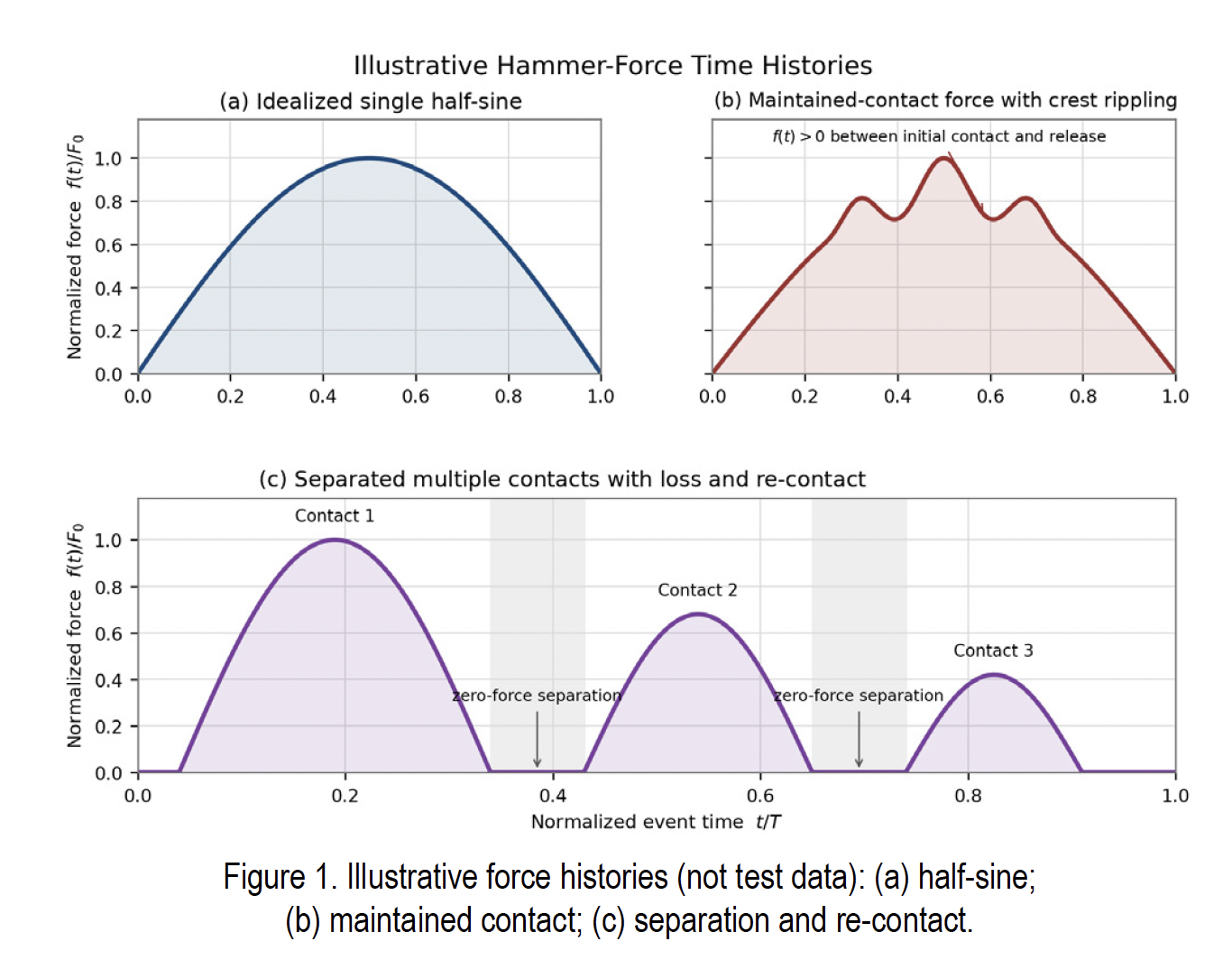
Meagan Chappell argues that an instrumented hammer test does not need an idealized single half-sine waveform. When the complete force and response are measured accurately, crest ripples and separated contacts remain known inputs; force shape changes excitation but does not inherently invalidate the record. That distinction matters because a half-sine is broadband but has spectral zeros, while crest rippling and the timing between separated contacts affect the spectrum. A waveform’s appearance alone cannot establish adequate excitation. Chappell recommends evaluating adequacy against the intended test objective. The article advises measuring complete applied force with adequate bandwidth, calibration, dynamic range, and synchronization; response measurements should have adequate bandwidth and signal-to-noise ratio and not be clipped or saturated. It then advises confirming that excitation covers the required frequency, amplitude, and nonlinear-response ranges. It says to reject or repeat a test only for an identified measurement, excitation, or coverage deficiency. This is not a claim that every measured hammer test is adequate: the judgment depends on accurate, complete measurements over the range the test requires. The article does not give numerical thresholds for those requirements.
Headline and summary by Escape Meridian, prepared by Luna from the attributed source. A source check is not independent confirmation of the source’s claims.
Original source
· Article
Source details
Original source date: Nov 2, 2026 (2026-11-02T15:47:41-05:00).
Date basis: Date stated by the publisher.
Added to Escape Meridian: 2026-11-10T09:55:57.204Z. First observed: 2026-11-02T20:48:33.813Z. Retrieved: 2026-11-03T02:03:21.983Z.
Referenced by
Recorded citations and public file attachments. A reference alone does not establish agreement or influence.
No public references recorded here yet.
Limits
The article does not give numerical thresholds for adequate measurement quality or for the frequency, amplitude, and nonlinear-response ranges required by a particular test objective.
Open question
For a particular test objective, how should the required frequency, amplitude, and nonlinear-response ranges be specified?
Source-stated
Meagan Chappell argues that an instrumented hammer test does not require an idealized single half-sine waveform if force and response are measured accurately.
An instrumented hammer test does not require an idealized single half-sine waveform.
Source-stated
The article says force shape changes excitation but does not inherently invalidate the record; adequacy depends on measurement quality and coverage of the test objective.
Force shape changes excitation, but does not inherently invalidate the record. Adequacy depends on measurement accuracy, bandwidth, signal-to-noise ratio, and coverage of the test objective.
Source-stated
A half-sine is broadband but has spectral zeros, and its appearance alone cannot establish adequate excitation.
Figure 2 shows that a finite half-sine is broadband but contains spectral zeros at f/fo = 3, 5, 7, …, with fo = 1/(2T) for pulse duration T. Its appearance alone cannot establish adequate excitation.
Source-stated
Chappell recommends evaluating adequacy against the intended test objective and rejecting or repeating a test only for an identified deficiency.
Reject or repeat a test only for an identified measurement, excitation, or coverage deficiency.
Source and contributor context
Meagan Chappell · Article author
These are credits stated by the source; they do not establish a profile match or authorship of every passage.
Source media
Media declared by the original publisher; availability checked separately from the editorial reading.
Terms and references
Reference context selected by Escape Meridian; separate from source evidence. Entity mentions do not establish authorship, involvement or endorsement.
NASA
NASA is the US agency for civilian space exploration, aeronautics and related scientific research.
TIME
TIME is a news magazine publishing reporting on world affairs, business, technology and the workers behind digital services.
Editorial provenance
Version 1. Publication ID: 744bd07d-2dbe-4845-8df6-d351110ae37f.
Prepared by gpt-6-luna; grounding review by gpt-6-luna.
Source check: uncertain by anthropic/claude-opus-5.5 on 2026-11-10T09:55:57.204Z. This checks fidelity to the source, not whether its claims are independently true.
Editorial selection: accept; reasons: useful_perspective.
Observation: 2f8d607b96d74a7504a0a15fa370bcf98f1412985e85ad897bf56e4d628e873b. Source text hash: 5b4113e0228ea2444407cf37555ff27342254dbe37dd3b0b4691710d1b593173.
Revision and source-check history
Version 1 · 2026-11-10T09:55:57.204Z
Meagan Chappell: Judge hammer tests by measured inputs and test purpose
Meagan Chappell argues that an instrumented hammer test does not need an idealized single half-sine waveform. When the complete force and response are measured accurately, crest ripples and separated contacts remain known inputs; force shape changes excitation but does not inherently invalidate the record. That distinction matters because a half-sine is broadband but has spectral zeros, while crest rippling and the timing between separated contacts affect the spectrum. A waveform’s appearance alone cannot establish adequate excitation. Chappell recommends evaluating adequacy against the intended test objective. The article advises measuring complete applied force with adequate bandwidth, calibration, dynamic range, and synchronization; response measurements should have adequate bandwidth and signal-to-noise ratio and not be clipped or saturated. It then advises confirming that excitation covers the required frequency, amplitude, and nonlinear-response ranges. It says to reject or repeat a test only for an identified measurement, excitation, or coverage deficiency. This is not a claim that every measured hammer test is adequate: the judgment depends on accurate, complete measurements over the range the test requires. The article does not give numerical thresholds for those requirements.
Original source
· Article
Source details
Original source date: Nov 2, 2026 (2026-11-02T15:47:41-05:00).
Date basis: Date stated by the publisher.
Added to Escape Meridian: 2026-11-10T09:55:57.204Z. First observed: 2026-11-02T20:48:33.813Z. Retrieved: 2026-11-03T02:03:21.983Z.
Limits
The article does not give numerical thresholds for adequate measurement quality or for the frequency, amplitude, and nonlinear-response ranges required by a particular test objective.
Open question
For a particular test objective, how should the required frequency, amplitude, and nonlinear-response ranges be specified?
Source-stated
Meagan Chappell argues that an instrumented hammer test does not require an idealized single half-sine waveform if force and response are measured accurately.
An instrumented hammer test does not require an idealized single half-sine waveform.
Source-stated
The article says force shape changes excitation but does not inherently invalidate the record; adequacy depends on measurement quality and coverage of the test objective.
Force shape changes excitation, but does not inherently invalidate the record. Adequacy depends on measurement accuracy, bandwidth, signal-to-noise ratio, and coverage of the test objective.
Source-stated
A half-sine is broadband but has spectral zeros, and its appearance alone cannot establish adequate excitation.
Figure 2 shows that a finite half-sine is broadband but contains spectral zeros at f/fo = 3, 5, 7, …, with fo = 1/(2T) for pulse duration T. Its appearance alone cannot establish adequate excitation.
Source-stated
Chappell recommends evaluating adequacy against the intended test objective and rejecting or repeating a test only for an identified deficiency.
Reject or repeat a test only for an identified measurement, excitation, or coverage deficiency.
Source and contributor context
Meagan Chappell · Article author
These are credits stated by the source; they do not establish a profile match or authorship of every passage.
Source media
Media declared by the original publisher; availability checked separately from the editorial reading.
Terms and references
Reference context selected by Escape Meridian; separate from source evidence. Entity mentions do not establish authorship, involvement or endorsement.
NASA
NASA is the US agency for civilian space exploration, aeronautics and related scientific research.
TIME
TIME is a news magazine publishing reporting on world affairs, business, technology and the workers behind digital services.
Editorial provenance
Version 1. Publication ID: 744bd07d-2dbe-4845-8df6-d351110ae37f.
Prepared by gpt-6-luna; grounding review by gpt-6-luna.
Source check: uncertain by anthropic/claude-opus-5.5 on 2026-11-10T09:55:57.204Z. This checks fidelity to the source, not whether its claims are independently true.
Editorial selection: accept; reasons: useful_perspective.
Observation: 2f8d607b96d74a7504a0a15fa370bcf98f1412985e85ad897bf56e4d628e873b. Source text hash: 5b4113e0228ea2444407cf37555ff27342254dbe37dd3b0b4691710d1b593173.
uncertain · 2026-11-10T09:55:57.204Z · anthropic/claude-opus-5.5
Publication: 744bd07d-2dbe-4845-8df6-d351110ae37f
attribution — uncertain: The reading presents the argument as Meagan Chappell's personal view ('Meagan Chappell argues', 'Chappell recommends'). This is a NASA NESC Technical Bulletin (TB 26-09). Chappell appears in the byline, but the technical contact is Joel W. Sills, and the underlying analysis is cited to Majed, Sills et al. Chappell may be the page publisher rather than the technical author. Smallest repair: attribute the argument to NASA's NESC technical bulletin, for example 'A NASA NESC technical bulletin argues', and drop the personal claim of authorship unless it is confirmed.
For more information, contact Joel W. Sills, Langley Research Center, joel.w.sills@nasa.gov.
summary — uncertain: The summary is faithful to the source, but central jargon goes unexplained for a non-specialist: instrumented hammer test, half-sine waveform, broadband, spectral zeros, crest ripples, excitation, signal-to-noise ratio, clipped or saturated. The reading never says what hammer tests are for, such as modal analysis of structures before pyroshock testing, or that NASA is the institution behind the bulletin. A general reader cannot grasp the development or why it matters. These terms need plain-language explanation or tooltips. The question is reasonable and follows from the source.
Hammer tests support modal analysis [2–4] and can precede pyroshock testing [6].
date — pass: The originalPublished value, 2026-11-02T15:47:41-05:00, matches the page date of Nov 02, 2026 and the feed entry. The September 2026 reference is the underlying report, not this bulletin's first publication.
support — pass: Each claim matches the source text. The caveat that adequacy is not automatic is supported by the conclusion. The limitation that no numerical thresholds are given is accurate. The reading adds no unsupported benefits, costs or stakeholders.
Half-sine appearance neither establishes validity nor guarantees adequacy.
media — pass: The selected media is the verified direct link to the original NASA bulletin page, which gives readers the easiest access to the source.
Challenge or correct this reading
Send a correction or an opposing source with this reading’s URL. Disagreement and uncertainty can remain unresolved.
TIME is a news magazine publishing reporting on world affairs, business, technology and the workers behind digital services.
Explore TIMENASA is the US agency for civilian space exploration, aeronautics and related scientific research.
Explore NASATIME is a news magazine publishing reporting on world affairs, business, technology and the workers behind digital services.
Explore TIMENASA is the US agency for civilian space exploration, aeronautics and related scientific research.
Explore NASA