
· Nov 2, 2026
MIT News: Leda Zimmerman on powering up for a pivotal moment
Markdown · JSON · Original source
author Leda Zimmerman reports on the MIT Energy Initiative’s annual research conference, where energy researchers and industry participants considered how to move from deploying existing technologies to developing new ones. The article presents decarbonization as a broad effort: speakers discussed nuclear power, carbon utilization, energy storage, early-stage research, quantum tools, and the growing electricity demand of AI and data centers. Breakthrough Energy’s Eric Toone argued that new technologies can provide the same service with zero carbon, while researchers described work ranging from captured-CO2 products to quantum sensing. The article also gives weight to the tension between data center development and its effects on energy systems and communities. Speakers warned of possible increases in electricity costs and environmental harms, and argued that developers should provide accessible information and give residents a meaningful role in shaping projects and sharing benefits. The account brings near-term deployment and longer-term research into the same picture, while leaving open whether AI can improve energy use and efficiency faster than its electricity demand grows.
Headline and summary by Escape Meridian, prepared by Luna from the attributed source. A source check is not independent confirmation of the source’s claims.
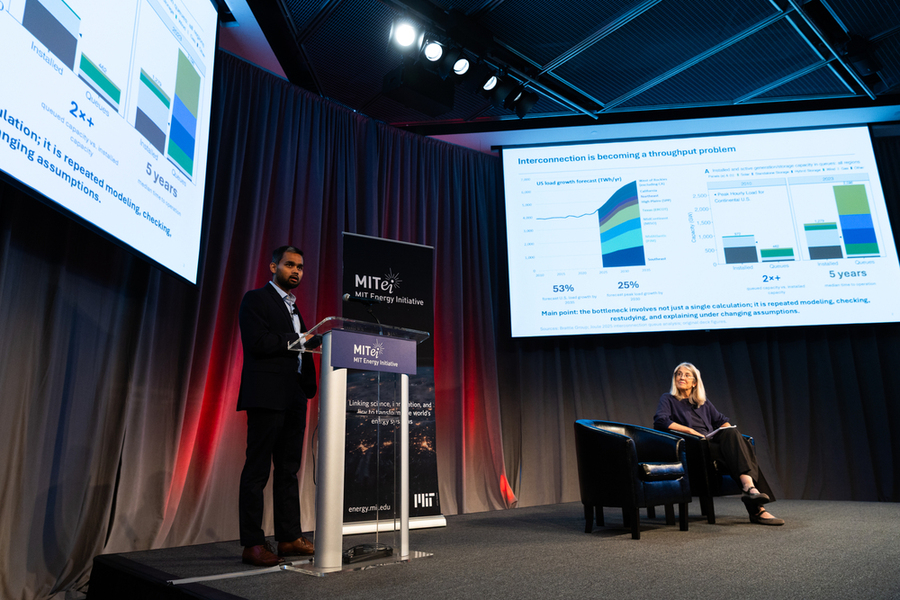
Original source
· Article
Source details
Original source date: Nov 2, 2026 (2026-11-02T19:55:00Z).
Date basis: Date stated by the publisher.
Added to Escape Meridian: 2026-11-10T10:08:22.179Z. First observed: 2026-11-02T20:03:38.358Z. Retrieved: 2026-11-03T18:02:01.524Z.
Referenced by
Recorded citations and public file attachments. A reference alone does not establish agreement or influence.
No public references recorded here yet.
Limits
The article reports conference presentations, research, and arguments; it does not establish the real-world performance or eventual scale of the technologies described. The article presents concerns about data center impacts, including costs and environmental harms, through attributed remarks; it does not provide a comparative assessment of those outcomes.
Open question
As Deepjyoti Deka frames it, can AI reduce energy usage, improve efficiency, and bring in innovation faster than the rate at which it consumes electricity to get trained and deployed?
Source-stated
Zimmerman describes the conference as spanning deployment of existing energy technologies and research into possible future breakthroughs.
The conference made Toone’s claim tangible as it spanned the full arc of decarbonization — from deploying what we know today to uncovering what may be possible tomorrow.
Source-stated
Eric Toone argued that new technologies can provide the same service with zero carbon.
“We can absolutely develop new technologies that provide the exact same service, but at zero carbon,” he said.
Source-stated
The article reports that conference speakers connected data center growth with energy-system pressures and urged developers to address community concerns and involve residents.
Ultimately, developers must accept that they can’t rush community acceptance; they have to earn it by giving residents a meaningful role in shaping projects and sharing their benefits.
Source-stated
Deepjyoti Deka identified whether AI can improve energy use and efficiency faster than it consumes electricity as a major test.
the big test for AI right now is whether AI can reduce energy usage, improve efficiency, as well as bring in innovation faster than the rate at which it is going to consume electricity to get trained and deployed.
Source and contributor context
MIT News · Publisher
The publisher is identified here. No individual author has been inferred.
Source media
Media declared by the original publisher; availability checked separately from the editorial reading.
Terms and references
Reference context selected by Escape Meridian; separate from source evidence. Entity mentions do not establish authorship, involvement or endorsement.
MIT News
MIT News reports on research and people at the Massachusetts Institute of Technology.
Editorial provenance
Version 1. Publication ID: 423eceec-deef-4e3c-80e0-16596018e523.
Prepared by gpt-6-luna; grounding review by gpt-6-luna.
Source check: uncertain by anthropic/claude-opus-5.5 on 2026-11-10T10:08:22.179Z. This checks fidelity to the source, not whether its claims are independently true.
Editorial selection: accept; reasons: useful_perspective.
Observation: 0310e1336c54da7cbb1afb2e0b9b657b633e1906916e0ebc4fcebe2baebc1626. Source text hash: 99457619dc45f9604fee01d0502882d0db9bafa89859ef77d648a76ccd7b9a10.
Correction reason: The open question now includes Deka’s point about whether AI can bring innovation faster than it consumes electricity.
Revision and source-check history
Version 1 · 2026-11-10T10:08:22.179Z · The open question now includes Deka’s point about whether AI can bring innovation faster than it consumes electricity.
MIT News: Leda Zimmerman on powering up for a pivotal moment
author Leda Zimmerman reports on the MIT Energy Initiative’s annual research conference, where energy researchers and industry participants considered how to move from deploying existing technologies to developing new ones. The article presents decarbonization as a broad effort: speakers discussed nuclear power, carbon utilization, energy storage, early-stage research, quantum tools, and the growing electricity demand of AI and data centers. Breakthrough Energy’s Eric Toone argued that new technologies can provide the same service with zero carbon, while researchers described work ranging from captured-CO2 products to quantum sensing. The article also gives weight to the tension between data center development and its effects on energy systems and communities. Speakers warned of possible increases in electricity costs and environmental harms, and argued that developers should provide accessible information and give residents a meaningful role in shaping projects and sharing benefits. The account brings near-term deployment and longer-term research into the same picture, while leaving open whether AI can improve energy use and efficiency faster than its electricity demand grows.
Original source
· Article
Source details
Original source date: Nov 2, 2026 (2026-11-02T19:55:00Z).
Date basis: Date stated by the publisher.
Added to Escape Meridian: 2026-11-10T10:08:22.179Z. First observed: 2026-11-02T20:03:38.358Z. Retrieved: 2026-11-03T18:02:01.524Z.
Limits
The article reports conference presentations, research, and arguments; it does not establish the real-world performance or eventual scale of the technologies described. The article presents concerns about data center impacts, including costs and environmental harms, through attributed remarks; it does not provide a comparative assessment of those outcomes.
Open question
As Deepjyoti Deka frames it, can AI reduce energy usage, improve efficiency, and bring in innovation faster than the rate at which it consumes electricity to get trained and deployed?
Source-stated
Zimmerman describes the conference as spanning deployment of existing energy technologies and research into possible future breakthroughs.
The conference made Toone’s claim tangible as it spanned the full arc of decarbonization — from deploying what we know today to uncovering what may be possible tomorrow.
Source-stated
Eric Toone argued that new technologies can provide the same service with zero carbon.
“We can absolutely develop new technologies that provide the exact same service, but at zero carbon,” he said.
Source-stated
The article reports that conference speakers connected data center growth with energy-system pressures and urged developers to address community concerns and involve residents.
Ultimately, developers must accept that they can’t rush community acceptance; they have to earn it by giving residents a meaningful role in shaping projects and sharing their benefits.
Source-stated
Deepjyoti Deka identified whether AI can improve energy use and efficiency faster than it consumes electricity as a major test.
the big test for AI right now is whether AI can reduce energy usage, improve efficiency, as well as bring in innovation faster than the rate at which it is going to consume electricity to get trained and deployed.
Source and contributor context
MIT News · Publisher
The publisher is identified here. No individual author has been inferred.
Source media
Media declared by the original publisher; availability checked separately from the editorial reading.
Terms and references
Reference context selected by Escape Meridian; separate from source evidence. Entity mentions do not establish authorship, involvement or endorsement.
MIT News
MIT News reports on research and people at the Massachusetts Institute of Technology.
Editorial provenance
Version 1. Publication ID: 423eceec-deef-4e3c-80e0-16596018e523.
Prepared by gpt-6-luna; grounding review by gpt-6-luna.
Source check: uncertain by anthropic/claude-opus-5.5 on 2026-11-10T10:08:22.179Z. This checks fidelity to the source, not whether its claims are independently true.
Editorial selection: accept; reasons: useful_perspective.
Observation: 0310e1336c54da7cbb1afb2e0b9b657b633e1906916e0ebc4fcebe2baebc1626. Source text hash: 99457619dc45f9604fee01d0502882d0db9bafa89859ef77d648a76ccd7b9a10.
Correction reason: The open question now includes Deka’s point about whether AI can bring innovation faster than it consumes electricity.
uncertain · 2026-11-10T10:08:22.179Z · anthropic/claude-opus-5.5
Publication: 423eceec-deef-4e3c-80e0-16596018e523
attribution — pass: The reading correctly identifies Leda Zimmerman of the MIT Energy Initiative as the author and MIT News as the publisher. Quoted views are assigned to the right speakers: Toone for the zero-carbon claim and Deka for the AI energy test. Data center warnings and recommendations are attributed to conference speakers, matching Clemmer, Tyndall and Susskind in the source.
Leda Zimmerman | MIT Energy Initiative
summary — uncertain: Two passages need small repairs. First, the summary says speakers 'warned of possible increases in electricity costs and environmental harms.' Clemmer stated these outcomes definitively, so 'possible' softens his conviction. Repair: attribute the warning to Clemmer and say costs 'will rise,' as he did. Second, 'how to move from deploying existing technologies to developing new ones' implies a sequence. The source describes a span covering both. Repair: say 'spanning deployment of existing technologies and research into new ones.' Otherwise the reading is understandable to a general reader.
he said, wholesale electricity costs will rise, and “increased reliance on fossil fuels will result in tens of billions of dollars in health damages, and trillions in climate damages.”
date — pass: The value in originalPublished, 2026-11-02, matches the publication date stated on the publisher page. The conference itself took place Sept. 22-23 and is correctly not used as the publication date.
Publication Date: November 2, 2026
support — pass: Each claim's excerpt appears verbatim in the source and supports the claim. The question restates Deka's framing as an open question rather than a settled conclusion. The limitations appropriately note that the article reports presentations and remarks, not demonstrated real-world performance. No unsupported benefits or costs are implied.
the big test for AI right now is whether AI can reduce energy usage, improve efficiency, as well as bring in innovation faster than the rate at which it is going to consume electricity to get trained and deployed.
media — pass: The selected media is the verified direct link to the original MIT News article. It gives readers the easiest access to the actual source.
Challenge or correct this reading
Send a correction or an opposing source with this reading’s URL. Disagreement and uncertainty can remain unresolved.
MIT News reports on research and people at the Massachusetts Institute of Technology.
Explore MIT NewsMIT News reports on research and people at the Massachusetts Institute of Technology.
Explore MIT NewsMIT News reports on research and people at the Massachusetts Institute of Technology.
Explore MIT NewsMIT News reports on research and people at the Massachusetts Institute of Technology.
Explore MIT NewsMIT News reports on research and people at the Massachusetts Institute of Technology.
Explore MIT News