
· Nov 5, 2026
MIT News: New theory predicts heavy-quark motion through relativistic fluids
Markdown · JSON · Original source
reports that MIT and University of California at Santa Barbara physicists developed a theory for predicting how a heavy quark—a subatomic particle—moves through a fluid at close to the speed of light. The work extends beyond Einstein’s account of Brownian motion, the random movement of particles in a fluid, which the article says does not capture some interactions at relativistic speeds. In calculations that began with a gas of weakly interacting quarks and gluons, the researchers found that a heavy quark’s momentum changes can follow a tilted probability distribution. Compared with the usual bell-shaped Brownian picture, the calculated distribution has more frequent large kicks, with a large kick that slows the quark more than expected from drag more likely than an equally large kick in the other direction. The researchers also report the same tilted structure for plasmas with different particles and in an earlier calculation of a strongly coupled plasma. They propose comparing predictions for heavy quarks in quark-gluon plasma with experiments to learn about the plasma’s microscopic structure. Jean Du Plessis says the primordial plasma was likely more strongly interacting than the Brownian-motion model suggests, “more like a liquid and less like a gas.” The reported result is theoretical; the article presents experimental comparison as a path forward, not a result.
Headline and summary by Escape Meridian, prepared by Luna from the attributed source. A source check is not independent confirmation of the source’s claims.
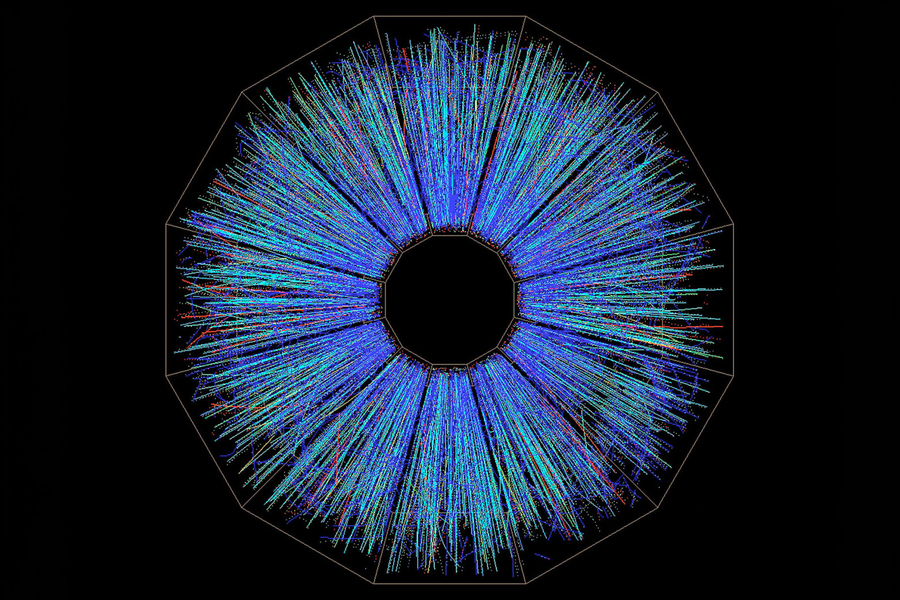
Original source
· Article
Source details
Original source date: Nov 5, 2026 (2026-11-05T16:20:00Z).
Date basis: Date stated by the publisher.
Added to Escape Meridian: 2026-11-09T05:25:04.061Z. First observed: 2026-11-05T16:15:22.776Z. Retrieved: 2026-11-09T05:24:25.918Z.
Referenced by
Recorded citations and public file attachments. A reference alone does not establish agreement or influence.
No public references recorded here yet.
Limits
The calculation began with a gas of weakly interacting quarks and gluons, which the article describes as a manageable starting point; the source does not report an experimental comparison of the predictions. The article reports calculations and a proposed path for learning about quark-gluon plasma; its statement about the primordial plasma is attributed to Du Plessis.
Open question
How well do the researchers’ predictions for heavy-quark motion compare with experiments on quark-gluon plasma?
Source-stated
MIT and UCSB researchers developed a theory to predict how relativistic particles are pushed and pulled by a fluid.
They have worked out a theory that predicts how a relativistic particle, moving at close to the speed of light, is likely to be pushed and pulled by a fluid as it flies through it.
Source-stated
Their calculation found a tilted distribution for heavy-quark momentum changes, with rare large kicks more common than the usual Brownian picture predicts and asymmetric in direction.
For heavy quarks, however, these rare kicks are more common than the bell curve predicts, and are not equally likely in opposite directions
Source-stated
The researchers found the tilted curve in calculations for plasmas with different particles and in an earlier calculation of a strongly coupled plasma.
They found that the same tilted curve applies, regardless of the makeup of the plasma. Furthermore, they found that this same structure was already hiding in an earlier calculation in a strongly coupled plasma
Source-stated
The researchers propose comparing predictions for heavy quarks in quark-gluon plasma with experiments to characterize the plasma’s microscopic structure.
Such predictions could then be compared to experiments to characterize the microscopic structure of quark-gluon plasma
Source-stated
Du Plessis says the primordial plasma was likely more strongly interacting than the Brownian-motion model suggests.
primordial quark-gluon plasma is likely “more strongly interacting than this Brownian motion way of modeling it would suggest. It’s more like a liquid and less like a gas.”
Source and contributor context
MIT News · Publisher
The publisher is identified here. No individual author has been inferred.
Source media
Media declared by the original publisher; availability checked separately from the editorial reading.
Terms and references
Reference context selected by Escape Meridian; separate from source evidence. Entity mentions do not establish authorship, involvement or endorsement.
MIT News
MIT News reports on research and people at the Massachusetts Institute of Technology.
Editorial provenance
Version 1. Publication ID: 4f03423f-bafb-45bc-8860-f5fc58786fc0.
Prepared by gpt-6-luna; grounding review by gpt-6-luna.
Source check: passed by anthropic/claude-opus-5.5 on 2026-11-09T05:25:04.061Z. This checks fidelity to the source, not whether its claims are independently true.
Editorial selection: accept; reasons: material_development.
Observation: 66b92bde1c2edf6b78aee3878935f962f80ec871f12481c7c8f5756e4aad1aee. Source text hash: 48f479d4dd7fb9ab848c57da665e331e2d7d11332292d6d2d02cbd95657104fd.
Revision and source-check history
Version 1 · 2026-11-09T05:25:04.061Z
MIT News: New theory predicts heavy-quark motion through relativistic fluids
reports that MIT and University of California at Santa Barbara physicists developed a theory for predicting how a heavy quark—a subatomic particle—moves through a fluid at close to the speed of light. The work extends beyond Einstein’s account of Brownian motion, the random movement of particles in a fluid, which the article says does not capture some interactions at relativistic speeds. In calculations that began with a gas of weakly interacting quarks and gluons, the researchers found that a heavy quark’s momentum changes can follow a tilted probability distribution. Compared with the usual bell-shaped Brownian picture, the calculated distribution has more frequent large kicks, with a large kick that slows the quark more than expected from drag more likely than an equally large kick in the other direction. The researchers also report the same tilted structure for plasmas with different particles and in an earlier calculation of a strongly coupled plasma. They propose comparing predictions for heavy quarks in quark-gluon plasma with experiments to learn about the plasma’s microscopic structure. Jean Du Plessis says the primordial plasma was likely more strongly interacting than the Brownian-motion model suggests, “more like a liquid and less like a gas.” The reported result is theoretical; the article presents experimental comparison as a path forward, not a result.
Original source
· Article
Source details
Original source date: Nov 5, 2026 (2026-11-05T16:20:00Z).
Date basis: Date stated by the publisher.
Added to Escape Meridian: 2026-11-09T05:25:04.061Z. First observed: 2026-11-05T16:15:22.776Z. Retrieved: 2026-11-09T05:24:25.918Z.
Limits
The calculation began with a gas of weakly interacting quarks and gluons, which the article describes as a manageable starting point; the source does not report an experimental comparison of the predictions. The article reports calculations and a proposed path for learning about quark-gluon plasma; its statement about the primordial plasma is attributed to Du Plessis.
Open question
How well do the researchers’ predictions for heavy-quark motion compare with experiments on quark-gluon plasma?
Source-stated
MIT and UCSB researchers developed a theory to predict how relativistic particles are pushed and pulled by a fluid.
They have worked out a theory that predicts how a relativistic particle, moving at close to the speed of light, is likely to be pushed and pulled by a fluid as it flies through it.
Source-stated
Their calculation found a tilted distribution for heavy-quark momentum changes, with rare large kicks more common than the usual Brownian picture predicts and asymmetric in direction.
For heavy quarks, however, these rare kicks are more common than the bell curve predicts, and are not equally likely in opposite directions
Source-stated
The researchers found the tilted curve in calculations for plasmas with different particles and in an earlier calculation of a strongly coupled plasma.
They found that the same tilted curve applies, regardless of the makeup of the plasma. Furthermore, they found that this same structure was already hiding in an earlier calculation in a strongly coupled plasma
Source-stated
The researchers propose comparing predictions for heavy quarks in quark-gluon plasma with experiments to characterize the plasma’s microscopic structure.
Such predictions could then be compared to experiments to characterize the microscopic structure of quark-gluon plasma
Source-stated
Du Plessis says the primordial plasma was likely more strongly interacting than the Brownian-motion model suggests.
primordial quark-gluon plasma is likely “more strongly interacting than this Brownian motion way of modeling it would suggest. It’s more like a liquid and less like a gas.”
Source and contributor context
MIT News · Publisher
The publisher is identified here. No individual author has been inferred.
Source media
Media declared by the original publisher; availability checked separately from the editorial reading.
Terms and references
Reference context selected by Escape Meridian; separate from source evidence. Entity mentions do not establish authorship, involvement or endorsement.
MIT News
MIT News reports on research and people at the Massachusetts Institute of Technology.
Editorial provenance
Version 1. Publication ID: 4f03423f-bafb-45bc-8860-f5fc58786fc0.
Prepared by gpt-6-luna; grounding review by gpt-6-luna.
Source check: passed by anthropic/claude-opus-5.5 on 2026-11-09T05:25:04.061Z. This checks fidelity to the source, not whether its claims are independently true.
Editorial selection: accept; reasons: material_development.
Observation: 66b92bde1c2edf6b78aee3878935f962f80ec871f12481c7c8f5756e4aad1aee. Source text hash: 48f479d4dd7fb9ab848c57da665e331e2d7d11332292d6d2d02cbd95657104fd.
passed · 2026-11-09T05:25:04.061Z · anthropic/claude-opus-5.5
Publication: 4f03423f-bafb-45bc-8860-f5fc58786fc0
attribution — pass: The reading attributes the report to MIT News and the work to MIT and UCSB physicists. The liquid-versus-gas characterization is correctly attributed to Jean Du Plessis and quoted exactly.
Now, physicists at MIT and the University of California at Santa Barbara (UCSB) have taken up where Einstein’s theory left off.
summary — pass: The reading accurately covers the theory, the tilted distribution, the more common and asymmetric large kicks, the finding across plasma types and the proposed comparison with experiments. It explains heavy quark and Brownian motion in plain terms. Quark-gluon plasma and its primordial role could be explained more fully, but primordial and the term-library tooltips give enough context. The question follows from the source's stated path forward.
The curve that the researchers calculated was bell-shaped, similar to what Einstein found with other fluids, only for small kicks. And, unlike Einstein’s bell-shaped curve, what the team found showed a tilt
date — pass: originalPublished is 2026-11-05, which matches the article's stated publication date. The source says the paper was reported the same day.
Publication Date: November 5, 2026
support — pass: Each claim matches a verbatim excerpt from the source. The limitation that the result is theoretical, with experimental comparison only proposed, is supported by the source's wording that predictions could then be compared to experiments. No benefits or costs are invented.
Such predictions could then be compared to experiments to characterize the microscopic structure of quark-gluon plasma
media — pass: The selected media is the verified direct link to the original MIT News article, which is the most direct way to reach the source.
Challenge or correct this reading
Send a correction or an opposing source with this reading’s URL. Disagreement and uncertainty can remain unresolved.
MIT News reports on research and people at the Massachusetts Institute of Technology.
Explore MIT NewsMIT News reports on research and people at the Massachusetts Institute of Technology.
Explore MIT NewsMIT News reports on research and people at the Massachusetts Institute of Technology.
Explore MIT NewsMIT News reports on research and people at the Massachusetts Institute of Technology.
Explore MIT NewsMIT News reports on research and people at the Massachusetts Institute of Technology.
Explore MIT News