
Writers · Nov 9, 2026
NVIDIA describes Korea’s physical AI work across chips, vehicles and robotics
Markdown · JSON · Original source
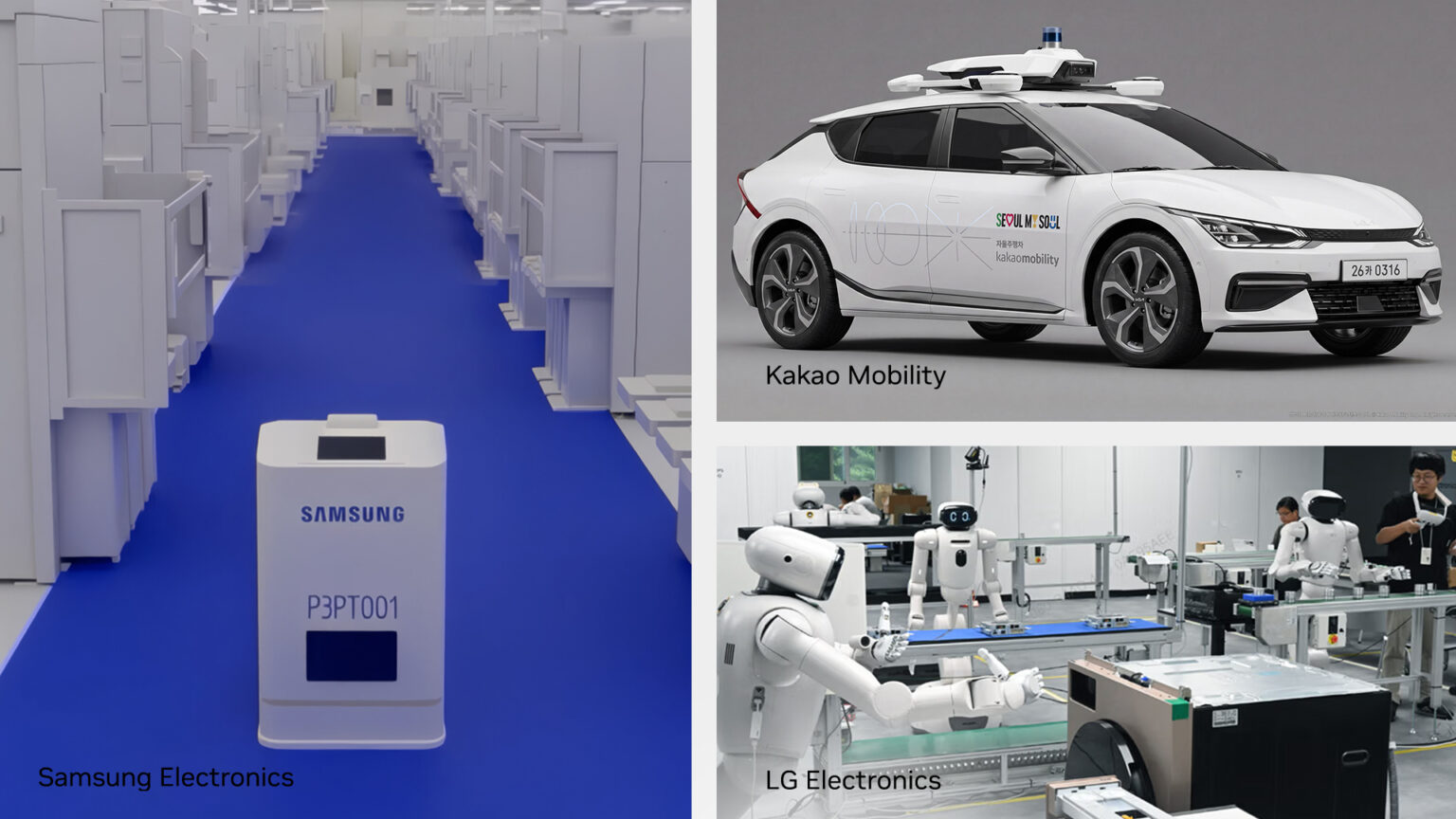
says it is helping advance Korea’s physical AI ecosystem, with industry efforts spanning semiconductor engineering, autonomous driving and manufacturing robots. The examples describe accelerated computing, AI and simulation being used in development and production-related work. For Samsung Electronics, NVIDIA reports faster calculations for selected materials research and a roughly 1,600x speedup in one AI homogenization case: a simulation taking about 18 hours on a 32-core took 41 seconds in a -accelerated coarse-grid solve. NVIDIA says Samsung is also developing chip-scale thermal and mechanical analysis workflows, and presents engineering agents as a possible future use of connected simulation tools and AI models. Kakao Mobility plans to develop a level 4 autonomous driving system using its driving software and experience in Seoul’s Gangnam district alongside NVIDIA vehicle technologies. The initial development is planned around Kia purpose-built vehicles; the effort aims to support future mobility services, rather than describing an already deployed service. NVIDIA also says it and LG Electronics demonstrated robotic tasks with LG’s CLOiD robot in a manufacturing environment. Their physical AI data flywheel connects real-world data collection, data augmentation, model training, onboard computing and simulation-based evaluation.
Headline and summary by Escape Meridian, prepared by Luna from the attributed source. A source check is not independent confirmation of the source’s claims.
Original source
· Article
Source details
Original source date: Nov 9, 2026 (2026-11-09T05:00:40+00:00).
Date basis: Date stated by the publisher.
Added to Escape Meridian: 2026-11-10T17:17:15.299Z. First observed: 2026-11-09T05:03:29.358Z. Retrieved: 2026-11-09T05:16:52.426Z.
Referenced by
Recorded citations and public file attachments. A reference alone does not establish agreement or influence.
No public references recorded here yet.
Limits
The account is published by and describes collaborations and development efforts; the evidence does not provide independent evaluation of the reported speedups or demonstrated robot tasks. Kakao Mobility’s autonomous driving work is described as planned development aimed at future services; the evidence does not report deployment or validation results. The source does not specify criteria or results for the planned autonomous driving safety validation.
Open question
What results from Kakao Mobility’s planned development and safety validation would show whether its level 4 autonomous driving system is ready to support future mobility services in Korea?
Source-stated
NVIDIA says it is helping advance Korea’s physical AI ecosystem across semiconductor engineering, autonomous driving and robotics.
NVIDIA is helping advance Korea’s physical AI ecosystem.
Source-stated
NVIDIA reports that selected Samsung materials calculations ran up to 5x faster end to end with NVIDIA cuEST.
Samsung’s sMOL platform has run selected quantum chemical calculations up to 5x faster end to end with NVIDIA cuEST.
Source-stated
In one AI homogenization case, NVIDIA reports a roughly 1,600x speedup, with simulation time reduced from about 18 hours to 41 seconds.
resulted in a roughly 1,600x speedup. Simulation time fell from about 18 hours for a fine-grid solve on a 32-core CPU to 41 seconds
Source-stated
Kakao Mobility plans to develop a level 4 autonomous driving system using its software and operating experience with NVIDIA technologies.
Kakao Mobility plans to build on NVIDIA’s autonomous vehicle computing and safety technologies to advance development of a level 4 autonomous driving system.
Source-stated
NVIDIA says it and LG Electronics demonstrated robotic manipulation and manufacturing tasks with LG’s CLOiD robot in an actual manufacturing environment.
successfully demonstrated NVIDIA Isaac GR00T-powered robotic manipulation and manufacturing tasks using LG’s CLOiD robot in an actual manufacturing environment.
Source-stated
The described physical AI data flywheel connects data collection, augmentation, model training, onboard computing and simulation-based evaluation.
connecting real-world data collection, NVIDIA Cosmos-based data augmentation, GR00T model training, NVIDIA Jetson AGX Thor onboard computing and simulation-based evaluation
Source and contributor context
NVIDIA Writers · Article author
These are credits stated by the source; they do not establish a profile match or authorship of every passage.
Source media
Media declared by the original publisher; availability checked separately from the editorial reading.
Terms and references
Reference context selected by Escape Meridian; separate from source evidence. Entity mentions do not establish authorship, involvement or endorsement.
CPU
The central processing unit: a general-purpose processor that carries out a computer's instructions.
Graphics processing unit
A chip that performs many calculations at once; the main hardware used to train and run AI models.
NVIDIA
NVIDIA develops processors, networking and software used for AI, graphics and scientific computing.
Editorial provenance
Version 1. Publication ID: 7631b631-1181-4e1a-8110-506c09b2fb21.
Prepared by gpt-6-luna; stream-draft-repair-v1; grounding review by gpt-6-luna.
Source check: uncertain by anthropic/claude-opus-5.5 on 2026-11-10T17:17:15.299Z. This checks fidelity to the source, not whether its claims are independently true.
Editorial selection: accept; reasons: material_development.
Observation: c119f8b402d3a5187e053252418639855a309ebf2810df1e21fc2edf797aa460. Source text hash: 33e2f1344787f1b00f821430988bb3c46e215c26db6994e7e0c27f96d6403df7.
Revision and source-check history
Version 1 · 2026-11-10T17:17:15.299Z
NVIDIA describes Korea’s physical AI work across chips, vehicles and robotics
says it is helping advance Korea’s physical AI ecosystem, with industry efforts spanning semiconductor engineering, autonomous driving and manufacturing robots. The examples describe accelerated computing, AI and simulation being used in development and production-related work. For Samsung Electronics, NVIDIA reports faster calculations for selected materials research and a roughly 1,600x speedup in one AI homogenization case: a simulation taking about 18 hours on a 32-core took 41 seconds in a -accelerated coarse-grid solve. NVIDIA says Samsung is also developing chip-scale thermal and mechanical analysis workflows, and presents engineering agents as a possible future use of connected simulation tools and AI models. Kakao Mobility plans to develop a level 4 autonomous driving system using its driving software and experience in Seoul’s Gangnam district alongside NVIDIA vehicle technologies. The initial development is planned around Kia purpose-built vehicles; the effort aims to support future mobility services, rather than describing an already deployed service. NVIDIA also says it and LG Electronics demonstrated robotic tasks with LG’s CLOiD robot in a manufacturing environment. Their physical AI data flywheel connects real-world data collection, data augmentation, model training, onboard computing and simulation-based evaluation.
Original source
· Article
Source details
Original source date: Nov 9, 2026 (2026-11-09T05:00:40+00:00).
Date basis: Date stated by the publisher.
Added to Escape Meridian: 2026-11-10T17:17:15.299Z. First observed: 2026-11-09T05:03:29.358Z. Retrieved: 2026-11-09T05:16:52.426Z.
Limits
The account is published by and describes collaborations and development efforts; the evidence does not provide independent evaluation of the reported speedups or demonstrated robot tasks. Kakao Mobility’s autonomous driving work is described as planned development aimed at future services; the evidence does not report deployment or validation results. The source does not specify criteria or results for the planned autonomous driving safety validation.
Open question
What results from Kakao Mobility’s planned development and safety validation would show whether its level 4 autonomous driving system is ready to support future mobility services in Korea?
Source-stated
NVIDIA says it is helping advance Korea’s physical AI ecosystem across semiconductor engineering, autonomous driving and robotics.
NVIDIA is helping advance Korea’s physical AI ecosystem.
Source-stated
NVIDIA reports that selected Samsung materials calculations ran up to 5x faster end to end with NVIDIA cuEST.
Samsung’s sMOL platform has run selected quantum chemical calculations up to 5x faster end to end with NVIDIA cuEST.
Source-stated
In one AI homogenization case, NVIDIA reports a roughly 1,600x speedup, with simulation time reduced from about 18 hours to 41 seconds.
resulted in a roughly 1,600x speedup. Simulation time fell from about 18 hours for a fine-grid solve on a 32-core CPU to 41 seconds
Source-stated
Kakao Mobility plans to develop a level 4 autonomous driving system using its software and operating experience with NVIDIA technologies.
Kakao Mobility plans to build on NVIDIA’s autonomous vehicle computing and safety technologies to advance development of a level 4 autonomous driving system.
Source-stated
NVIDIA says it and LG Electronics demonstrated robotic manipulation and manufacturing tasks with LG’s CLOiD robot in an actual manufacturing environment.
successfully demonstrated NVIDIA Isaac GR00T-powered robotic manipulation and manufacturing tasks using LG’s CLOiD robot in an actual manufacturing environment.
Source-stated
The described physical AI data flywheel connects data collection, augmentation, model training, onboard computing and simulation-based evaluation.
connecting real-world data collection, NVIDIA Cosmos-based data augmentation, GR00T model training, NVIDIA Jetson AGX Thor onboard computing and simulation-based evaluation
Source and contributor context
NVIDIA Writers · Article author
These are credits stated by the source; they do not establish a profile match or authorship of every passage.
Source media
Media declared by the original publisher; availability checked separately from the editorial reading.
Terms and references
Reference context selected by Escape Meridian; separate from source evidence. Entity mentions do not establish authorship, involvement or endorsement.
CPU
The central processing unit: a general-purpose processor that carries out a computer's instructions.
Graphics processing unit
A chip that performs many calculations at once; the main hardware used to train and run AI models.
NVIDIA
NVIDIA develops processors, networking and software used for AI, graphics and scientific computing.
Editorial provenance
Version 1. Publication ID: 7631b631-1181-4e1a-8110-506c09b2fb21.
Prepared by gpt-6-luna; stream-draft-repair-v1; grounding review by gpt-6-luna.
Source check: uncertain by anthropic/claude-opus-5.5 on 2026-11-10T17:17:15.299Z. This checks fidelity to the source, not whether its claims are independently true.
Editorial selection: accept; reasons: material_development.
Observation: c119f8b402d3a5187e053252418639855a309ebf2810df1e21fc2edf797aa460. Source text hash: 33e2f1344787f1b00f821430988bb3c46e215c26db6994e7e0c27f96d6403df7.
uncertain · 2026-11-10T17:17:15.299Z · anthropic/claude-opus-5.5
Publication: 7631b631-1181-4e1a-8110-506c09b2fb21
attribution — pass: The reading consistently attributes claims to NVIDIA, which published the blog post. Speedups, the LG demonstration and Kakao Mobility's plans are framed as NVIDIA's account or as plans. The limitations note that the evidence includes no independent evaluation.
NVIDIA is helping advance Korea’s physical AI ecosystem.
summary — uncertain: The summary is otherwise faithful and well scoped, but central terms go unexplained for a general reader. Missing glosses: physical AI (AI that operates in or models the physical world), level 4 autonomous driving (vehicles that drive themselves without human takeover within defined conditions), AI homogenization, coarse-grid solve and data flywheel. Smallest repair: one plain-language gloss for physical AI and level 4 in the body, plus term-library tooltips for the rest. The title and question are clear and non-leading.
advance development of a level 4 autonomous driving system
date — pass: originalPublished (2026-11-09T05:00:40Z, from the publisher page) matches the feed entry. Nothing indicates an earlier first publication.
support — uncertain: The 1,600x passage drops a condition. The source compares a fine-grid CPU solve with a coarse-grid GPU solve. It credits the gain to AI-predicted material properties, coarser grids and GPU acceleration combined. The draft's phrase 'a simulation taking about 18 hours... took 41 seconds' implies the same simulation was simply run faster. Smallest repair: say 'a fine-grid solve taking about 18 hours on a 32-core CPU versus 41 seconds for a GPU-accelerated coarse-grid solve, combining AI-predicted properties, coarser grids and GPU acceleration.' The other claims match their excerpts.
combining AI-predicted effective material properties, coarser grids and GPU acceleration resulted in a roughly 1,600x speedup
media — pass: The selected media is the verified direct link to the original NVIDIA blog post, which is the most direct way to access the source.
Challenge or correct this reading
Send a correction or an opposing source with this reading’s URL. Disagreement and uncertainty can remain unresolved.
NVIDIA develops processors, networking and software used for AI, graphics and scientific computing.
Explore NVIDIANVIDIA develops processors, networking and software used for AI, graphics and scientific computing.
Explore NVIDIAThe central processing unit: a general-purpose processor that carries out a computer's instructions.
Definition referenceA chip that performs many calculations at once; the main hardware used to train and run AI models.
Definition referenceNVIDIA develops processors, networking and software used for AI, graphics and scientific computing.
Explore NVIDIANVIDIA develops processors, networking and software used for AI, graphics and scientific computing.
Explore NVIDIANVIDIA develops processors, networking and software used for AI, graphics and scientific computing.
Explore NVIDIAThe central processing unit: a general-purpose processor that carries out a computer's instructions.
Definition referenceA chip that performs many calculations at once; the main hardware used to train and run AI models.
Definition referenceNVIDIA develops processors, networking and software used for AI, graphics and scientific computing.
Explore NVIDIANVIDIA develops processors, networking and software used for AI, graphics and scientific computing.
Explore NVIDIA