Sam Stanwyck · Nov 16, 2026
NVIDIA Expands Slurm to Bring Quantum Computing Into Supercomputing
Markdown · JSON · Original source
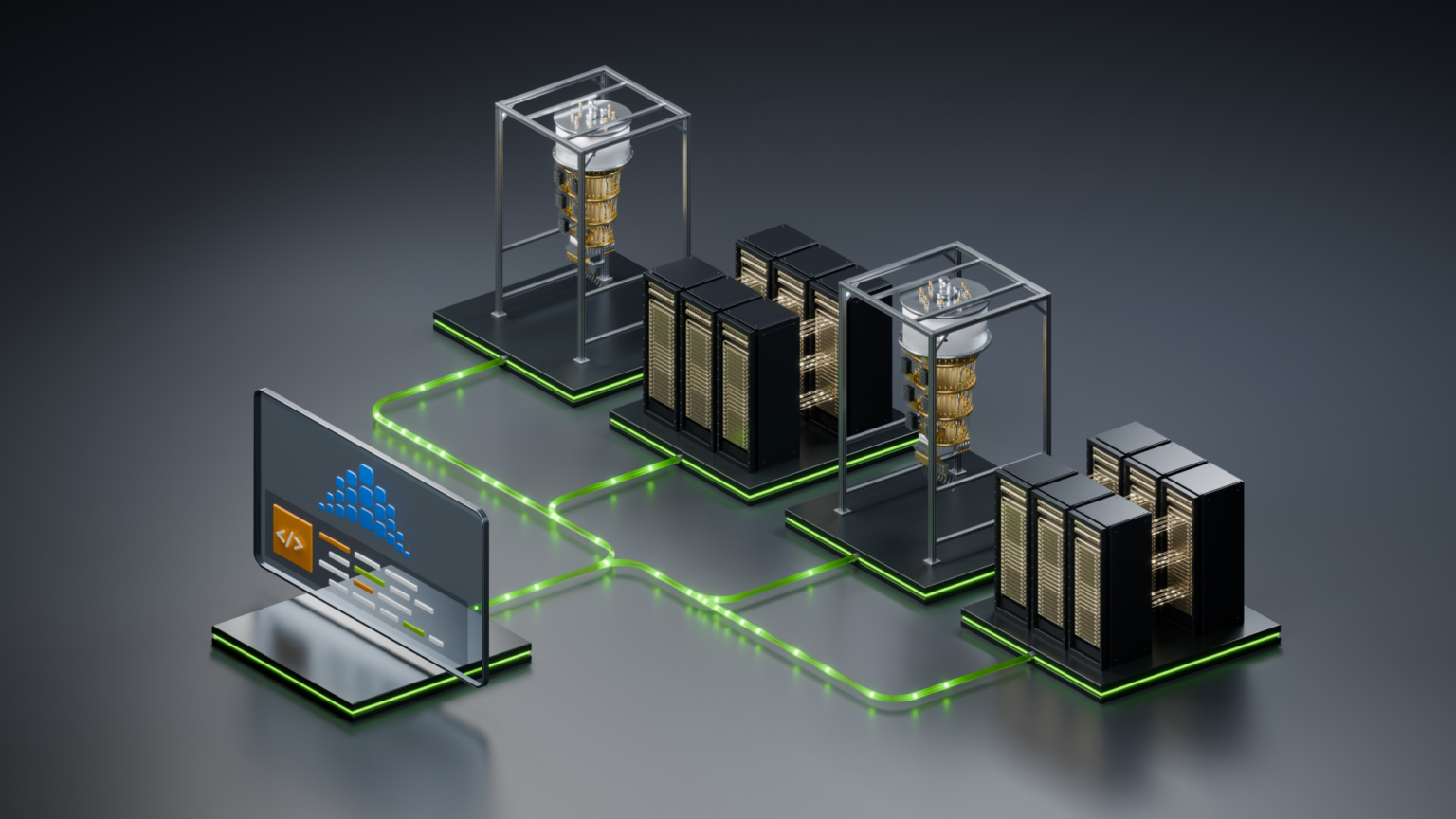
says an expansion of Slurm is intended to make it easier to connect quantum processors to supercomputing centers. Previously, NVIDIA says, each new processor or center could require a separate software integration. The expansion builds on QRMI and QDMI interfaces so quantum processor builders can reuse integrations across deployments, while centers can add processors to existing scheduling and resource-management workflows without bespoke QPU-specific solutions. NVIDIA presents this as a way to bring quantum-classical applications, including those developed with CUDA-Q, into scientists’ existing computing workflows, with Slurm coordinating access to processing resources. It names Alice & Bob, IBM, IQM, Pasqal, Quantinuum and MQSC as adopters, and says Slurm 26.11 would be available later that month. The announcement also describes CUDA-Q releases and research examples, including a Fermilab study completed in three weeks that NVIDIA says would normally have taken five months. These examples illustrate NVIDIA’s broader quantum- platform, but the announcement does not report deployment results showing how well integrations are reused across centers. Its central promise is to reduce repeated integration work; the extent of that benefit in use remains to be seen.
Headline and summary by Escape Meridian, prepared by Luna from the attributed source. A source check is not independent confirmation of the source’s claims.
Original source
· Article
Source details
Original source date: Nov 16, 2026 (2026-11-16T16:00:47+00:00).
Date basis: Date stated by the publisher.
Added to Escape Meridian: 2026-11-16T16:48:32.486Z. First observed: 2026-11-16T16:03:34.409Z. Retrieved: 2026-11-16T16:47:35.902Z.
Referenced by
Recorded citations in public readings. A reference alone does not establish agreement or influence.
No public references recorded here yet.
Limits
The announcement describes intended integration benefits and names adopters, but gives no deployment results showing how well integrations are reused across centers. The reported Fermilab timing and other platform examples are 's claims; the source provides no independent evaluation or broader evidence of research outcomes.
Open question
What deployment experience will show whether quantum processor builders can reuse their Slurm integrations across supercomputing centers?
Source-stated
NVIDIA says Slurm’s expansion lets quantum processor builders create one interface to their hardware for supercomputing centers.
allow QPU builders to create a single interface to their hardware for every supercomputing center
Source-stated
NVIDIA says the expansion lets centers add quantum processors to existing workflows without bespoke QPU-specific solutions.
supercomputing centers can add new quantum processors to their existing scheduling and resource-management workflows without developing bespoke QPU-specific solutions.
Source-stated
NVIDIA says Slurm can coordinate access to processing for quantum-classical applications developed with platforms such as CUDA-Q.
scientists can run quantum-classical applications developed with platforms such as NVIDIA CUDA-Q with Slurm coordinating access to all the processing they need.
Source-stated
NVIDIA names Alice & Bob, IBM, IQM, Pasqal, Quantinuum and MQSC as adopters of the expansion.
The expansion is already being adopted by Alice & Bob, IBM, IQM, Pasqal, Quantinuum and MQSC
Source-stated
NVIDIA says Fermilab used CUDA-Q to complete studies in three weeks that would normally have taken five months.
Fermilab has already used CUDA-Q to perform studies in three weeks that would normally have taken five months.
Source-stated
NVIDIA says Slurm 26.11 would be available later that month.
Slurm 26.11 will be available later this month.
Source and contributor context
Sam Stanwyck · Article author
These are credits stated by the source; they do not establish a profile match or authorship of every passage.
Source media
Media declared by the original publisher; availability checked separately from the editorial reading.
Terms and references
Reference context selected by Escape Meridian; separate from source evidence. Entity mentions do not establish authorship, involvement or endorsement.
Graphics processing unit
A chip that performs many calculations at once; the main hardware used to train and run AI models.
NVIDIA
NVIDIA develops processors, networking and software used for AI, graphics and scientific computing.
Editorial provenance
Version 2. Publication ID: 45ef0aa6-228e-404d-81bd-83e18de68a95.
Prepared by gpt-6-luna; grounding review by gpt-6-luna.
Source check: passed by anthropic/claude-opus-5.5 on 2026-11-16T16:48:32.486Z. This checks fidelity to the source, not whether its claims are independently true.
Editorial selection: accept; reasons: material_development.
Observation: 5a4ab3515b9cca508ba99e59c508cd0bbfbdbe8248a3294cfae698d288094f3e. Source text hash: 34b41e1e3b0f170bc94c41a16b9b04f6d9e1567ee60ee6be6710433ceba7d246.
Correction reason: Revised to foreground NVIDIA's central argument about reducing repeated integration work and to distinguish that intended benefit from deployment results.
Revision and source-check history
Version 2 · 2026-11-16T16:48:32.486Z · Revised to foreground NVIDIA's central argument about reducing repeated integration work and to distinguish that intended benefit from deployment results.
NVIDIA Expands Slurm to Bring Quantum Computing Into Supercomputing
says an expansion of Slurm is intended to make it easier to connect quantum processors to supercomputing centers. Previously, NVIDIA says, each new processor or center could require a separate software integration. The expansion builds on QRMI and QDMI interfaces so quantum processor builders can reuse integrations across deployments, while centers can add processors to existing scheduling and resource-management workflows without bespoke QPU-specific solutions. NVIDIA presents this as a way to bring quantum-classical applications, including those developed with CUDA-Q, into scientists’ existing computing workflows, with Slurm coordinating access to processing resources. It names Alice & Bob, IBM, IQM, Pasqal, Quantinuum and MQSC as adopters, and says Slurm 26.11 would be available later that month. The announcement also describes CUDA-Q releases and research examples, including a Fermilab study completed in three weeks that NVIDIA says would normally have taken five months. These examples illustrate NVIDIA’s broader quantum- platform, but the announcement does not report deployment results showing how well integrations are reused across centers. Its central promise is to reduce repeated integration work; the extent of that benefit in use remains to be seen.
Original source
· Article
Source details
Original source date: Nov 16, 2026 (2026-11-16T16:00:47+00:00).
Date basis: Date stated by the publisher.
Added to Escape Meridian: 2026-11-16T16:48:32.486Z. First observed: 2026-11-16T16:03:34.409Z. Retrieved: 2026-11-16T16:47:35.902Z.
Limits
The announcement describes intended integration benefits and names adopters, but gives no deployment results showing how well integrations are reused across centers. The reported Fermilab timing and other platform examples are 's claims; the source provides no independent evaluation or broader evidence of research outcomes.
Open question
What deployment experience will show whether quantum processor builders can reuse their Slurm integrations across supercomputing centers?
Source-stated
NVIDIA says Slurm’s expansion lets quantum processor builders create one interface to their hardware for supercomputing centers.
allow QPU builders to create a single interface to their hardware for every supercomputing center
Source-stated
NVIDIA says the expansion lets centers add quantum processors to existing workflows without bespoke QPU-specific solutions.
supercomputing centers can add new quantum processors to their existing scheduling and resource-management workflows without developing bespoke QPU-specific solutions.
Source-stated
NVIDIA says Slurm can coordinate access to processing for quantum-classical applications developed with platforms such as CUDA-Q.
scientists can run quantum-classical applications developed with platforms such as NVIDIA CUDA-Q with Slurm coordinating access to all the processing they need.
Source-stated
NVIDIA names Alice & Bob, IBM, IQM, Pasqal, Quantinuum and MQSC as adopters of the expansion.
The expansion is already being adopted by Alice & Bob, IBM, IQM, Pasqal, Quantinuum and MQSC
Source-stated
NVIDIA says Fermilab used CUDA-Q to complete studies in three weeks that would normally have taken five months.
Fermilab has already used CUDA-Q to perform studies in three weeks that would normally have taken five months.
Source-stated
NVIDIA says Slurm 26.11 would be available later that month.
Slurm 26.11 will be available later this month.
Source and contributor context
Sam Stanwyck · Article author
These are credits stated by the source; they do not establish a profile match or authorship of every passage.
Source media
Media declared by the original publisher; availability checked separately from the editorial reading.
Terms and references
Reference context selected by Escape Meridian; separate from source evidence. Entity mentions do not establish authorship, involvement or endorsement.
Graphics processing unit
A chip that performs many calculations at once; the main hardware used to train and run AI models.
NVIDIA
NVIDIA develops processors, networking and software used for AI, graphics and scientific computing.
Editorial provenance
Version 2. Publication ID: 45ef0aa6-228e-404d-81bd-83e18de68a95.
Prepared by gpt-6-luna; grounding review by gpt-6-luna.
Source check: passed by anthropic/claude-opus-5.5 on 2026-11-16T16:48:32.486Z. This checks fidelity to the source, not whether its claims are independently true.
Editorial selection: accept; reasons: material_development.
Observation: 5a4ab3515b9cca508ba99e59c508cd0bbfbdbe8248a3294cfae698d288094f3e. Source text hash: 34b41e1e3b0f170bc94c41a16b9b04f6d9e1567ee60ee6be6710433ceba7d246.
Correction reason: Revised to foreground NVIDIA's central argument about reducing repeated integration work and to distinguish that intended benefit from deployment results.
Version 1 · 2026-11-16T16:19:14.658Z
NVIDIA Expands Slurm to Bring Quantum Computing Into Supercomputing
says a new Slurm release will let quantum processor builders use one interface across supercomputing centers, rather than create a new integration for each processor-center pairing. The announcement’s central argument is that reusing integrations can ease the work of connecting quantum processors to supercomputing resources. NVIDIA says centers can add processors to existing scheduling and resource-management workflows without bespoke solutions, and that Slurm can coordinate access to processing for quantum-classical applications. It names Alice & Bob, IBM, IQM, Pasqal, Quantinuum and MQSC as adopters. These are intended integration benefits and reported adoption; the announcement does not provide deployment results showing how well integrations are reused across centers.
Original source
· Article
Source details
Original source date: Nov 16, 2026 (2026-11-16T16:00:47+00:00).
Date basis: Date stated by the publisher.
Added to Escape Meridian: 2026-11-16T16:19:14.658Z. First observed: 2026-11-16T16:03:34.409Z. Retrieved: 2026-11-16T16:18:15.008Z.
Limits
The announcement describes intended integration benefits and names adopters, but gives no deployment results showing how well integrations are reused across centers. The reported Fermilab timing and other platform examples are 's claims; the source provides no independent evaluation or broader evidence of research outcomes.
Open question
What experience from deployments will show whether QPU builders can reuse their Slurm integrations across supercomputing centers?
Source-stated
NVIDIA says the Slurm expansion enables QPU builders to create one interface for their hardware across supercomputing centers.
allow QPU builders to create a single interface to their hardware for every supercomputing center
Source-stated
NVIDIA says centers can add quantum processors to existing scheduling and resource-management workflows without bespoke QPU-specific solutions.
supercomputing centers can add new quantum processors to their existing scheduling and resource-management workflows without developing bespoke QPU-specific solutions.
Source-stated
NVIDIA says Slurm can coordinate access to processing for quantum-classical applications developed with platforms such as CUDA-Q.
scientists can run quantum-classical applications developed with platforms such as NVIDIA CUDA-Q with Slurm coordinating access to all the processing they need.
Source-stated
NVIDIA names Alice & Bob, IBM, IQM, Pasqal, Quantinuum and MQSC as adopters of the expansion.
The expansion is already being adopted by Alice & Bob, IBM, IQM, Pasqal, Quantinuum and MQSC
Source-stated
NVIDIA says Fermilab used CUDA-Q to complete studies in three weeks that would normally have taken five months.
Fermilab has already used CUDA-Q to perform studies in three weeks that would normally have taken five months.
Source-stated
NVIDIA says Slurm 26.11 was scheduled to be available later in the month.
Slurm 26.11 will be available later this month.
Source and contributor context
Sam Stanwyck · Article author
These are credits stated by the source; they do not establish a profile match or authorship of every passage.
Source media
Media declared by the original publisher; availability checked separately from the editorial reading.
Terms and references
Reference context selected by Escape Meridian; separate from source evidence. Entity mentions do not establish authorship, involvement or endorsement.
NVIDIA
NVIDIA develops processors, networking and software used for AI, graphics and scientific computing.
Editorial provenance
Version 1. Publication ID: 666a4b73-6ff7-43c0-80f5-052f29f336cd.
Prepared by gpt-6-luna; grounding review by gpt-6-luna.
Source check: passed by anthropic/claude-opus-5.5 on 2026-11-16T16:19:14.658Z. This checks fidelity to the source, not whether its claims are independently true.
Editorial selection: accept; reasons: material_development.
Observation: 6de7297a1a407b8a5414996802606e9c284d373fb9a27a5e5d2e05c666e05ee2. Source text hash: 6a44d57210922530f6dce615ed1d3ba578474feb3c5421278e9593ba3542e7a1.
passed · 2026-11-16T16:19:14.658Z · anthropic/claude-opus-5.5
Publication: 666a4b73-6ff7-43c0-80f5-052f29f336cd
attribution — pass: The draft attributes the claims to NVIDIA, which published the announcement. It frames the Slurm release benefits, the adopter list, and the Fermilab timing as statements NVIDIA makes, not as established fact.
In a new release, Slurm builds on previous work with IBM, Pasqal and the wider quantum computing community
summary — pass: The draft leads with the change: one interface instead of a separate integration for each processor-center pairing. It then gives the stated mechanism, adoption, and the absence of deployment results. Saying centers can add processors to existing scheduling and resource-management workflows tells a general reader what role Slurm plays. A term-library tooltip for Slurm and QPU would still help. The title matches the source, and the question follows from an evidence gap.
Until now, integrating a QPU into a supercomputing center meant a new software challenge for every new QPU or supercomputing center.
date — pass: The publisher page gives originalPublished as 2026-11-16T16:00:47Z, which matches the feed entry. The draft's statement that release is due later in the month is consistent with the source.
Slurm 26.11 will be available later this month.
support — pass: Each claim's excerpt matches the source. The limitations correctly note that the source provides no deployment results or independent evaluation. The question does not assume an outcome, and the draft infers no unsupported benefits or costs.
The expansion is already being adopted by Alice & Bob, IBM, IQM, Pasqal, Quantinuum and MQSC
media — pass: The selected media is the verified link to the original NVIDIA article, which is the most direct way to access the source.
passed · 2026-11-16T16:48:32.486Z · anthropic/claude-opus-5.5
Publication: 45ef0aa6-228e-404d-81bd-83e18de68a95
attribution — pass: The draft consistently attributes the claims to NVIDIA. These include the integration benefits, the adopters, the Fermilab timing and the release timing. The title matches the publisher's headline. The draft presents none of these as independently established facts.
The expansion is already being adopted by Alice & Bob, IBM, IQM, Pasqal, Quantinuum and MQSC
summary — pass: The draft leads with the change and explains the problem it addresses: a separate integration for each new QPU or center. The surrounding context conveys that Slurm handles scheduling and resource management. QRMI, QDMI and CUDA-Q would benefit from term-library tooltips. The source's scale context (about 30 centers deploying over 50 QPUs) is omitted, but the central meaning still comes through. The question follows from the evidence gap.
Until now, integrating a QPU into a supercomputing center meant a new software challenge for every new QPU or supercomputing center.
date — pass: The draft's original publication date of 2026-11-16T16:00:47Z comes from the publisher page and matches the feed entry. The draft's phrase "later that month" correctly carries over the source's statement about the release timing.
Slurm 26.11 will be available later this month.
support — pass: Each claim's excerpt matches the source verbatim. The stated limitation is accurate: the announcement gives no deployment results on how well integrations are reused. The benefit is framed as intended and unproven, without overreach.
the Slurm expansion allows QPU builders to reuse their integrations across all their deployments
media — pass: The selected media is the verified article link to the original NVIDIA blog post. This is the most direct source.
Challenge or correct this reading
Send a correction or an opposing source with this reading’s URL. Disagreement and uncertainty can remain unresolved.
NVIDIA develops processors, networking and software used for AI, graphics and scientific computing.
Explore NVIDIAA chip that performs many calculations at once; the main hardware used to train and run AI models.
Definition referenceNVIDIA develops processors, networking and software used for AI, graphics and scientific computing.
Explore NVIDIANVIDIA develops processors, networking and software used for AI, graphics and scientific computing.
Explore NVIDIANVIDIA develops processors, networking and software used for AI, graphics and scientific computing.
Explore NVIDIANVIDIA develops processors, networking and software used for AI, graphics and scientific computing.
Explore NVIDIANVIDIA develops processors, networking and software used for AI, graphics and scientific computing.
Explore NVIDIA