
Sasa Docca · Nov 9, 2026
NVIDIA presents simulation tools for training robots in delicate tasks
Markdown · JSON · Original source
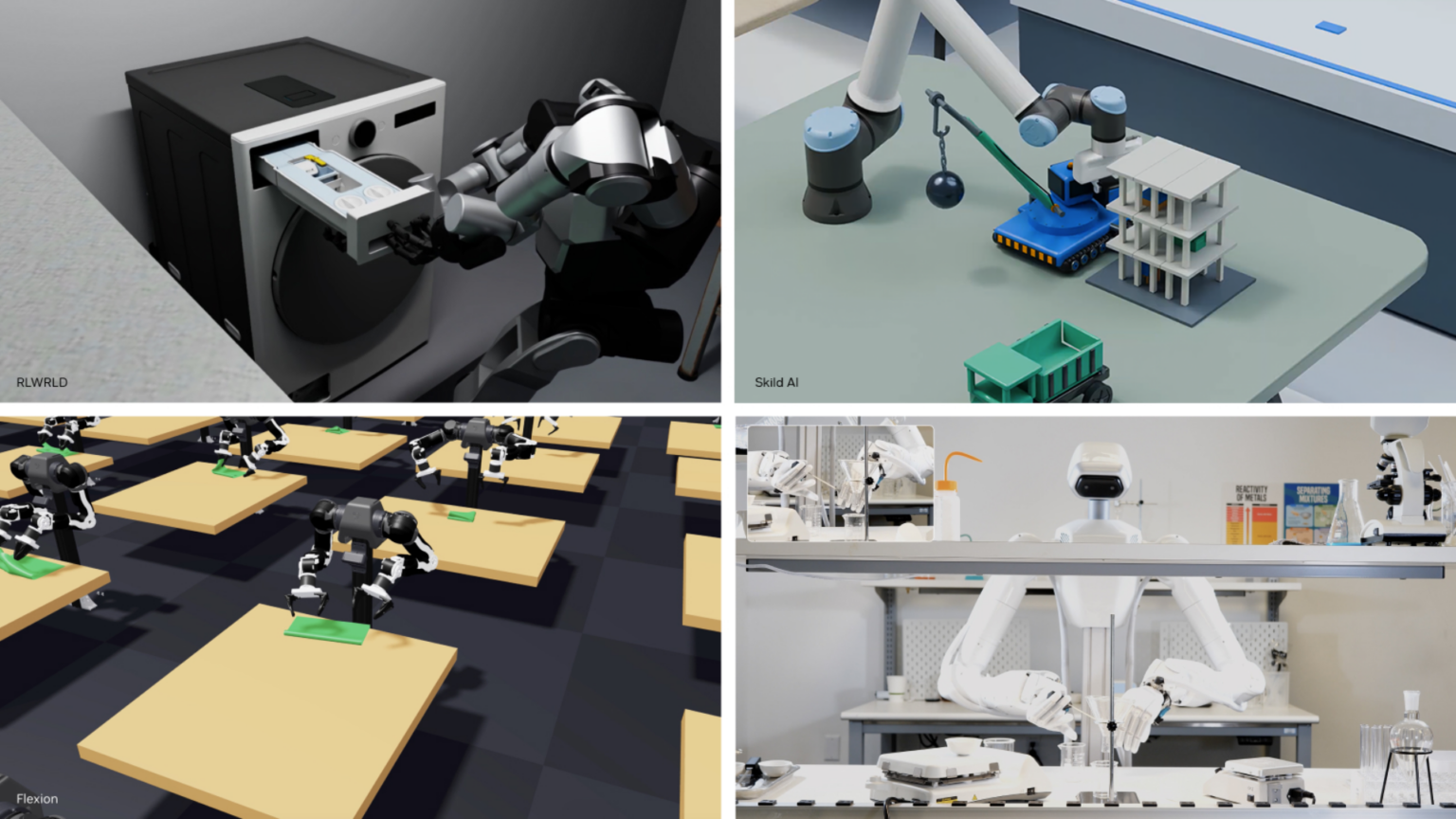
says simulation is moving from training robots to walk, roll and hop toward teaching delicate manipulation, including aligning gears, connecting cables and assembling small components. At CoRL, NVIDIA is introducing GR00T 2, an open world action model, alongside simulation tools, and robotics workflows. NVIDIA reports that GR00T 2 completed 40 of 50 evaluated tasks at least once without task-specific demonstrations, and achieved 71% average success across 50 tasks with one demonstration per task, rising to 95% with five. The company also says Isaac Lab 3.0 with Newton achieved up to 2.5x the training throughput of an earlier Isaac Lab and PhysX setup in a vision-based dexterous manipulation benchmark. The proposed workflow is to train and evaluate skills in simulation, inspect failures, and refine policies before physical deployment. NVIDIA describes partners testing or evaluating the tools, while a University of Washington and NVIDIA method directs practice toward tasks a policy succeeds at about half the . These results concern evaluations and simulation; the source does not establish how reliably they transfer to physical industrial work.
Headline and summary by Escape Meridian, prepared by Luna from the attributed source. A source check is not independent confirmation of the source’s claims.
Original source
· Article
Source details
Original source date: Nov 9, 2026 (2026-11-09T14:00:01+00:00).
Date basis: Date stated by the publisher.
Added to Escape Meridian: 2026-11-09T14:17:20.019Z. First observed: 2026-11-09T14:06:24.010Z. Retrieved: 2026-11-09T14:16:07.854Z.
Referenced by
Recorded citations and public file attachments. A reference alone does not establish agreement or influence.
No public references recorded here yet.
Limits
The performance figures are reported by for evaluations and simulation ; the source does not describe independent validation. The source identifies partners testing, applying, exploring or evaluating the technologies, but does not establish broad physical deployment outcomes.
Open question
How reliably do the reported simulation results transfer to physical robots performing these tasks in industrial settings?
Source-stated
NVIDIA presents simulation as a way to train robots for delicate manipulation tasks, extending beyond locomotion.
Simulation, which has long been the proving ground for robots learning to walk, roll and hop, is now helping researchers teach robots tasks that require a finer touch: aligning gears, connecting cables and assembling small components.
Source-stated
NVIDIA is introducing GR00T 2, an open world action model, and reports task performance from its evaluations.
At CoRL, NVIDIA is introducing GR00T 2, an open frontier world action model built on NVIDIA Cosmos.
Source-stated
NVIDIA reports GR00T 2 achieved 71% average success across 50 tasks with one demonstration per task and 95% with five.
Achieved 71% average success across 50 tasks with just one demonstration per task, increasing to 95% with five.
Source-stated
NVIDIA reports up to 2.5x training throughput for Isaac Lab 3.0 with Newton compared with Isaac Lab 2.3 with PhysX in a vision-based dexterous manipulation benchmark.
In a vision-based dexterous manipulation benchmark, Isaac Lab 3.0 with Newton achieved up to 2.5x the training throughput of Isaac Lab 2.3 with PhysX.
Source-stated
The source describes simulation-based training and evaluation as preparation for deployment on physical robots.
Simulation lets researchers train, refine and evaluate skills at scale before deploying them on physical robots.
Escape Meridian interpretation
The reported simulation and benchmark results do not by themselves establish performance after transfer to physical industrial work.
These advancements help researchers train robots on complex tasks, evaluate their performance across changing conditions and use failures to guide further learning
Source and contributor context
Sasa Docca · Article author
These are credits stated by the source; they do not establish a profile match or authorship of every passage.
Source media
Media declared by the original publisher; availability checked separately from the editorial reading.
Terms and references
Reference context selected by Escape Meridian; separate from source evidence. Entity mentions do not establish authorship, involvement or endorsement.
Benchmark
A defined set of tests used to compare systems. Results depend on the tasks and measures selected.
Agentic AI
AI systems that plan and carry out a series of steps toward a goal, often by using other software, rather than giving one answer.
NVIDIA
NVIDIA develops processors, networking and software used for AI, graphics and scientific computing.
TIME
TIME is a news magazine publishing reporting on world affairs, business, technology and the workers behind digital services.
Editorial provenance
Version 1. Publication ID: 8c112111-31e5-46a9-8fa0-d432f01959c8.
Prepared by gpt-6-luna; grounding review by gpt-6-luna.
Source check: passed by anthropic/claude-opus-5.5 on 2026-11-09T14:17:20.019Z. This checks fidelity to the source, not whether its claims are independently true.
Editorial selection: accept; reasons: material_development.
Observation: d5de7b861a26aeb0f90e39f0d5a9bee9d1204eb446a22b378dd0e3ca2664e0af. Source text hash: 0734a31e848c603c7a56a2f73e74de92367d0598721c6f1a35bd5ade985c2128.
Revision and source-check history
Version 1 · 2026-11-09T14:17:20.019Z
NVIDIA presents simulation tools for training robots in delicate tasks
says simulation is moving from training robots to walk, roll and hop toward teaching delicate manipulation, including aligning gears, connecting cables and assembling small components. At CoRL, NVIDIA is introducing GR00T 2, an open world action model, alongside simulation tools, and robotics workflows. NVIDIA reports that GR00T 2 completed 40 of 50 evaluated tasks at least once without task-specific demonstrations, and achieved 71% average success across 50 tasks with one demonstration per task, rising to 95% with five. The company also says Isaac Lab 3.0 with Newton achieved up to 2.5x the training throughput of an earlier Isaac Lab and PhysX setup in a vision-based dexterous manipulation benchmark. The proposed workflow is to train and evaluate skills in simulation, inspect failures, and refine policies before physical deployment. NVIDIA describes partners testing or evaluating the tools, while a University of Washington and NVIDIA method directs practice toward tasks a policy succeeds at about half the . These results concern evaluations and simulation; the source does not establish how reliably they transfer to physical industrial work.
Original source
· Article
Source details
Original source date: Nov 9, 2026 (2026-11-09T14:00:01+00:00).
Date basis: Date stated by the publisher.
Added to Escape Meridian: 2026-11-09T14:17:20.019Z. First observed: 2026-11-09T14:06:24.010Z. Retrieved: 2026-11-09T14:16:07.854Z.
Limits
The performance figures are reported by for evaluations and simulation ; the source does not describe independent validation. The source identifies partners testing, applying, exploring or evaluating the technologies, but does not establish broad physical deployment outcomes.
Open question
How reliably do the reported simulation results transfer to physical robots performing these tasks in industrial settings?
Source-stated
NVIDIA presents simulation as a way to train robots for delicate manipulation tasks, extending beyond locomotion.
Simulation, which has long been the proving ground for robots learning to walk, roll and hop, is now helping researchers teach robots tasks that require a finer touch: aligning gears, connecting cables and assembling small components.
Source-stated
NVIDIA is introducing GR00T 2, an open world action model, and reports task performance from its evaluations.
At CoRL, NVIDIA is introducing GR00T 2, an open frontier world action model built on NVIDIA Cosmos.
Source-stated
NVIDIA reports GR00T 2 achieved 71% average success across 50 tasks with one demonstration per task and 95% with five.
Achieved 71% average success across 50 tasks with just one demonstration per task, increasing to 95% with five.
Source-stated
NVIDIA reports up to 2.5x training throughput for Isaac Lab 3.0 with Newton compared with Isaac Lab 2.3 with PhysX in a vision-based dexterous manipulation benchmark.
In a vision-based dexterous manipulation benchmark, Isaac Lab 3.0 with Newton achieved up to 2.5x the training throughput of Isaac Lab 2.3 with PhysX.
Source-stated
The source describes simulation-based training and evaluation as preparation for deployment on physical robots.
Simulation lets researchers train, refine and evaluate skills at scale before deploying them on physical robots.
Escape Meridian interpretation
The reported simulation and benchmark results do not by themselves establish performance after transfer to physical industrial work.
These advancements help researchers train robots on complex tasks, evaluate their performance across changing conditions and use failures to guide further learning
Source and contributor context
Sasa Docca · Article author
These are credits stated by the source; they do not establish a profile match or authorship of every passage.
Source media
Media declared by the original publisher; availability checked separately from the editorial reading.
Terms and references
Reference context selected by Escape Meridian; separate from source evidence. Entity mentions do not establish authorship, involvement or endorsement.
Benchmark
A defined set of tests used to compare systems. Results depend on the tasks and measures selected.
Agentic AI
AI systems that plan and carry out a series of steps toward a goal, often by using other software, rather than giving one answer.
NVIDIA
NVIDIA develops processors, networking and software used for AI, graphics and scientific computing.
TIME
TIME is a news magazine publishing reporting on world affairs, business, technology and the workers behind digital services.
Editorial provenance
Version 1. Publication ID: 8c112111-31e5-46a9-8fa0-d432f01959c8.
Prepared by gpt-6-luna; grounding review by gpt-6-luna.
Source check: passed by anthropic/claude-opus-5.5 on 2026-11-09T14:17:20.019Z. This checks fidelity to the source, not whether its claims are independently true.
Editorial selection: accept; reasons: material_development.
Observation: d5de7b861a26aeb0f90e39f0d5a9bee9d1204eb446a22b378dd0e3ca2664e0af. Source text hash: 0734a31e848c603c7a56a2f73e74de92367d0598721c6f1a35bd5ade985c2128.
passed · 2026-11-09T14:17:20.019Z · anthropic/claude-opus-5.5
Publication: 8c112111-31e5-46a9-8fa0-d432f01959c8
attribution — pass: The reading attributes performance figures and framing to NVIDIA. It correctly credits Success-Guided Sampling to the University of Washington and NVIDIA. It also states that partners are testing or evaluating the tools, without presenting deployment as established.
Behind those results is Success-Guided Sampling, or SGS, from the University of Washington and NVIDIA.
summary — pass: The summary leads with NVIDIA's claimed shift from locomotion to manipulation, then the GR00T 2 figures, the throughput claim, and the simulate-evaluate-refine workflow. The question about real-world transfer follows from the evidence. Terms such as world action model, Isaac Lab, Newton, PhysX and policy are left for tooltips. A brief gloss on world action model would help, but the central development is understandable. Suggested tooltip additions: world action model, policy, CoRL.
The shift from locomotion to manipulation is taking center stage at this week’s Conference on Robot Learning (CoRL) in Austin, Texas
date — pass: The originalPublished value is 2026-11-09 from the publisher page. It matches the feed entry, and nothing suggests an earlier first publication.
support — pass: The numeric claims match the source exactly: 40 of 50 tasks, 71% rising to 95%, and up to 2.5x throughput versus Isaac Lab 2.3 with PhysX. The workflow description is stated in the source. The transfer caveat is labeled as interpretation and does not overstate. The limitations about the absence of independent validation and partner status are accurate.
Generalization with little data: Achieved 71% average success across 50 tasks with just one demonstration per task, increasing to 95% with five.
media — pass: The selected media is the verified direct link to the original NVIDIA blog post, which is the actual source.
Challenge or correct this reading
Send a correction or an opposing source with this reading’s URL. Disagreement and uncertainty can remain unresolved.
NVIDIA develops processors, networking and software used for AI, graphics and scientific computing.
Explore NVIDIAA defined set of tests used to compare systems. Results depend on the tasks and measures selected.
Definition referenceAI systems that plan and carry out a series of steps toward a goal, often by using other software, rather than giving one answer.
Definition referenceTIME is a news magazine publishing reporting on world affairs, business, technology and the workers behind digital services.
Explore TIMENVIDIA develops processors, networking and software used for AI, graphics and scientific computing.
Explore NVIDIANVIDIA develops processors, networking and software used for AI, graphics and scientific computing.
Explore NVIDIAA defined set of tests used to compare systems. Results depend on the tasks and measures selected.
Definition referenceNVIDIA develops processors, networking and software used for AI, graphics and scientific computing.
Explore NVIDIAA defined set of tests used to compare systems. Results depend on the tasks and measures selected.
Definition referenceAI systems that plan and carry out a series of steps toward a goal, often by using other software, rather than giving one answer.
Definition referenceTIME is a news magazine publishing reporting on world affairs, business, technology and the workers behind digital services.
Explore TIMENVIDIA develops processors, networking and software used for AI, graphics and scientific computing.
Explore NVIDIANVIDIA develops processors, networking and software used for AI, graphics and scientific computing.
Explore NVIDIAA defined set of tests used to compare systems. Results depend on the tasks and measures selected.
Definition reference