
Soma Velayutham · Nov 6, 2026
NVIDIA’s open-source tools support research on next-generation 6G networks
Markdown · JSON · Original source
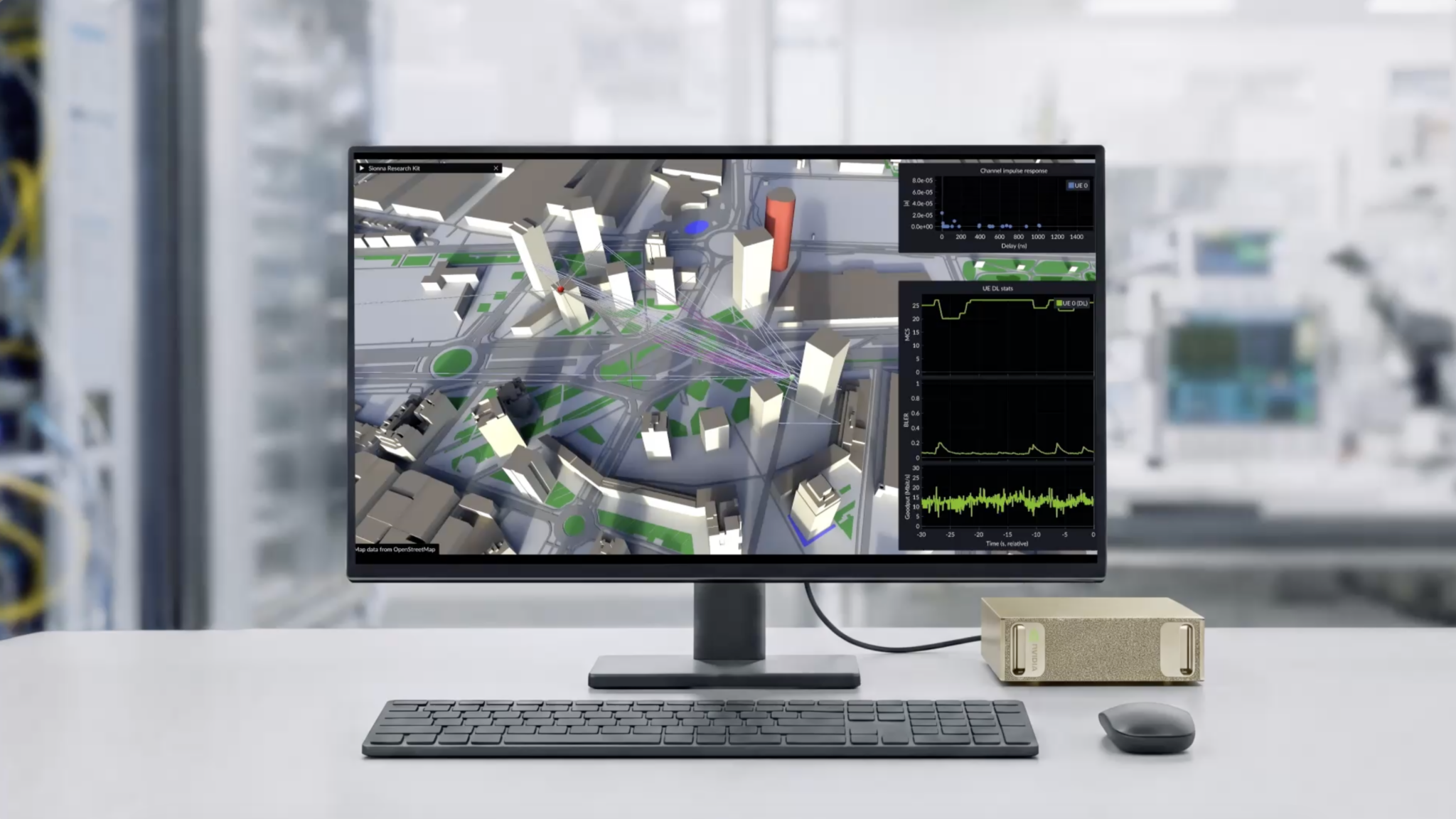
says its open-source Aerial wireless software, Sionna and related tools are helping researchers test ideas across simulation, AI training and experiments on real wireless systems. The company presents projects exploring how 6G networks might help robots respond faster, improve signal reception, reduce energy use and speed up network simulation. In King’s College London experiments, transmitting compact descriptions instead of periodic images reduced robot task completion by up to 52.6% and improved task success. In controlled tests, SoftBank’s neural receiver achieved higher uplink throughput than a conventional receiver at all 15 tested settings, with a maximum gain of roughly 60%. Researchers at the University of Leeds reported a 45.6% reduction in RAN power consumption while maintaining device connectivity. An early evaluation at CTTC reduced simulation runtime from approximately three hours to 10–20 minutes, depending on the integration, while preserving expected statistical behavior and network performance. These are results from specific experiments and evaluations; NVIDIA frames them as a view of possible future networks, not as evidence that the systems are already deployed at scale. How the reported results translate beyond the tested setups remains unresolved.
Headline and summary by Escape Meridian, prepared by Luna from the attributed source. A source check is not independent confirmation of the source’s claims.
Original source
· Article
Source details
Original source date: Nov 6, 2026 (2026-11-06T16:00:35+00:00).
Date basis: Date stated by the publisher.
Added to Escape Meridian: 2026-11-08T01:04:45.671Z. First observed: 2026-11-06T16:09:31.390Z. Retrieved: 2026-11-08T01:03:49.015Z.
Referenced by
Recorded citations and public file attachments. A reference alone does not establish agreement or influence.
No public references recorded here yet.
Limits
The reported findings come from specific experiments, controlled tests and an early evaluation; the source does not report deployment outcomes at scale. The robot experiments involved fruit-packing and cube-stacking with deliberately introduced faults. The source says the simulation runtime reduction depended on the integration.
Open question
How would the reported results hold up beyond the specific experimental setups and evaluations described?
Source-stated
NVIDIA says its open-source tools connect simulation and AI training with experiments on real over-the-air wireless systems.
connecting simulation and AI training with experiments on real over-the-air wireless systems.
Source-stated
In King’s College London experiments, the approach reduced robot task completion time by up to 52.6% and improved task success compared with sending periodic images.
the approach reduced robot task completion time by up to 52.6% and improved task success compared with sending periodic images.
Source-stated
SoftBank reported higher uplink throughput for a neural receiver than for a conventional receiver at all 15 tested settings, with a maximum gain of roughly 60% in controlled tests with interference.
In controlled tests with interference, the neural receiver delivered higher uplink throughput than a conventional receiver at all 15 tested settings, with a maximum gain of roughly 60%.
Source-stated
The University of Leeds team reported a 45.6% reduction in RAN power consumption relative to a full-power baseline while maintaining device connectivity.
The result: researchers reported a 45.6% reduction in RAN power consumption relative to a full-power baseline while maintaining device connectivity.
Source-stated
An early CTTC evaluation reduced simulation runtime from approximately three hours to 10–20 minutes, depending on the integration, while preserving expected statistical behavior and network performance.
In an early evaluation, the approach reduced simulation runtime from approximately three hours to 10-20 minutes, depending on the integration, while preserving the expected statistical behavior and network performance.
Source and contributor context
Soma Velayutham · Article author
These are credits stated by the source; they do not establish a profile match or authorship of every passage.
Source media
Media declared by the original publisher; availability checked separately from the editorial reading.
Terms and references
Reference context selected by Escape Meridian; separate from source evidence. Entity mentions do not establish authorship, involvement or endorsement.
NVIDIA
NVIDIA develops processors, networking and software used for AI, graphics and scientific computing.
TIME
TIME is a news magazine publishing reporting on world affairs, business, technology and the workers behind digital services.
Editorial provenance
Version 1. Publication ID: d275ab13-48a3-40f7-802a-e4c0ff9c6af7.
Prepared by gpt-6-luna; grounding review by gpt-6-luna.
Source check: uncertain by anthropic/claude-opus-5.5 on 2026-11-08T01:04:45.671Z. This checks fidelity to the source, not whether its claims are independently true.
Editorial selection: accept; reasons: material_development.
Observation: d3445cb0b48cc5d50f18662e5902eed06619d18a44563d98afc2d1a0dbd80d98. Source text hash: 9261e85f0373925cb9f6356528d5fb1257f908060e4136b3c04ffe2d23e0493c.
Revision and source-check history
Version 1 · 2026-11-08T01:04:45.671Z
NVIDIA’s open-source tools support research on next-generation 6G networks
says its open-source Aerial wireless software, Sionna and related tools are helping researchers test ideas across simulation, AI training and experiments on real wireless systems. The company presents projects exploring how 6G networks might help robots respond faster, improve signal reception, reduce energy use and speed up network simulation. In King’s College London experiments, transmitting compact descriptions instead of periodic images reduced robot task completion by up to 52.6% and improved task success. In controlled tests, SoftBank’s neural receiver achieved higher uplink throughput than a conventional receiver at all 15 tested settings, with a maximum gain of roughly 60%. Researchers at the University of Leeds reported a 45.6% reduction in RAN power consumption while maintaining device connectivity. An early evaluation at CTTC reduced simulation runtime from approximately three hours to 10–20 minutes, depending on the integration, while preserving expected statistical behavior and network performance. These are results from specific experiments and evaluations; NVIDIA frames them as a view of possible future networks, not as evidence that the systems are already deployed at scale. How the reported results translate beyond the tested setups remains unresolved.
Original source
· Article
Source details
Original source date: Nov 6, 2026 (2026-11-06T16:00:35+00:00).
Date basis: Date stated by the publisher.
Added to Escape Meridian: 2026-11-08T01:04:45.671Z. First observed: 2026-11-06T16:09:31.390Z. Retrieved: 2026-11-08T01:03:49.015Z.
Limits
The reported findings come from specific experiments, controlled tests and an early evaluation; the source does not report deployment outcomes at scale. The robot experiments involved fruit-packing and cube-stacking with deliberately introduced faults. The source says the simulation runtime reduction depended on the integration.
Open question
How would the reported results hold up beyond the specific experimental setups and evaluations described?
Source-stated
NVIDIA says its open-source tools connect simulation and AI training with experiments on real over-the-air wireless systems.
connecting simulation and AI training with experiments on real over-the-air wireless systems.
Source-stated
In King’s College London experiments, the approach reduced robot task completion time by up to 52.6% and improved task success compared with sending periodic images.
the approach reduced robot task completion time by up to 52.6% and improved task success compared with sending periodic images.
Source-stated
SoftBank reported higher uplink throughput for a neural receiver than for a conventional receiver at all 15 tested settings, with a maximum gain of roughly 60% in controlled tests with interference.
In controlled tests with interference, the neural receiver delivered higher uplink throughput than a conventional receiver at all 15 tested settings, with a maximum gain of roughly 60%.
Source-stated
The University of Leeds team reported a 45.6% reduction in RAN power consumption relative to a full-power baseline while maintaining device connectivity.
The result: researchers reported a 45.6% reduction in RAN power consumption relative to a full-power baseline while maintaining device connectivity.
Source-stated
An early CTTC evaluation reduced simulation runtime from approximately three hours to 10–20 minutes, depending on the integration, while preserving expected statistical behavior and network performance.
In an early evaluation, the approach reduced simulation runtime from approximately three hours to 10-20 minutes, depending on the integration, while preserving the expected statistical behavior and network performance.
Source and contributor context
Soma Velayutham · Article author
These are credits stated by the source; they do not establish a profile match or authorship of every passage.
Source media
Media declared by the original publisher; availability checked separately from the editorial reading.
Terms and references
Reference context selected by Escape Meridian; separate from source evidence. Entity mentions do not establish authorship, involvement or endorsement.
NVIDIA
NVIDIA develops processors, networking and software used for AI, graphics and scientific computing.
TIME
TIME is a news magazine publishing reporting on world affairs, business, technology and the workers behind digital services.
Editorial provenance
Version 1. Publication ID: d275ab13-48a3-40f7-802a-e4c0ff9c6af7.
Prepared by gpt-6-luna; grounding review by gpt-6-luna.
Source check: uncertain by anthropic/claude-opus-5.5 on 2026-11-08T01:04:45.671Z. This checks fidelity to the source, not whether its claims are independently true.
Editorial selection: accept; reasons: material_development.
Observation: d3445cb0b48cc5d50f18662e5902eed06619d18a44563d98afc2d1a0dbd80d98. Source text hash: 9261e85f0373925cb9f6356528d5fb1257f908060e4136b3c04ffe2d23e0493c.
uncertain · 2026-11-08T01:04:45.671Z · anthropic/claude-opus-5.5
Publication: d275ab13-48a3-40f7-802a-e4c0ff9c6af7
attribution — pass: The reading frames the piece as NVIDIA's account and presents each result as coming from named groups (King's College London, SoftBank, University of Leeds, CTTC). Minor nuance: the source says SoftBank 'demonstrated' the result, so it is NVIDIA reporting SoftBank's test, not a SoftBank-published report. This does not misattribute the claim.
SoftBank demonstrated this by integrating a neural receiver into NVIDIA Aerial CUDA-Accelerated RAN (ACAR)
summary — uncertain: The Leeds sentence drops the source's stated comparison point. It says 45.6% reduction without 'relative to a full-power baseline', and it omits the mechanism of forecasting demand to put base stations to sleep. Smallest repair: add the baseline and a brief clause on the sleep decisions. Central terms RAN, uplink throughput and neural receiver are not explained in plain language, which may block general readers. Suggest tooltips for RAN (radio access network) and uplink throughput. CTTC is also not expanded.
The result: researchers reported a 45.6% reduction in RAN power consumption relative to a full-power baseline while maintaining device connectivity.
date — pass: originalPublished (2026-11-06T16:00:35Z, from the publisher page) matches the feed entry timestamp and first observation. No earlier publication is indicated.
support — pass: Each claim's figure, condition and qualifier matches the quoted source text: up to 52.6%, all 15 settings, roughly 60%, 45.6% vs full-power baseline, three hours to 10-20 minutes. Qualifiers such as 'early evaluation', 'controlled tests' and 'depending on the integration' are preserved. The limitations and the question do not add unsupported benefits or costs. The 'view of how future networks could look' framing is sourced.
The projects emerging today offer a view of how future networks could look.
media — pass: The selected media is the verified original NVIDIA article, the most direct access to the source.
Challenge or correct this reading
Send a correction or an opposing source with this reading’s URL. Disagreement and uncertainty can remain unresolved.
NVIDIA develops processors, networking and software used for AI, graphics and scientific computing.
Explore NVIDIATIME is a news magazine publishing reporting on world affairs, business, technology and the workers behind digital services.
Explore TIMENVIDIA develops processors, networking and software used for AI, graphics and scientific computing.
Explore NVIDIANVIDIA develops processors, networking and software used for AI, graphics and scientific computing.
Explore NVIDIATIME is a news magazine publishing reporting on world affairs, business, technology and the workers behind digital services.
Explore TIMENVIDIA develops processors, networking and software used for AI, graphics and scientific computing.
Explore NVIDIA