Brian Sparks · Nov 16, 2026
NVIDIA says Lambda is using Photonics switches in a 10,000-GPU AI factory
Markdown · JSON · Original source
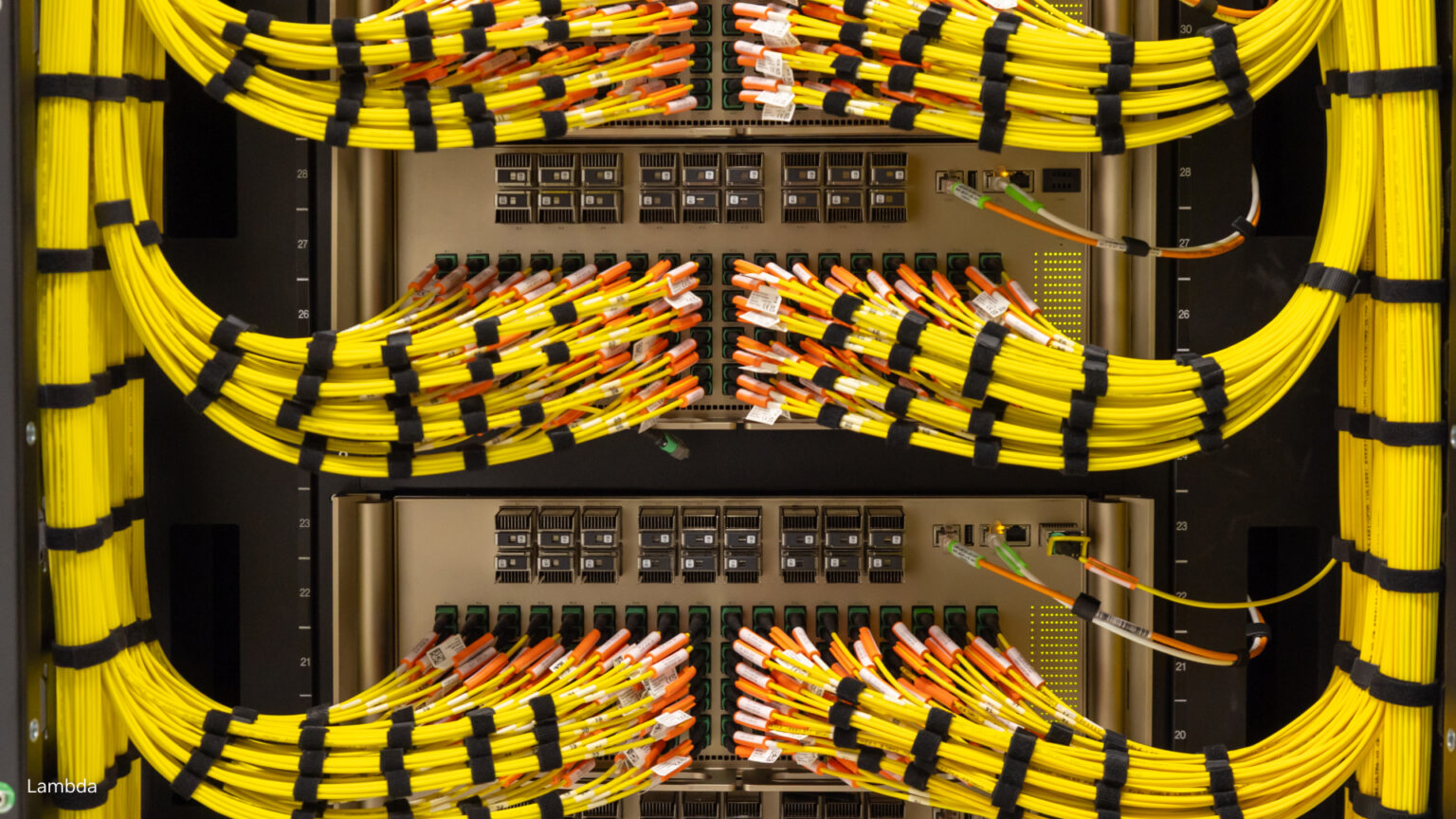
reports that cloud provider Lambda is using its Photonics co-packaged optics (CPO) switches to connect NVIDIA GB300 NVL72 racks with more than 10,000 . The switches replace pluggable transceivers with optical engines on the switch package, and use removable external light sources that technicians can replace in the field. NVIDIA says this design uses fewer lasers and shorter electrical paths, and removes retimer chips. NVIDIA reports that, in tests using the switches, network fell by about 4% at rack scale and up to about 10% at pod scale, while throughput matched conventional pluggable optics across tested configurations. The company also says Photonics delivers up to 5x better power efficiency and up to 15x higher reliability than conventional pluggable optics. Lambda reports lower median optics temperature than with conventional pluggable optics and more stable signal integrity in its tests. The stated stakes are operational: NVIDIA argues that an interrupted link can stall thousands of GPUs during a large training job, while network disruptions can add cascading latency in inference. The announcement describes a deployment and reports test results, but does not give the test methods or establish how results vary beyond the reported configurations.
Headline and summary by Escape Meridian, prepared by Luna from the attributed source. A source check is not independent confirmation of the source’s claims.
Press play to watch. If playback is unavailable, open the source below.
Original source
· Article
Source details
Original source date: Nov 16, 2026 (2026-11-16T16:00:51+00:00).
Date basis: Date stated by the publisher.
Added to Escape Meridian: 2026-11-16T16:18:13.604Z. First observed: 2026-11-16T16:03:33.223Z. Retrieved: 2026-11-16T16:17:17.764Z.
Referenced by
Recorded citations in public readings. A reference alone does not establish agreement or influence.
No public references recorded here yet.
Limits
The performance, temperature, power-efficiency and reliability comparisons are reported by or Lambda; the source does not provide test methods or conditions. The reported comparisons do not establish how results vary beyond the configurations and tests described in the source.
Open question
What test methods and conditions underpin ’s reported power-efficiency and reliability comparisons with conventional pluggable optics?
Source-stated
NVIDIA says Lambda is using NVIDIA Photonics CPO switches to connect GB300 NVL72 racks with more than 10,000 GPUs.
The cloud provider is using the switches to connect NVIDIA GB300 NVL72 racks with more than 10,000 GPUs
Source-stated
NVIDIA reports that its tests found network latency dropped about 4% at rack scale and up to about 10% at pod scale, with throughput matching conventional pluggable optics across the stated configurations.
network latency — the time needed for moving data — dropped by about 4% at rack scale and by up to about 10% at pod scale. Across rack, scalable unit and pod configurations, the network maintains the same throughput as conventional pluggable optics.
Source-stated
NVIDIA says Photonics provides up to 5x better power efficiency and up to 15x higher reliability than conventional pluggable optics, and uses 4x fewer lasers.
it delivers up to 5x better power efficiency and up to 15x higher reliability than conventional pluggable optics. It also uses 4x fewer lasers
Source-stated
NVIDIA says Lambda’s tests found a lower median optics temperature and more stable signal integrity than with conventional pluggable optics.
The company reports a median optics temperature of 36°C, compared with 51°C for conventional pluggable optics, and its tests find more stable signal integrity.
Source-stated
NVIDIA argues that network interruptions can disrupt AI workloads: a link interruption can stall GPUs during training, and a network disruption can introduce cascading latency effects with agentic inference.
In a large training job, one interrupted link can stall thousands of GPUs. With agentic inference, one network disruption can introduce cascading latency effects on many agents.
Source and contributor context
Brian Sparks · Article author
These are credits stated by the source; they do not establish a profile match or authorship of every passage.
Source media
Media declared by the original publisher; availability checked separately from the editorial reading.
Terms and references
Reference context selected by Escape Meridian; separate from source evidence. Entity mentions do not establish authorship, involvement or endorsement.
Graphics processing unit
A chip that performs many calculations at once; the main hardware used to train and run AI models.
Latency
The delay between sending a request and receiving the result.
Agentic AI
AI systems that plan and carry out a series of steps toward a goal, often by using other software, rather than giving one answer.
NVIDIA
NVIDIA develops processors, networking and software used for AI, graphics and scientific computing.
Editorial provenance
Version 1. Publication ID: 8aa8d088-cbf2-47e1-8e68-3e9dc407052d.
Prepared by gpt-6-luna; grounding review by gpt-6-luna.
Source check: uncertain by anthropic/claude-opus-5.5 on 2026-11-16T16:18:13.604Z. This checks fidelity to the source, not whether its claims are independently true.
Editorial selection: accept; reasons: material_development.
Observation: 8fa8773010e90c2b84e86a16d8a586b1ee843f3db151b01601539cdfd6c1fd71. Source text hash: 14a9ae1ac931acfff7c885831aaa21d5aaee6f28ec7b63efce6641653471bbad.
Revision and source-check history
Version 1 · 2026-11-16T16:18:13.604Z
NVIDIA says Lambda is using Photonics switches in a 10,000-GPU AI factory
reports that cloud provider Lambda is using its Photonics co-packaged optics (CPO) switches to connect NVIDIA GB300 NVL72 racks with more than 10,000 . The switches replace pluggable transceivers with optical engines on the switch package, and use removable external light sources that technicians can replace in the field. NVIDIA says this design uses fewer lasers and shorter electrical paths, and removes retimer chips. NVIDIA reports that, in tests using the switches, network fell by about 4% at rack scale and up to about 10% at pod scale, while throughput matched conventional pluggable optics across tested configurations. The company also says Photonics delivers up to 5x better power efficiency and up to 15x higher reliability than conventional pluggable optics. Lambda reports lower median optics temperature than with conventional pluggable optics and more stable signal integrity in its tests. The stated stakes are operational: NVIDIA argues that an interrupted link can stall thousands of GPUs during a large training job, while network disruptions can add cascading latency in inference. The announcement describes a deployment and reports test results, but does not give the test methods or establish how results vary beyond the reported configurations.
Original source
· Article
Source details
Original source date: Nov 16, 2026 (2026-11-16T16:00:51+00:00).
Date basis: Date stated by the publisher.
Added to Escape Meridian: 2026-11-16T16:18:13.604Z. First observed: 2026-11-16T16:03:33.223Z. Retrieved: 2026-11-16T16:17:17.764Z.
Limits
The performance, temperature, power-efficiency and reliability comparisons are reported by or Lambda; the source does not provide test methods or conditions. The reported comparisons do not establish how results vary beyond the configurations and tests described in the source.
Open question
What test methods and conditions underpin ’s reported power-efficiency and reliability comparisons with conventional pluggable optics?
Source-stated
NVIDIA says Lambda is using NVIDIA Photonics CPO switches to connect GB300 NVL72 racks with more than 10,000 GPUs.
The cloud provider is using the switches to connect NVIDIA GB300 NVL72 racks with more than 10,000 GPUs
Source-stated
NVIDIA reports that its tests found network latency dropped about 4% at rack scale and up to about 10% at pod scale, with throughput matching conventional pluggable optics across the stated configurations.
network latency — the time needed for moving data — dropped by about 4% at rack scale and by up to about 10% at pod scale. Across rack, scalable unit and pod configurations, the network maintains the same throughput as conventional pluggable optics.
Source-stated
NVIDIA says Photonics provides up to 5x better power efficiency and up to 15x higher reliability than conventional pluggable optics, and uses 4x fewer lasers.
it delivers up to 5x better power efficiency and up to 15x higher reliability than conventional pluggable optics. It also uses 4x fewer lasers
Source-stated
NVIDIA says Lambda’s tests found a lower median optics temperature and more stable signal integrity than with conventional pluggable optics.
The company reports a median optics temperature of 36°C, compared with 51°C for conventional pluggable optics, and its tests find more stable signal integrity.
Source-stated
NVIDIA argues that network interruptions can disrupt AI workloads: a link interruption can stall GPUs during training, and a network disruption can introduce cascading latency effects with agentic inference.
In a large training job, one interrupted link can stall thousands of GPUs. With agentic inference, one network disruption can introduce cascading latency effects on many agents.
Source and contributor context
Brian Sparks · Article author
These are credits stated by the source; they do not establish a profile match or authorship of every passage.
Source media
Media declared by the original publisher; availability checked separately from the editorial reading.
Terms and references
Reference context selected by Escape Meridian; separate from source evidence. Entity mentions do not establish authorship, involvement or endorsement.
Graphics processing unit
A chip that performs many calculations at once; the main hardware used to train and run AI models.
Latency
The delay between sending a request and receiving the result.
Agentic AI
AI systems that plan and carry out a series of steps toward a goal, often by using other software, rather than giving one answer.
NVIDIA
NVIDIA develops processors, networking and software used for AI, graphics and scientific computing.
Editorial provenance
Version 1. Publication ID: 8aa8d088-cbf2-47e1-8e68-3e9dc407052d.
Prepared by gpt-6-luna; grounding review by gpt-6-luna.
Source check: uncertain by anthropic/claude-opus-5.5 on 2026-11-16T16:18:13.604Z. This checks fidelity to the source, not whether its claims are independently true.
Editorial selection: accept; reasons: material_development.
Observation: 8fa8773010e90c2b84e86a16d8a586b1ee843f3db151b01601539cdfd6c1fd71. Source text hash: 14a9ae1ac931acfff7c885831aaa21d5aaee6f28ec7b63efce6641653471bbad.
uncertain · 2026-11-16T16:18:13.604Z · anthropic/claude-opus-5.5
Publication: 8aa8d088-cbf2-47e1-8e68-3e9dc407052d
attribution — pass: The deployment, test results and efficiency claims are attributed to NVIDIA or Lambda rather than stated as fact. The source's 'the company's tests' is somewhat ambiguous between Lambda and NVIDIA. The draft's 'NVIDIA reports that, in tests' and 'NVIDIA says Lambda's tests' handle this acceptably. The Lambda quote is not misattributed.
In the company’s tests using the switches, network latency — the time needed for moving data — dropped by about 4% at rack scale
summary — uncertain: The reading is faithful but may be hard to follow for a non-specialist. It never says what the optics do: the optical engines turn electrical signals into light that carries data over fiber between parts of the cluster. Latency is also left undefined, even though the source defines it. The stakes paragraph drops the source's power argument, that every watt spent on networking is a watt unavailable for compute. Smallest repair: add one plain sentence on optical engines and latency, and restore the watt-for-compute stake. Central terms such as co-packaged optics, retimer and agentic inference should get term-library tooltips. Separately, the title's '10,000-GPU' slightly flattens the source's 'more than 10,000 GPUs'.
Every interruption costs time, and every watt spent on networking is a watt not available for compute.
date — pass: originalPublished (2026-11-16T16:00:51Z, publisher page) matches the feed entry. Nothing in the source indicates an earlier first publication.
support — pass: Each claim matches its verbatim excerpt. The 4% and 10% latency figures, matching throughput, 5x power efficiency, 15x reliability, 4x fewer lasers, temperature and signal-integrity findings, and the interruption stakes all appear in the source. The limitations correctly note that test methods are absent. The question follows from that gap without leading.
it delivers up to 5x better power efficiency and up to 15x higher reliability than conventional pluggable optics. It also uses 4x fewer lasers
media — pass: The selected media is the verified direct link to the original NVIDIA blog post, which is the most direct access to the source.
Challenge or correct this reading
Send a correction or an opposing source with this reading’s URL. Disagreement and uncertainty can remain unresolved.
NVIDIA develops processors, networking and software used for AI, graphics and scientific computing.
Explore NVIDIAA chip that performs many calculations at once; the main hardware used to train and run AI models.
Definition referenceThe delay between sending a request and receiving the result.
Definition referenceAI systems that plan and carry out a series of steps toward a goal, often by using other software, rather than giving one answer.
Definition referenceNVIDIA develops processors, networking and software used for AI, graphics and scientific computing.
Explore NVIDIANVIDIA develops processors, networking and software used for AI, graphics and scientific computing.
Explore NVIDIANVIDIA develops processors, networking and software used for AI, graphics and scientific computing.
Explore NVIDIANVIDIA develops processors, networking and software used for AI, graphics and scientific computing.
Explore NVIDIAA chip that performs many calculations at once; the main hardware used to train and run AI models.
Definition referenceThe delay between sending a request and receiving the result.
Definition referenceAI systems that plan and carry out a series of steps toward a goal, often by using other software, rather than giving one answer.
Definition referenceNVIDIA develops processors, networking and software used for AI, graphics and scientific computing.
Explore NVIDIANVIDIA develops processors, networking and software used for AI, graphics and scientific computing.
Explore NVIDIANVIDIA develops processors, networking and software used for AI, graphics and scientific computing.
Explore NVIDIA