· Nov 20, 2026
OpenAI describes defenses against adversarial distillation
Markdown · JSON · Original source
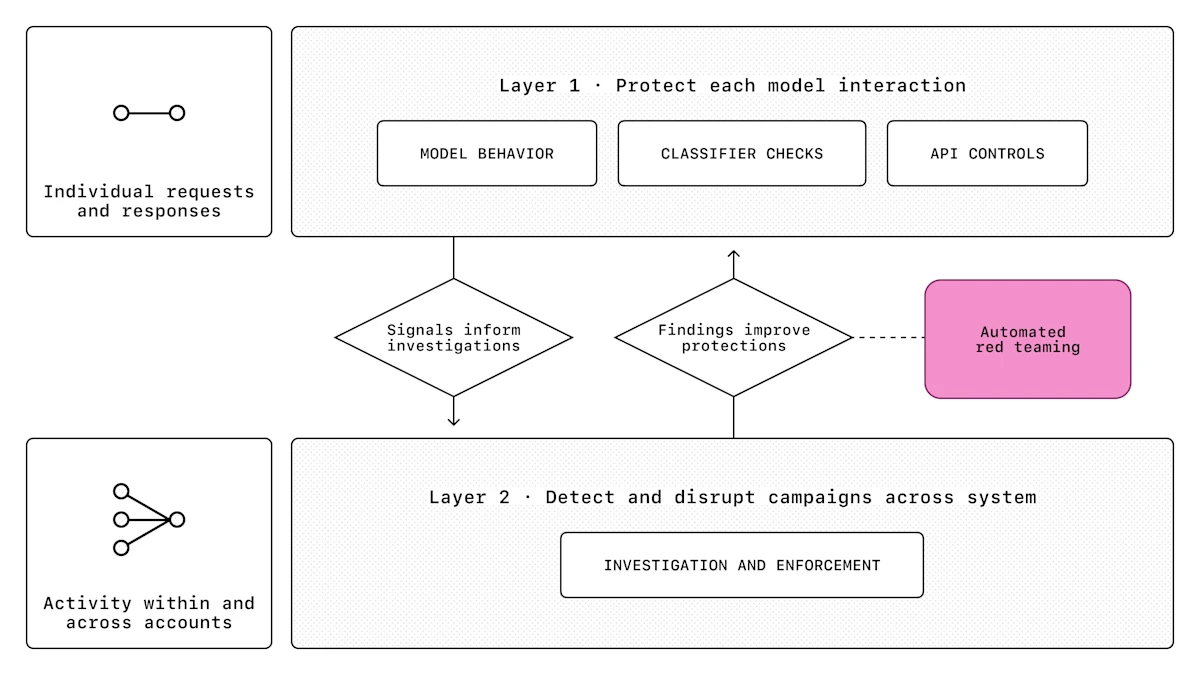
says adversarial distillation can let an unauthorized actor train a second model on a ’s outputs, potentially transferring capabilities without comparable safeguards. It argues that exact —the model’s intermediate steps—can be especially valuable training data, and reports an internal cyber study in which students trained on exact reasoning traces generally outperformed those trained on reasoning summaries after supervised . OpenAI describes combining model training, classifiers, -level protections and investigations of coordinated campaigns. In its adaptive black-box evaluation, the average attack success rate for extracting protected reasoning from an earlier request was lower for GPT‑6.2 Astra with updated safeguards than for GPT‑6 Astra with original safeguards. The company also says its weekly enforcement actions against campaigns ranged from thousands to tens of thousands of accounts, and advocates shared defenses across providers. These are OpenAI’s reported findings and policy positions; the evaluations described are internal, and the company says it will continue studying capability transfer across student models and training recipes.
Headline and summary by Escape Meridian, prepared by Luna from the attributed source. A source check is not independent confirmation of the source’s claims.
Original source
· Article
Source details
Original source date: Nov 20, 2026 (2026-11-20T10:00:00.000Z).
Date basis: Date supplied by the publisher’s feed.
Added to Escape Meridian: 2026-11-21T19:46:50.840Z. First observed: 2026-11-20T19:37:05.318Z. Retrieved: 2026-11-21T19:45:59.691Z.
Referenced by
Recorded citations in public readings. A reference alone does not establish agreement or influence.
No public references recorded here yet.
Limits
The reported evaluations are internal; the source does not report independent replication of these results. The cyber capability-transfer study uses specified student models, training data and evaluation settings; says it will continue studying transfer across different student models and distillation training recipes. The source attributes reported campaign activity and its account enforcement figures to OpenAI; it does not provide independent verification in this article.
Open question
How much additional capability transfers across different student models and distillation training recipes, which says it will continue studying?
Source-stated
OpenAI argues that adversarial distillation can transfer frontier-model capabilities to a second model without comparable safeguards.
a second model can learn advanced frontier capabilities without inheriting the safeguards that govern how the original model can use them.
Source-stated
OpenAI reports that, after supervised fine-tuning, the student trained on exact reasoning traces generally outperformed the student trained on reasoning summaries.
After supervised fine-tuning, the student trained on exact reasoning traces generally outperformed the student trained on reasoning summaries.
Source-stated
In an internal adaptive black-box evaluation, OpenAI reports lower average attack success rates for GPT‑6.2 Astra with updated safeguards than for GPT‑6 Astra with original safeguards.
On GPT‑6.2 Astra with its updated safeguards, the average attack success rate was below 1% for each attack type. Both rates were substantially lower than on GPT‑6 Astra with its original safeguards.
Source-stated
OpenAI says its weekly enforcement actions against adversarial distillation campaigns ranged in scale from thousands to tens of thousands of accounts.
Our weekly enforcement actions against these campaigns have ranged in scale from thousands to tens of thousands of accounts
Source and contributor context
OpenAI · Publisher
The publisher is identified here. No individual author has been inferred.
Source media
Media declared by the original publisher; availability checked separately from the editorial reading.
Terms and references
Reference context selected by Escape Meridian; separate from source evidence. Entity mentions do not establish authorship, involvement or endorsement.
Frontier model
One of the most capable AI models available at a given time; the set shifts as models improve.
Chain of thought
The step-by-step working a model writes out before giving its final answer.
Fine-tuning
Further training of an existing model to adapt it to a particular task or use.
API
An application programming interface: a defined way for software to request data or actions from another system.
OpenAI
OpenAI develops AI models and products and publishes research, release announcements and evaluations.
Editorial provenance
Version 1. Publication ID: 64e516c9-189a-4421-8f20-75a2f1098e16.
Prepared by gpt-6-luna; grounding review by gpt-6-luna.
Source check: uncertain by anthropic/claude-opus-5.5 on 2026-11-21T19:46:50.840Z. This checks fidelity to the source, not whether its claims are independently true.
Editorial selection: accept; reasons: material_development.
Observation: 12a089c0dc0025a0212c6446ed333b74c0c9982fac7a1f7ec708f42d7a9acfee. Source text hash: 62f9d780a2de136a3dfeab1077eb6a308586f0ad3418e2e8fe053ccd337bd370.
Revision and source-check history
Version 1 · 2026-11-21T19:46:50.840Z
OpenAI describes defenses against adversarial distillation
says adversarial distillation can let an unauthorized actor train a second model on a ’s outputs, potentially transferring capabilities without comparable safeguards. It argues that exact —the model’s intermediate steps—can be especially valuable training data, and reports an internal cyber study in which students trained on exact reasoning traces generally outperformed those trained on reasoning summaries after supervised . OpenAI describes combining model training, classifiers, -level protections and investigations of coordinated campaigns. In its adaptive black-box evaluation, the average attack success rate for extracting protected reasoning from an earlier request was lower for GPT‑6.2 Astra with updated safeguards than for GPT‑6 Astra with original safeguards. The company also says its weekly enforcement actions against campaigns ranged from thousands to tens of thousands of accounts, and advocates shared defenses across providers. These are OpenAI’s reported findings and policy positions; the evaluations described are internal, and the company says it will continue studying capability transfer across student models and training recipes.
Original source
· Article
Source details
Original source date: Nov 20, 2026 (2026-11-20T10:00:00.000Z).
Date basis: Date supplied by the publisher’s feed.
Added to Escape Meridian: 2026-11-21T19:46:50.840Z. First observed: 2026-11-20T19:37:05.318Z. Retrieved: 2026-11-21T19:45:59.691Z.
Limits
The reported evaluations are internal; the source does not report independent replication of these results. The cyber capability-transfer study uses specified student models, training data and evaluation settings; says it will continue studying transfer across different student models and distillation training recipes. The source attributes reported campaign activity and its account enforcement figures to OpenAI; it does not provide independent verification in this article.
Open question
How much additional capability transfers across different student models and distillation training recipes, which says it will continue studying?
Source-stated
OpenAI argues that adversarial distillation can transfer frontier-model capabilities to a second model without comparable safeguards.
a second model can learn advanced frontier capabilities without inheriting the safeguards that govern how the original model can use them.
Source-stated
OpenAI reports that, after supervised fine-tuning, the student trained on exact reasoning traces generally outperformed the student trained on reasoning summaries.
After supervised fine-tuning, the student trained on exact reasoning traces generally outperformed the student trained on reasoning summaries.
Source-stated
In an internal adaptive black-box evaluation, OpenAI reports lower average attack success rates for GPT‑6.2 Astra with updated safeguards than for GPT‑6 Astra with original safeguards.
On GPT‑6.2 Astra with its updated safeguards, the average attack success rate was below 1% for each attack type. Both rates were substantially lower than on GPT‑6 Astra with its original safeguards.
Source-stated
OpenAI says its weekly enforcement actions against adversarial distillation campaigns ranged in scale from thousands to tens of thousands of accounts.
Our weekly enforcement actions against these campaigns have ranged in scale from thousands to tens of thousands of accounts
Source and contributor context
OpenAI · Publisher
The publisher is identified here. No individual author has been inferred.
Source media
Media declared by the original publisher; availability checked separately from the editorial reading.
Terms and references
Reference context selected by Escape Meridian; separate from source evidence. Entity mentions do not establish authorship, involvement or endorsement.
Frontier model
One of the most capable AI models available at a given time; the set shifts as models improve.
Chain of thought
The step-by-step working a model writes out before giving its final answer.
Fine-tuning
Further training of an existing model to adapt it to a particular task or use.
API
An application programming interface: a defined way for software to request data or actions from another system.
OpenAI
OpenAI develops AI models and products and publishes research, release announcements and evaluations.
Editorial provenance
Version 1. Publication ID: 64e516c9-189a-4421-8f20-75a2f1098e16.
Prepared by gpt-6-luna; grounding review by gpt-6-luna.
Source check: uncertain by anthropic/claude-opus-5.5 on 2026-11-21T19:46:50.840Z. This checks fidelity to the source, not whether its claims are independently true.
Editorial selection: accept; reasons: material_development.
Observation: 12a089c0dc0025a0212c6446ed333b74c0c9982fac7a1f7ec708f42d7a9acfee. Source text hash: 62f9d780a2de136a3dfeab1077eb6a308586f0ad3418e2e8fe053ccd337bd370.
uncertain · 2026-11-21T19:46:50.840Z · anthropic/claude-opus-5.5
Publication: 64e516c9-189a-4421-8f20-75a2f1098e16
attribution — pass: The reading consistently attributes the arguments, evaluations, enforcement figures and recommendations to OpenAI. It labels them as OpenAI's reported findings and policy positions, and that matches the publisher page.
We’re sharing how OpenAI detects and disrupts adversarial distillation
summary — uncertain: The core mechanics are accurate and adversarial distillation and reasoning traces are explained. Three gaps remain. (1) 'Students' and 'supervised fine-tuning' are used without explanation; the source defines teacher and student, and one clause would fix this. (2) The reading erases a major argument: OpenAI frames distillation as a national security risk, names DeepSeek and Moonshot AI activity, and supports specific legislation. 'Policy positions' alone hides this. (3) It omits that after reinforcement learning the summary-trained student scored higher at lower budgets. Smallest repair: add a sentence each on the student and national-security points.
Adversarial distillation also poses a national security risk.
date — pass: The originalPublished value of 2026-11-20 matches the date printed at the top of the source text. No earlier first publication is indicated.
November 20, 2026 Combatting adversarial distillation
support — pass: Each claim's excerpt appears verbatim in the source and supports the claim as worded. The SFT result is correctly scoped to after supervised fine-tuning. The evaluations are correctly labeled internal. The question restates OpenAI's own stated open issue, and the limitations add no unsupported assumptions.
We will continue studying how much additional capability transfers across different student models and distillation training recipes.
media — pass: The selected media is the verified direct link to the original OpenAI article, which is the most direct way to access the source.
Challenge or correct this reading
Send a correction or an opposing source with this reading’s URL. Disagreement and uncertainty can remain unresolved.
OpenAI develops AI models and products and publishes research, release announcements and evaluations.
Explore OpenAIOpenAI develops AI models and products and publishes research, release announcements and evaluations.
Explore OpenAIOne of the most capable AI models available at a given time; the set shifts as models improve.
Definition referenceThe step-by-step working a model writes out before giving its final answer.
Definition referenceFurther training of an existing model to adapt it to a particular task or use.
Definition referenceAn application programming interface: a defined way for software to request data or actions from another system.
Definition referenceOpenAI develops AI models and products and publishes research, release announcements and evaluations.
Explore OpenAIOpenAI develops AI models and products and publishes research, release announcements and evaluations.
Explore OpenAIOpenAI develops AI models and products and publishes research, release announcements and evaluations.
Explore OpenAIOpenAI develops AI models and products and publishes research, release announcements and evaluations.
Explore OpenAIOne of the most capable AI models available at a given time; the set shifts as models improve.
Definition referenceThe step-by-step working a model writes out before giving its final answer.
Definition referenceFurther training of an existing model to adapt it to a particular task or use.
Definition referenceAn application programming interface: a defined way for software to request data or actions from another system.
Definition referenceOpenAI develops AI models and products and publishes research, release announcements and evaluations.
Explore OpenAIOpenAI develops AI models and products and publishes research, release announcements and evaluations.
Explore OpenAIOpenAI develops AI models and products and publishes research, release announcements and evaluations.
Explore OpenAI