
Dr. · Nov 1, 2026
The Innermost Loop: AI’s build-out meets constraints on money, power and resources
Markdown · JSON · Original source
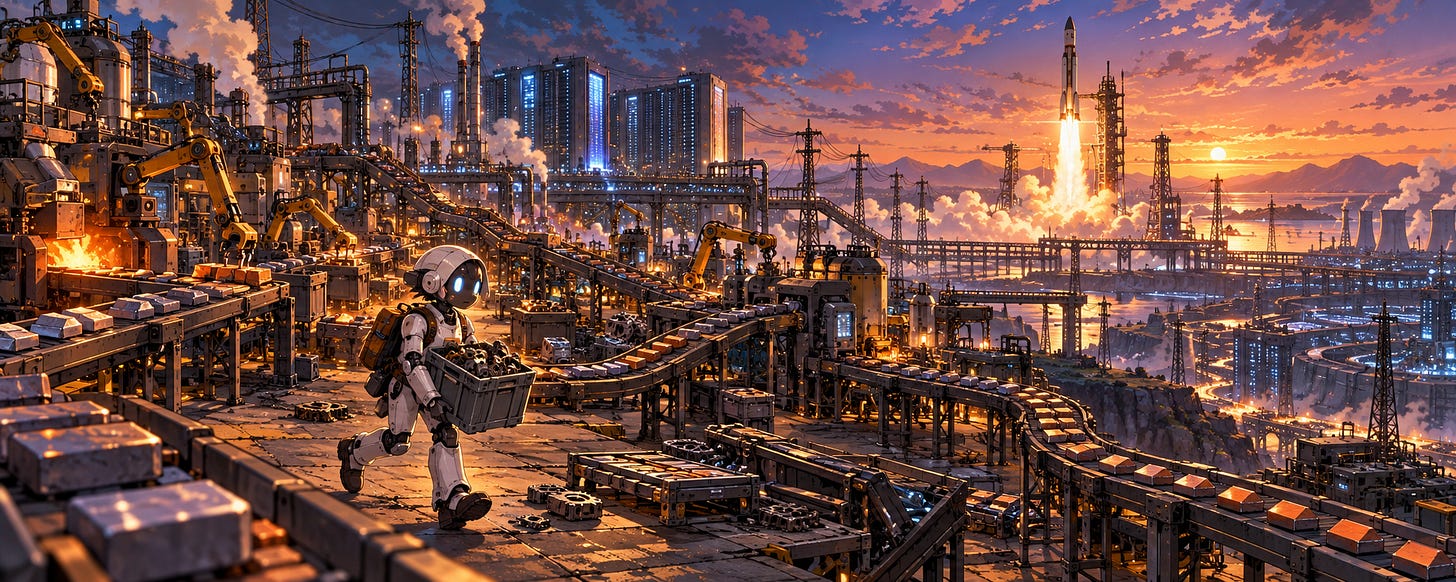
Dr. ’s roundup argues that the AI build-out is encountering constraints beyond compute: lenders are tightening terms, data centers face local opposition over resources, and memory is becoming a contested asset. He connects these pressures to proposals to charge content companies for bandwidth and tax AI revenue, and to changing expectations around human work and identity. The roundup also follows AI into medicine, space and robotics, while keeping its limits in view: in a Factorio test, GPT-5.6 Sol reached the rocket only by hand-carrying supplies between production lines it failed to connect. Wissner-Gross’s closing image is wry rather than triumphant: “Out of the crooked timber of , a rocket was nonetheless launched.” Escape Meridian’s interpretation is that the examples raise a question about whether the AI build-out can keep expanding under pressure from finance, infrastructure and local resources; the roundup does not establish how those constraints will develop.
Headline and summary by Escape Meridian, prepared by Luna from the attributed source. A source check is not independent confirmation of the source’s claims.
Original source
· Article
Source details
Original source date: Nov 1, 2026 (2026-11-01T12:56:38+00:00).
Date basis: Date stated by the publisher.
Added to Escape Meridian: 2026-11-11T03:09:56.035Z. First observed: 2026-11-01T13:00:18.838Z. Retrieved: 2026-11-01T13:00:59.529Z.
Referenced by
Recorded citations and public file attachments. A reference alone does not establish agreement or influence.
No public references recorded here yet.
Limits
The excerpt is a roundup and does not provide underlying documentation for the reported figures or establish how financing and local resource pressures will affect the pace of the AI build-out. The Factorio result describes a game run; it does not establish broader real-world reliability or planning ability.
Open question
Will tighter financing and local resource constraints slow or redirect the AI data-center build-out?
Source-stated
Wissner-Gross says lenders are demanding tougher terms as they assess risks to AI infrastructure financing.
Lenders who once funded the build-out with few questions are demanding tougher terms, wary of delays, slower AI profits, and a glut of AI stock and bond offerings.
Source-stated
The author describes local resource limits and opposition as growing constraints on data-center expansion.
The binding constraint is increasingly local. A surprisingly bipartisan backlash against data centers is growing in Arizona
Source-stated
Wissner-Gross frames memory as another contested resource, with hyperscalers increasing demand and Sam Altman arguing that home-PC memory is idle much of the time.
Sam Altman wants your memory in the cloud too, calling it “quite terrible” that scarce DRAM sits in home PCs idle 95% of the time
Source-stated
In the reported Factorio test, GPT-5.6 Sol completed a run but did not connect production lines, instead moving supplies by hand.
Sol reached the rocket only by hand-ferrying supplies between production lines it failed to connect.
Escape Meridian interpretation
The roundup’s examples support the interpretation that the AI build-out faces linked pressures in finance, infrastructure and resources, but do not establish their eventual effects.
The binding constraint is increasingly local. A surprisingly bipartisan backlash against data centers is growing in Arizona
Source and contributor context
Dr. Alex Wissner-Gross · Article author
These are credits stated by the source; they do not establish a profile match or authorship of every passage.
Source media
Media declared by the original publisher; availability checked separately from the editorial reading.
Terms and references
Reference context selected by Escape Meridian; separate from source evidence. Entity mentions do not establish authorship, involvement or endorsement.
Superintelligence
A hypothetical AI far more capable than people across most intellectual tasks.
The Innermost Loop
The Innermost Loop is Alexander Wissner-Gross’s publication interpreting developments in AI and other technologies.
Alexander Wissner-Gross
Alexander Wissner-Gross is a scientist and entrepreneur who writes The Innermost Loop and discusses technology on Moonshots.
Editorial provenance
Version 1. Publication ID: d769cb12-118e-4baa-8d2f-ccdb1894ed85.
Prepared by gpt-6-luna; grounding review by gpt-6-luna.
Source check: passed by anthropic/claude-opus-5.5 on 2026-11-11T03:09:56.035Z. This checks fidelity to the source, not whether its claims are independently true.
Editorial selection: accept; reasons: useful_perspective.
Observation: 6593006bac8c924690c7b2fc763c37d8a5b810925810898a4b60784c1c0e22f1. Source text hash: d9eeb3cb0ef0460355388b2992d119c2ccae40a407b11a0342e5c1512f6abc9a.
Revision and source-check history
Version 1 · 2026-11-11T03:09:56.035Z
The Innermost Loop: AI’s build-out meets constraints on money, power and resources
Dr. ’s roundup argues that the AI build-out is encountering constraints beyond compute: lenders are tightening terms, data centers face local opposition over resources, and memory is becoming a contested asset. He connects these pressures to proposals to charge content companies for bandwidth and tax AI revenue, and to changing expectations around human work and identity. The roundup also follows AI into medicine, space and robotics, while keeping its limits in view: in a Factorio test, GPT-5.6 Sol reached the rocket only by hand-carrying supplies between production lines it failed to connect. Wissner-Gross’s closing image is wry rather than triumphant: “Out of the crooked timber of , a rocket was nonetheless launched.” Escape Meridian’s interpretation is that the examples raise a question about whether the AI build-out can keep expanding under pressure from finance, infrastructure and local resources; the roundup does not establish how those constraints will develop.
Original source
· Article
Source details
Original source date: Nov 1, 2026 (2026-11-01T12:56:38+00:00).
Date basis: Date stated by the publisher.
Added to Escape Meridian: 2026-11-11T03:09:56.035Z. First observed: 2026-11-01T13:00:18.838Z. Retrieved: 2026-11-01T13:00:59.529Z.
Limits
The excerpt is a roundup and does not provide underlying documentation for the reported figures or establish how financing and local resource pressures will affect the pace of the AI build-out. The Factorio result describes a game run; it does not establish broader real-world reliability or planning ability.
Open question
Will tighter financing and local resource constraints slow or redirect the AI data-center build-out?
Source-stated
Wissner-Gross says lenders are demanding tougher terms as they assess risks to AI infrastructure financing.
Lenders who once funded the build-out with few questions are demanding tougher terms, wary of delays, slower AI profits, and a glut of AI stock and bond offerings.
Source-stated
The author describes local resource limits and opposition as growing constraints on data-center expansion.
The binding constraint is increasingly local. A surprisingly bipartisan backlash against data centers is growing in Arizona
Source-stated
Wissner-Gross frames memory as another contested resource, with hyperscalers increasing demand and Sam Altman arguing that home-PC memory is idle much of the time.
Sam Altman wants your memory in the cloud too, calling it “quite terrible” that scarce DRAM sits in home PCs idle 95% of the time
Source-stated
In the reported Factorio test, GPT-5.6 Sol completed a run but did not connect production lines, instead moving supplies by hand.
Sol reached the rocket only by hand-ferrying supplies between production lines it failed to connect.
Escape Meridian interpretation
The roundup’s examples support the interpretation that the AI build-out faces linked pressures in finance, infrastructure and resources, but do not establish their eventual effects.
The binding constraint is increasingly local. A surprisingly bipartisan backlash against data centers is growing in Arizona
Source and contributor context
Dr. Alex Wissner-Gross · Article author
These are credits stated by the source; they do not establish a profile match or authorship of every passage.
Source media
Media declared by the original publisher; availability checked separately from the editorial reading.
Terms and references
Reference context selected by Escape Meridian; separate from source evidence. Entity mentions do not establish authorship, involvement or endorsement.
Superintelligence
A hypothetical AI far more capable than people across most intellectual tasks.
The Innermost Loop
The Innermost Loop is Alexander Wissner-Gross’s publication interpreting developments in AI and other technologies.
Alexander Wissner-Gross
Alexander Wissner-Gross is a scientist and entrepreneur who writes The Innermost Loop and discusses technology on Moonshots.
Editorial provenance
Version 1. Publication ID: d769cb12-118e-4baa-8d2f-ccdb1894ed85.
Prepared by gpt-6-luna; grounding review by gpt-6-luna.
Source check: passed by anthropic/claude-opus-5.5 on 2026-11-11T03:09:56.035Z. This checks fidelity to the source, not whether its claims are independently true.
Editorial selection: accept; reasons: useful_perspective.
Observation: 6593006bac8c924690c7b2fc763c37d8a5b810925810898a4b60784c1c0e22f1. Source text hash: d9eeb3cb0ef0460355388b2992d119c2ccae40a407b11a0342e5c1512f6abc9a.
passed · 2026-11-11T03:09:56.035Z · anthropic/claude-opus-5.5
Publication: d769cb12-118e-4baa-8d2f-ccdb1894ed85
attribution — pass: The reading correctly attributes the roundup and its framing to Dr. Alex Wissner-Gross of The Innermost Loop. Sam Altman's DRAM comment is attributed to Altman. The Factorio result is presented as a reported test rather than an established fact.
Welcome to November 1, 2026 Dr. Alex Wissner-Gross
summary — pass: The summary faithfully captures the roundup's thread: financing, local resource, power and memory constraints on the build-out, the bandwidth levy and AI-revenue tax proposals, and the wry closing quote. It omits the $3 trillion headline commitments, but the central development remains understandable. Factorio could be glossed as a factory-building game. The question follows from the evidence without leading.
Out of the crooked timber of superintelligence, a rocket was nonetheless launched.
date — pass: originalPublished (2026-11-01T12:56:38Z) matches the publisher page byline date and the feed entry. No earlier first publication is indicated.
Dr. Alex Wissner-Gross Nov 01, 2026
support — pass: Each claim matches its excerpt. On memory, the source's hyperscaler demand concerns flash supply, which reasonably falls under 'memory', while DRAM comes from Altman. The interpretation is labeled as Escape Meridian interpretation and is explicitly limited. The limitations correctly decline to turn the Factorio game result into real-world reliability.
Lenders who once funded the build-out with few questions are demanding tougher terms, wary of delays, slower AI profits, and a glut of AI stock and bond offerings.
media — pass: The selected media is the verified direct link to the original article. It is the most direct way to access the source.
Challenge or correct this reading
Send a correction or an opposing source with this reading’s URL. Disagreement and uncertainty can remain unresolved.
Alexander Wissner-Gross is a scientist and entrepreneur who writes The Innermost Loop and discusses technology on Moonshots.
Explore Alexander Wissner-GrossAlexander Wissner-Gross is a scientist and entrepreneur who writes The Innermost Loop and discusses technology on Moonshots.
Explore Alexander Wissner-GrossA hypothetical AI far more capable than people across most intellectual tasks.
Definition referenceThe Innermost Loop is Alexander Wissner-Gross’s publication interpreting developments in AI and other technologies.
Explore The Innermost LoopAlexander Wissner-Gross is a scientist and entrepreneur who writes The Innermost Loop and discusses technology on Moonshots.
Explore Alexander Wissner-GrossA hypothetical AI far more capable than people across most intellectual tasks.
Definition referenceThe Innermost Loop is Alexander Wissner-Gross’s publication interpreting developments in AI and other technologies.
Explore The Innermost Loop