
Gergely Orosz · Oct 6, 2026
The Pragmatic Engineer: Gergely Orosz on the tech industry in 2026
Markdown · JSON · Original source
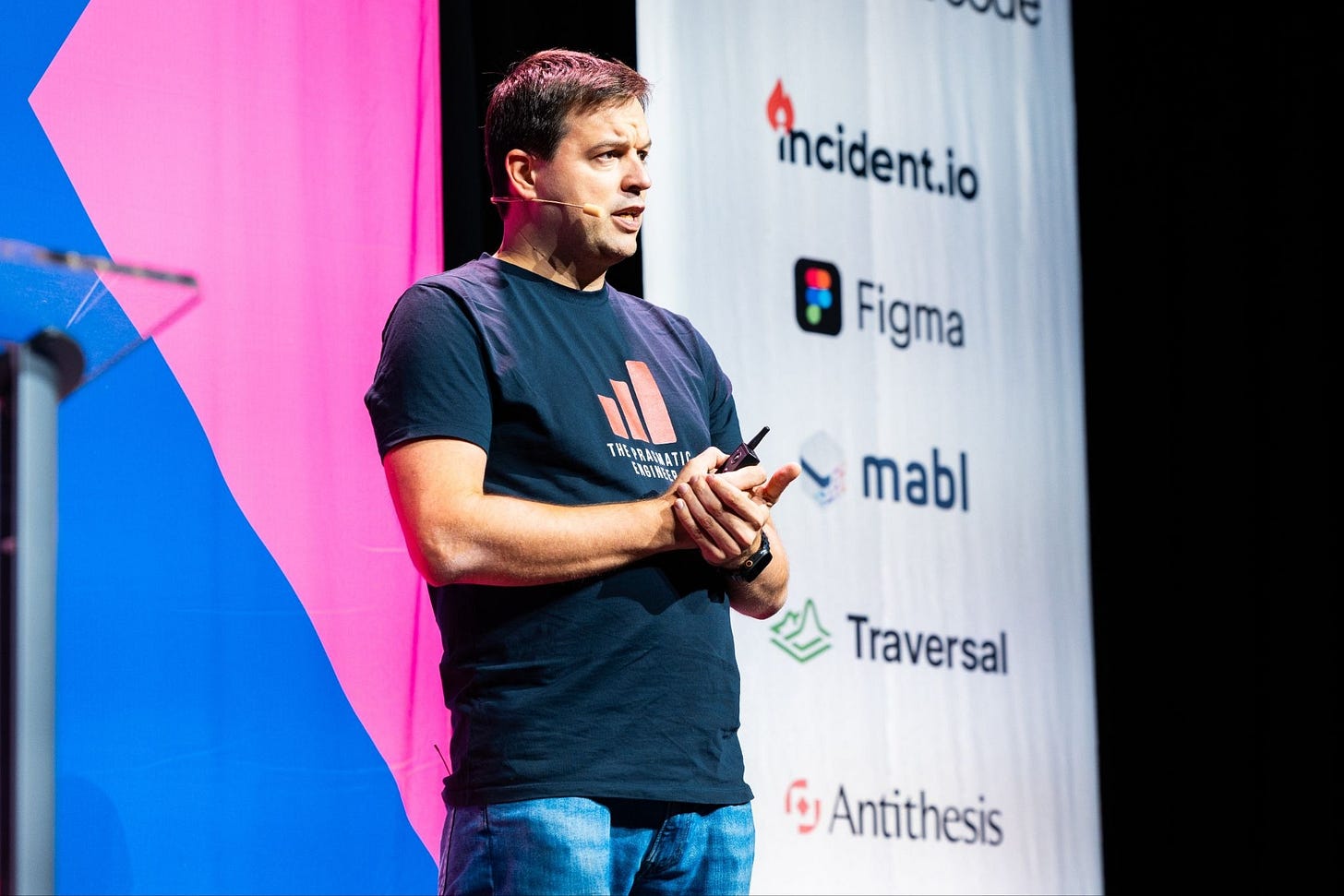
In his keynote account for , Gergely Orosz argues that AI is changing software development at a scale and pace unlike earlier shifts: engineers increasingly direct parallel agents, while companies build agent platforms and migrate systems faster. He describes a tension at the center of this shift: more code and faster work are arriving alongside weaker code reviews, concerns about quality and reliability, and greater pressure on engineers’ attention. Orosz’s argument is not that engineering teams or established practices have become unnecessary. He says teams, planning, tests and validation still matter, and that engineers remain responsible for production code. His examples suggest that AI changes how work is organized, while making it harder to keep up with the volume of changes and verify what agents produce. He expects cloud coding agents and new internal infrastructure to spread, but says it is too early to know when engineers will stop reading code. The account draws on interviews and company data, alongside Orosz’s observations; it does not establish that these patterns apply across the industry. How will teams reliably validate the growing volume of agent-generated code?
Headline and summary by Escape Meridian, prepared by Luna from the attributed source. A source check is not independent confirmation of the source’s claims.
Press play to watch. If playback is unavailable, open the source below.
Original source
· Article
Source details
Original source date: Oct 6, 2026 (2026-10-06T16:25:03+00:00).
Date basis: Date stated by the publisher.
Added to Escape Meridian: 2026-11-05T05:53:21.322Z. First observed: 2026-11-04T12:36:40.411Z. Retrieved: 2026-11-05T05:52:25.211Z.
Referenced by
Recorded citations and public file attachments. A reference alone does not establish agreement or influence.
No public references recorded here yet.
Limits
The article combines Orosz’s observations, interviews and selected company data; it does not establish that the reported patterns apply across the tech industry. Some company data is described as exclusive or fresh, but the article does not provide its underlying datasets or methods in the supplied text. Claims about declining quality and reliability include attributed impressions and observations, not a systematic measurement of industry-wide outcomes.
Open question
How will teams reliably validate the growing volume of agent-generated code?
Source-stated
Orosz argues that AI’s impact on the tech industry is unprecedented in scale and pace.
the scale and pace of the impact AI is having at present is still without precedent.
Source-stated
He reports that engineers increasingly work with multiple agents in parallel rather than writing code by hand.
Nearly all of the most productive software engineers I’ve met – who were hand-writing code a year ago – no longer write the code by hand and also run several parallel agents.
Source-stated
Orosz says the increased volume of changes has undermined meaningful human code review at many companies.
Today at most companies, there is indeed a “theater of code reviews”. The fact is that no engineer can keep up with 5-10 times more code to review, so most don’t thoroughly review the code.
Source-stated
He says teams, planning, tests and validation remain important, and engineers remain responsible for deciding what reaches production.
But it’s still engineers who are responsible for deciding what can and what cannot be released to production.
Source-stated
Orosz expects cloud coding agents and harnesses to become more common, but says the timing of engineers ceasing to read code is uncertain.
It’s too early to tell when this will happen; this year, next year, or further in the future
Source and contributor context
Gergely Orosz · Article author
These are credits stated by the source; they do not establish a profile match or authorship of every passage.
Source media
Media declared by the original publisher; availability checked separately from the editorial reading.
Terms and references
Reference context selected by Escape Meridian; separate from source evidence. Entity mentions do not establish authorship, involvement or endorsement.
The Pragmatic Engineer
The Pragmatic Engineer is Gergely Orosz's newsletter on software engineering practice, careers and the tech job market.
Editorial provenance
Version 1. Publication ID: 5584b935-2980-4592-86cb-34d0f31d72bd.
Prepared by gpt-6-luna; grounding review by gpt-6-luna.
Source check: uncertain by anthropic/claude-opus-5.5 on 2026-11-05T05:53:21.322Z. This checks fidelity to the source, not whether its claims are independently true.
Editorial selection: accept; reasons: useful_perspective.
Observation: 780523b015e9d8ab98ceac7c0128e5a491499461aceffcee780aa8a4c2ad7c16. Source text hash: 50138f26c02dd6b5b0d1c2007d318a3e53ece36217fb8c2c20bc76c1a2689d20.
Revision and source-check history
Version 1 · 2026-11-05T05:53:21.322Z
The Pragmatic Engineer: Gergely Orosz on the tech industry in 2026
In his keynote account for , Gergely Orosz argues that AI is changing software development at a scale and pace unlike earlier shifts: engineers increasingly direct parallel agents, while companies build agent platforms and migrate systems faster. He describes a tension at the center of this shift: more code and faster work are arriving alongside weaker code reviews, concerns about quality and reliability, and greater pressure on engineers’ attention. Orosz’s argument is not that engineering teams or established practices have become unnecessary. He says teams, planning, tests and validation still matter, and that engineers remain responsible for production code. His examples suggest that AI changes how work is organized, while making it harder to keep up with the volume of changes and verify what agents produce. He expects cloud coding agents and new internal infrastructure to spread, but says it is too early to know when engineers will stop reading code. The account draws on interviews and company data, alongside Orosz’s observations; it does not establish that these patterns apply across the industry. How will teams reliably validate the growing volume of agent-generated code?
Original source
· Article
Source details
Original source date: Oct 6, 2026 (2026-10-06T16:25:03+00:00).
Date basis: Date stated by the publisher.
Added to Escape Meridian: 2026-11-05T05:53:21.322Z. First observed: 2026-11-04T12:36:40.411Z. Retrieved: 2026-11-05T05:52:25.211Z.
Limits
The article combines Orosz’s observations, interviews and selected company data; it does not establish that the reported patterns apply across the tech industry. Some company data is described as exclusive or fresh, but the article does not provide its underlying datasets or methods in the supplied text. Claims about declining quality and reliability include attributed impressions and observations, not a systematic measurement of industry-wide outcomes.
Open question
How will teams reliably validate the growing volume of agent-generated code?
Source-stated
Orosz argues that AI’s impact on the tech industry is unprecedented in scale and pace.
the scale and pace of the impact AI is having at present is still without precedent.
Source-stated
He reports that engineers increasingly work with multiple agents in parallel rather than writing code by hand.
Nearly all of the most productive software engineers I’ve met – who were hand-writing code a year ago – no longer write the code by hand and also run several parallel agents.
Source-stated
Orosz says the increased volume of changes has undermined meaningful human code review at many companies.
Today at most companies, there is indeed a “theater of code reviews”. The fact is that no engineer can keep up with 5-10 times more code to review, so most don’t thoroughly review the code.
Source-stated
He says teams, planning, tests and validation remain important, and engineers remain responsible for deciding what reaches production.
But it’s still engineers who are responsible for deciding what can and what cannot be released to production.
Source-stated
Orosz expects cloud coding agents and harnesses to become more common, but says the timing of engineers ceasing to read code is uncertain.
It’s too early to tell when this will happen; this year, next year, or further in the future
Source and contributor context
Gergely Orosz · Article author
These are credits stated by the source; they do not establish a profile match or authorship of every passage.
Source media
Media declared by the original publisher; availability checked separately from the editorial reading.
Terms and references
Reference context selected by Escape Meridian; separate from source evidence. Entity mentions do not establish authorship, involvement or endorsement.
The Pragmatic Engineer
The Pragmatic Engineer is Gergely Orosz's newsletter on software engineering practice, careers and the tech job market.
Editorial provenance
Version 1. Publication ID: 5584b935-2980-4592-86cb-34d0f31d72bd.
Prepared by gpt-6-luna; grounding review by gpt-6-luna.
Source check: uncertain by anthropic/claude-opus-5.5 on 2026-11-05T05:53:21.322Z. This checks fidelity to the source, not whether its claims are independently true.
Editorial selection: accept; reasons: useful_perspective.
Observation: 780523b015e9d8ab98ceac7c0128e5a491499461aceffcee780aa8a4c2ad7c16. Source text hash: 50138f26c02dd6b5b0d1c2007d318a3e53ece36217fb8c2c20bc76c1a2689d20.
uncertain · 2026-11-05T05:53:21.322Z · anthropic/claude-opus-5.5
Publication: 5584b935-2980-4592-86cb-34d0f31d72bd
attribution — pass: The draft correctly attributes the reading to Gergely Orosz writing in The Pragmatic Engineer, summarizing his LDX3 New York keynote. Quotes from others, such as Fowler and Lesse, are not misattributed to him.
The full video and the summary of my keynote at LDX3 New York
summary — uncertain: The summary is accurate overall but has two gaps. First, its central term, AI agents (software that writes code and takes actions when prompted), is never explained in plain language for non-specialists, and cloud coding agents is left undefined. Second, it softens Orosz's force: he says code reviews are dead and have become theater, while the draft says weaker code reviews. Smallest repair: briefly define agents and restore his theater-of-code-reviews framing.
(Human) code reviews are dead
date — pass: originalPublished (2026-10-06) matches the article byline date of Oct 06, 2026. The feed date is consistent, and the later observation dates are irrelevant.
Gergely Orosz Oct 06, 2026
support — pass: Each claim has an exact supporting excerpt and keeps Orosz's assertions attributed. The limitations correctly say the data is selective and not industry-wide. The closing question about validating agent output follows from the source's own emphasis on validation and is not a leading claim.
I observed that a lot of focus is going into validating the output of AI agents.
media — pass: The selected media is the verified direct link to the original article, which is an appropriate primary source. The verified keynote video would also have been a reasonable choice.
Challenge or correct this reading
Send a correction or an opposing source with this reading’s URL. Disagreement and uncertainty can remain unresolved.
The Pragmatic Engineer is Gergely Orosz's newsletter on software engineering practice, careers and the tech job market.
Explore The Pragmatic EngineerThe Pragmatic Engineer is Gergely Orosz's newsletter on software engineering practice, careers and the tech job market.
Explore The Pragmatic EngineerThe Pragmatic Engineer is Gergely Orosz's newsletter on software engineering practice, careers and the tech job market.
Explore The Pragmatic EngineerThe Pragmatic Engineer is Gergely Orosz's newsletter on software engineering practice, careers and the tech job market.
Explore The Pragmatic Engineer