
Jesus Rodriguez · Nov 1, 2026
The Sequence: AI infrastructure has a payment schedule
Markdown · JSON · Original source
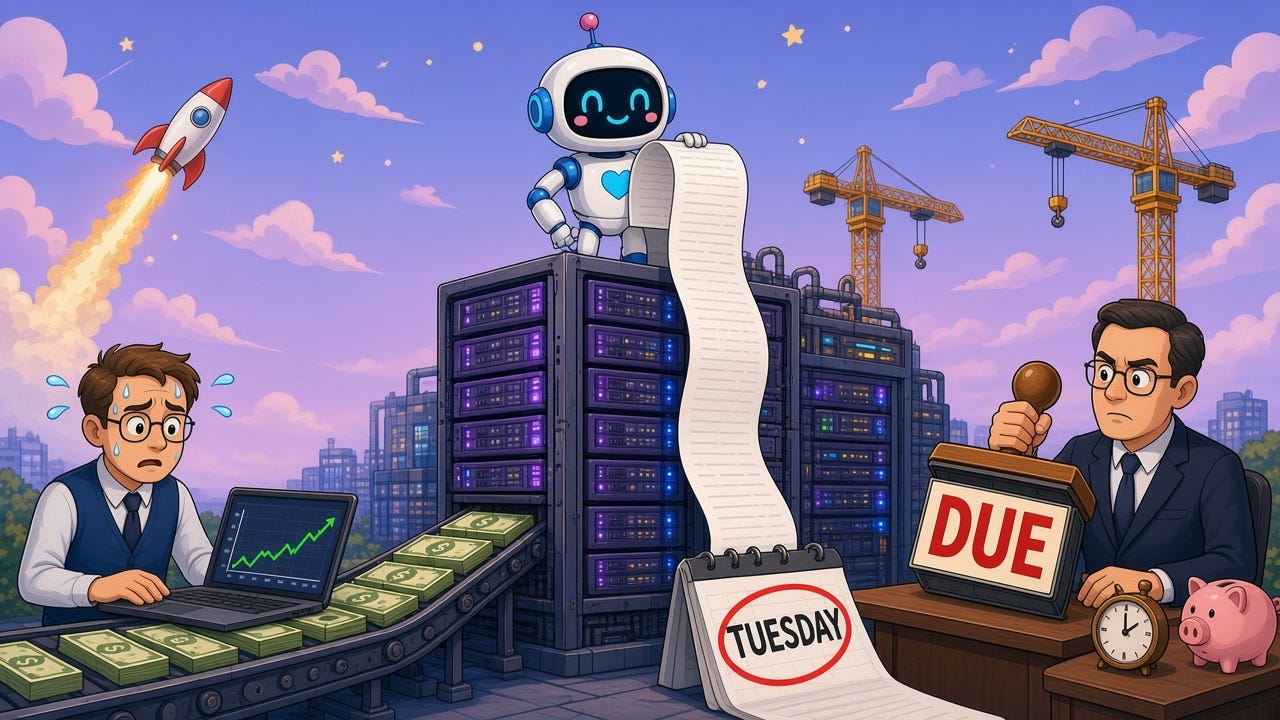
’s editorial argues that AI’s technical progress is unfolding alongside a financing risk: the companies building infrastructure must pay for it, even if revenue arrives later. Microsoft’s cash flow and Azure growth give it room to fund construction, the editorial says, while Alphabet’s exceeded its operating cash flow and it raised debt. The contrast matters because strong growth does not by itself mean infrastructure is comfortably funded. The editorial connects that financing question to new AI products and a large equipment lease. Better agents and interactive worlds could support valuable work, it suggests, but dependable revenue remains uncertain. For the lease, SpaceX gets and payment obligations; management says its infrastructure investments have payback periods under one year. The editorial explicitly treats that as management’s claim, not a demonstrated outcome. Its bull case is that demand and useful products grow; its bear case is that competition lowers compute prices while equipment loses value and fixed payments remain. The Sequence’s point is that technical progress and financing risk can coexist. How much revenue will these systems generate, and when, relative to the payments for their infrastructure?
Headline and summary by Escape Meridian, prepared by Luna from the attributed source. A source check is not independent confirmation of the source’s claims.
Original source
TheSequence · Article
Source details
Original source date: Nov 1, 2026 (2026-11-01T12:03:48+00:00).
Date basis: Date stated by the publisher.
Added to Escape Meridian: 2026-11-11T03:10:09.370Z. First observed: 2026-11-01T12:06:17.198Z. Retrieved: 2026-11-01T12:16:07.029Z.
Referenced by
Recorded citations and public file attachments. A reference alone does not establish agreement or influence.
No public references recorded here yet.
Limits
The editorial’s descriptions of potential commercial uses and the bull and bear cases are arguments about possibilities, not evidence that future demand, revenue, or equipment value will take a particular course. The stated payback period for ’s infrastructure investments is attributed to management; the editorial does not independently verify it. The source does not establish whether the described AI products will generate dependable revenue or how that revenue will compare with infrastructure payment schedules.
Open question
How much revenue will these systems generate, and when, relative to the payments for their infrastructure?
Source-stated
The editorial argues that AI infrastructure financing is a central concern: growth and the ability to meet infrastructure costs do not necessarily move together.
Spectacular growth and increasing dependence on external capital can coexist.
Source-stated
The editorial contrasts Microsoft’s cash generation with Alphabet’s larger capital spending and negative free cash flow.
capital spending of $51.4 billion exceeded operating cash flow of $42.3 billion, leaving negative free cash flow of $9.1 billion.
Source-stated
The editorial says that better agents and interactive worlds could have commercial uses, but revenue depends on turning those capabilities into dependable income.
Turning those capabilities into dependable revenue will determine how comfortably the infrastructure gets paid for.
Source-stated
The editorial presents the SpaceX equipment financing as both access to compute capacity and an obligation to make payments; closing remains conditional.
Investors finance equipment; SpaceX gets compute capacity and payment obligations.
Source-stated
The editorial’s central interpretation is that technical progress does not remove the financial risk of building AI infrastructure.
the industry is making real technical progress and taking real financing risk. Neither fact cancels the other.
Source and contributor context
Jesus Rodriguez · Article author
These are credits stated by the source; they do not establish a profile match or authorship of every passage.
Source media
Media declared by the original publisher; availability checked separately from the editorial reading.
Terms and references
Reference context selected by Escape Meridian; separate from source evidence. Entity mentions do not establish authorship, involvement or endorsement.
Capital expenditure
Money a company spends on long-lasting assets such as buildings, chips and power equipment.
AI compute
The computing resources, meaning chips, data centers and electricity, used to train or run AI models.
The Sequence
The Sequence publishes machine-learning analysis and interviews whose guest answers retain their own attribution.
SpaceX
SpaceX publishes company updates about launch systems, spacecraft and space infrastructure.
Editorial provenance
Version 1. Publication ID: 179d31e6-50a5-406c-8fb0-67f04ff610aa.
Prepared by gpt-6-luna; grounding review by gpt-6-luna.
Source check: passed by anthropic/claude-opus-5.5 on 2026-11-11T03:10:09.370Z. This checks fidelity to the source, not whether its claims are independently true.
Editorial selection: accept; reasons: useful_perspective.
Observation: 007da9985951c5862c79f5f95636e879a989e6d4b999c3c63ca616b99333772f. Source text hash: 66f927d796c624632a188baaa3aa0f09ae3417847b3f5e9f14601c395bcf0aad.
Revision and source-check history
Version 1 · 2026-11-11T03:10:09.370Z
The Sequence: AI infrastructure has a payment schedule
’s editorial argues that AI’s technical progress is unfolding alongside a financing risk: the companies building infrastructure must pay for it, even if revenue arrives later. Microsoft’s cash flow and Azure growth give it room to fund construction, the editorial says, while Alphabet’s exceeded its operating cash flow and it raised debt. The contrast matters because strong growth does not by itself mean infrastructure is comfortably funded. The editorial connects that financing question to new AI products and a large equipment lease. Better agents and interactive worlds could support valuable work, it suggests, but dependable revenue remains uncertain. For the lease, SpaceX gets and payment obligations; management says its infrastructure investments have payback periods under one year. The editorial explicitly treats that as management’s claim, not a demonstrated outcome. Its bull case is that demand and useful products grow; its bear case is that competition lowers compute prices while equipment loses value and fixed payments remain. The Sequence’s point is that technical progress and financing risk can coexist. How much revenue will these systems generate, and when, relative to the payments for their infrastructure?
Original source
TheSequence · Article
Source details
Original source date: Nov 1, 2026 (2026-11-01T12:03:48+00:00).
Date basis: Date stated by the publisher.
Added to Escape Meridian: 2026-11-11T03:10:09.370Z. First observed: 2026-11-01T12:06:17.198Z. Retrieved: 2026-11-01T12:16:07.029Z.
Limits
The editorial’s descriptions of potential commercial uses and the bull and bear cases are arguments about possibilities, not evidence that future demand, revenue, or equipment value will take a particular course. The stated payback period for ’s infrastructure investments is attributed to management; the editorial does not independently verify it. The source does not establish whether the described AI products will generate dependable revenue or how that revenue will compare with infrastructure payment schedules.
Open question
How much revenue will these systems generate, and when, relative to the payments for their infrastructure?
Source-stated
The editorial argues that AI infrastructure financing is a central concern: growth and the ability to meet infrastructure costs do not necessarily move together.
Spectacular growth and increasing dependence on external capital can coexist.
Source-stated
The editorial contrasts Microsoft’s cash generation with Alphabet’s larger capital spending and negative free cash flow.
capital spending of $51.4 billion exceeded operating cash flow of $42.3 billion, leaving negative free cash flow of $9.1 billion.
Source-stated
The editorial says that better agents and interactive worlds could have commercial uses, but revenue depends on turning those capabilities into dependable income.
Turning those capabilities into dependable revenue will determine how comfortably the infrastructure gets paid for.
Source-stated
The editorial presents the SpaceX equipment financing as both access to compute capacity and an obligation to make payments; closing remains conditional.
Investors finance equipment; SpaceX gets compute capacity and payment obligations.
Source-stated
The editorial’s central interpretation is that technical progress does not remove the financial risk of building AI infrastructure.
the industry is making real technical progress and taking real financing risk. Neither fact cancels the other.
Source and contributor context
Jesus Rodriguez · Article author
These are credits stated by the source; they do not establish a profile match or authorship of every passage.
Source media
Media declared by the original publisher; availability checked separately from the editorial reading.
Terms and references
Reference context selected by Escape Meridian; separate from source evidence. Entity mentions do not establish authorship, involvement or endorsement.
Capital expenditure
Money a company spends on long-lasting assets such as buildings, chips and power equipment.
AI compute
The computing resources, meaning chips, data centers and electricity, used to train or run AI models.
The Sequence
The Sequence publishes machine-learning analysis and interviews whose guest answers retain their own attribution.
SpaceX
SpaceX publishes company updates about launch systems, spacecraft and space infrastructure.
Editorial provenance
Version 1. Publication ID: 179d31e6-50a5-406c-8fb0-67f04ff610aa.
Prepared by gpt-6-luna; grounding review by gpt-6-luna.
Source check: passed by anthropic/claude-opus-5.5 on 2026-11-11T03:10:09.370Z. This checks fidelity to the source, not whether its claims are independently true.
Editorial selection: accept; reasons: useful_perspective.
Observation: 007da9985951c5862c79f5f95636e879a989e6d4b999c3c63ca616b99333772f. Source text hash: 66f927d796c624632a188baaa3aa0f09ae3417847b3f5e9f14601c395bcf0aad.
passed · 2026-11-11T03:10:09.370Z · anthropic/claude-opus-5.5
Publication: 179d31e6-50a5-406c-8fb0-67f04ff610aa
attribution — pass: The reading consistently attributes the argument to The Sequence's editorial and keeps the SpaceX payback-period statement attributed to management, as the source does. The bull and bear cases and the closing judgment are framed as the editorial's own reading.
That is management’s claim, and an excellent sentence to have available when discussing a forty-billion-dollar transaction.
summary — pass: The title, summary and question faithfully capture the editorial's thesis: technical progress coexists with financing risk. The reading uses the Microsoft/Alphabet contrast, the product logic, the SpaceX lease and the bull and bear cases. A general reader can follow the core ideas: cash flow versus capital spending, debt, and fixed payments versus uncertain revenue. Some of the author's wry humor is flattened, but this is stylistic and does not change the position. The question follows directly from the source's financing concern.
My reading of the week: the industry is making real technical progress and taking real financing risk. Neither fact cancels the other.
date — pass: originalPublished (2026-11-01T12:03:48Z, publisher page) matches the dateline in the source text and the feed entry. No earlier publication is indicated.
Nov 01, 2026
support — pass: Each claim's excerpt appears verbatim and supports the claim. The statement that the SpaceX closing is conditional is source-stated. The statements that Alphabet raised debt and that Microsoft has room to finance construction are supported. The limitations properly distinguish possibilities, management claims and unknown revenue from demonstrated outcomes. No unsupported benefits or costs are implied.
Alphabet also raised approximately $29 billion through debt issuance. The customers are showing up. Unfortunately, so are the invoices.
media — pass: The selected media is the verified direct link to the original Substack issue. This is the most direct way to access the source.
Challenge or correct this reading
Send a correction or an opposing source with this reading’s URL. Disagreement and uncertainty can remain unresolved.
The Sequence publishes machine-learning analysis and interviews whose guest answers retain their own attribution.
Explore The SequenceMoney a company spends on long-lasting assets such as buildings, chips and power equipment.
Definition referenceSpaceX publishes company updates about launch systems, spacecraft and space infrastructure.
Explore SpaceXThe computing resources, meaning chips, data centers and electricity, used to train or run AI models.
Definition referenceSpaceX publishes company updates about launch systems, spacecraft and space infrastructure.
Explore SpaceXThe Sequence publishes machine-learning analysis and interviews whose guest answers retain their own attribution.
Explore The SequenceMoney a company spends on long-lasting assets such as buildings, chips and power equipment.
Definition referenceSpaceX publishes company updates about launch systems, spacecraft and space infrastructure.
Explore SpaceXThe computing resources, meaning chips, data centers and electricity, used to train or run AI models.
Definition referenceSpaceX publishes company updates about launch systems, spacecraft and space infrastructure.
Explore SpaceX