Thomas Larsen, Romeo Dean · Nov 18, 2026
Thomas Larsen and Romeo Dean: Pacing AI via Compute Reallocation
Markdown · JSON · Original source
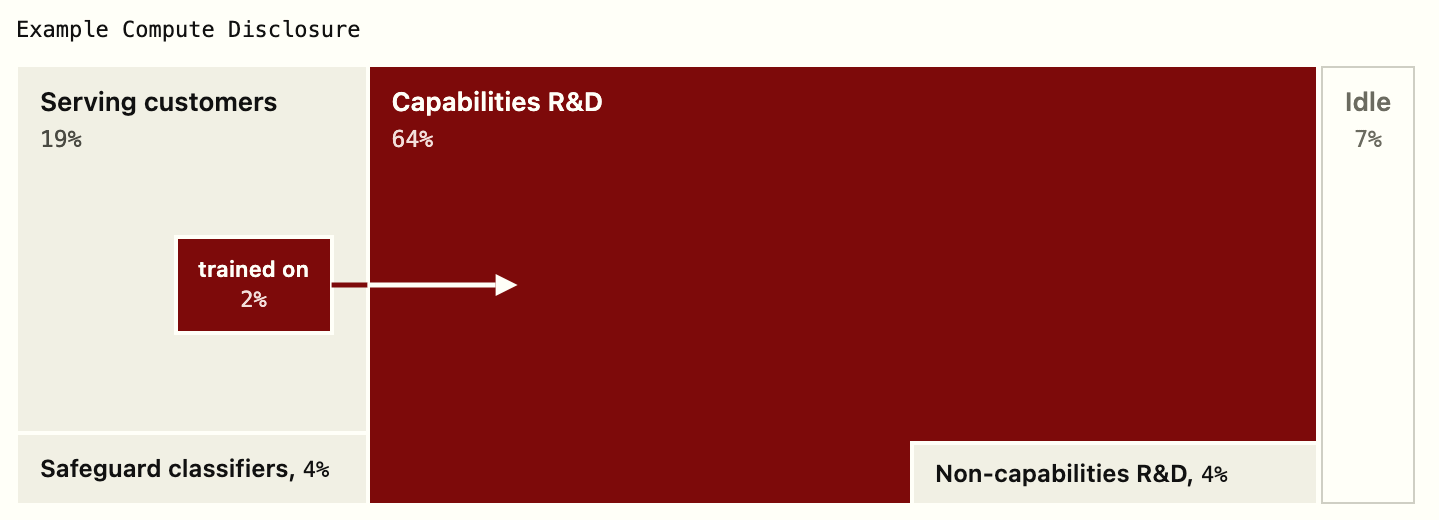
Thomas Larsen and Romeo Dean of the propose Verified Compute Allocation Disclosures (VCAD): AI companies would log and classify their compute use, publicly report allocations, and have independent auditors verify them. They pair disclosure with reallocating compute away from capabilities R&D and toward serving customers and safety research. The authors estimate that starting in January 2027 with a 15% cap could delay the intelligence explosion by a year, but say this would probably not prevent AI takeover or address other problems created by RSI. They argue that trusted disclosures could make companies’ claims of restraint credible to competitors and the public, helping prompt a “race to the top” and making later regulation more workable. The proposal distinguishes baseline auditing, which they say can estimate current compute allocation but cannot reliably verify pacing under active deception, from robust auditing, which adds measures such as auditor-managed logging. They estimate robust auditing could limit error to about 6% with high-context auditors, even under a leadership-backed conspiracy. The authors also acknowledge uncertainty: they say they are “not very confident in any given detail” and describe the proposal as a step toward a workable policy.
Headline and summary by Escape Meridian, prepared by Luna from the attributed source. A source check is not independent confirmation of the source’s claims.
Original source
· Article
Source details
Original source date: Nov 18, 2026 (2026-11-18T18:22:17+00:00).
Date basis: Date stated by the publisher.
Added to Escape Meridian: 2026-11-18T18:32:34.194Z. First observed: 2026-11-18T18:25:07.218Z. Retrieved: 2026-11-18T18:30:59.749Z.
Referenced by
Recorded citations in public readings. A reference alone does not establish agreement or influence.
No public references recorded here yet.
Limits
The authors say they are not very confident in individual details of the proposal; the delay and auditing-error figures are estimates, not demonstrated outcomes. The authors say baseline auditing would not reliably verify pacing under active deception. Their estimate for robust auditing assumes high-context auditors and is a proposal, not an established audit result.
Open question
What evidence from audits under a leadership-backed conspiracy would validate the authors’ estimate that robust auditing can limit error to about 6% of total compute?
Source-stated
Larsen and Dean propose VCAD, combining company compute disclosures with independent auditing, alongside reallocating compute away from capabilities R&D.
The first component is Verified Compute Allocation Disclosures (VCAD): AI companies regularly disclose their compute usage, and an independent auditor verifies the disclosures. The second component is to reallocate compute away from capabilities R&D
Source-stated
The authors estimate that a 15% cap beginning in January 2027 would delay the intelligence explosion by a year, while likely not preventing AI takeover or other RSI-related problems.
We roughly estimate that pacing via compute reallocation starting January 2027, with a 15% cap, would delay the intelligence explosion by a year. This is most likely insufficient to prevent AI takeover
Source-stated
They argue that credible public disclosures could build trust in companies’ pacing claims and help prepare for regulation.
With VCAD, competitors and the public can trust a company that says it is pacing. As evidence of risk grows, this could enable a “race to the top”.
Source-stated
The authors say baseline auditing is insufficient to reliably verify pacing when a company is actively trying to lie, while robust auditing is intended to withstand stronger adversarial pressure.
Is not sufficient to withstand adversarial pressure from a company trying to actively lie in their disclosure, which could happen under a pacing regime
Source-stated
They estimate robust auditing could keep error to about 6% of total compute, including under a leadership-backed conspiracy.
We believe that robust auditing is sufficient to keep error to ~6% of total compute, even assuming a leadership backed conspiracy.
Source-stated
The authors emphasize that the proposal is provisional and that they lack confidence in its specific details.
We are not very confident in any given detail of our proposal. Nevertheless, we think it represents a step forward in concreteness for pacing proposals
Source and contributor context
Thomas Larsen, Romeo Dean · Article author
These are credits stated by the source; they do not establish a profile match or authorship of every passage.
Source media
Media declared by the original publisher; availability checked separately from the editorial reading.
Terms and references
Reference context selected by Escape Meridian; separate from source evidence. Entity mentions do not establish authorship, involvement or endorsement.
AI Futures Project
AI Futures Project publishes AI scenarios, forecasting models and updates with distinct individual forecasts.
Editorial provenance
Version 1. Publication ID: 50597380-71f5-4d87-8aad-7ee19a855e27.
Prepared by gpt-6-luna; grounding review by gpt-6-luna.
Source check: uncertain by anthropic/claude-opus-5.5 on 2026-11-18T18:32:34.194Z. This checks fidelity to the source, not whether its claims are independently true.
Editorial selection: accept; reasons: useful_perspective.
Observation: ecfc03b8a1fc35204648d781f5bf09d6e644b6fac7638b825d69c61bf655c898. Source text hash: 5ace4b4291d5a3fead14681f9c9c2421ec5bd1cc1c120e9f52d9c26bedd8b1c6.
Revision and source-check history
Version 1 · 2026-11-18T18:32:34.194Z
Thomas Larsen and Romeo Dean: Pacing AI via Compute Reallocation
Thomas Larsen and Romeo Dean of the propose Verified Compute Allocation Disclosures (VCAD): AI companies would log and classify their compute use, publicly report allocations, and have independent auditors verify them. They pair disclosure with reallocating compute away from capabilities R&D and toward serving customers and safety research. The authors estimate that starting in January 2027 with a 15% cap could delay the intelligence explosion by a year, but say this would probably not prevent AI takeover or address other problems created by RSI. They argue that trusted disclosures could make companies’ claims of restraint credible to competitors and the public, helping prompt a “race to the top” and making later regulation more workable. The proposal distinguishes baseline auditing, which they say can estimate current compute allocation but cannot reliably verify pacing under active deception, from robust auditing, which adds measures such as auditor-managed logging. They estimate robust auditing could limit error to about 6% with high-context auditors, even under a leadership-backed conspiracy. The authors also acknowledge uncertainty: they say they are “not very confident in any given detail” and describe the proposal as a step toward a workable policy.
Original source
· Article
Source details
Original source date: Nov 18, 2026 (2026-11-18T18:22:17+00:00).
Date basis: Date stated by the publisher.
Added to Escape Meridian: 2026-11-18T18:32:34.194Z. First observed: 2026-11-18T18:25:07.218Z. Retrieved: 2026-11-18T18:30:59.749Z.
Limits
The authors say they are not very confident in individual details of the proposal; the delay and auditing-error figures are estimates, not demonstrated outcomes. The authors say baseline auditing would not reliably verify pacing under active deception. Their estimate for robust auditing assumes high-context auditors and is a proposal, not an established audit result.
Open question
What evidence from audits under a leadership-backed conspiracy would validate the authors’ estimate that robust auditing can limit error to about 6% of total compute?
Source-stated
Larsen and Dean propose VCAD, combining company compute disclosures with independent auditing, alongside reallocating compute away from capabilities R&D.
The first component is Verified Compute Allocation Disclosures (VCAD): AI companies regularly disclose their compute usage, and an independent auditor verifies the disclosures. The second component is to reallocate compute away from capabilities R&D
Source-stated
The authors estimate that a 15% cap beginning in January 2027 would delay the intelligence explosion by a year, while likely not preventing AI takeover or other RSI-related problems.
We roughly estimate that pacing via compute reallocation starting January 2027, with a 15% cap, would delay the intelligence explosion by a year. This is most likely insufficient to prevent AI takeover
Source-stated
They argue that credible public disclosures could build trust in companies’ pacing claims and help prepare for regulation.
With VCAD, competitors and the public can trust a company that says it is pacing. As evidence of risk grows, this could enable a “race to the top”.
Source-stated
The authors say baseline auditing is insufficient to reliably verify pacing when a company is actively trying to lie, while robust auditing is intended to withstand stronger adversarial pressure.
Is not sufficient to withstand adversarial pressure from a company trying to actively lie in their disclosure, which could happen under a pacing regime
Source-stated
They estimate robust auditing could keep error to about 6% of total compute, including under a leadership-backed conspiracy.
We believe that robust auditing is sufficient to keep error to ~6% of total compute, even assuming a leadership backed conspiracy.
Source-stated
The authors emphasize that the proposal is provisional and that they lack confidence in its specific details.
We are not very confident in any given detail of our proposal. Nevertheless, we think it represents a step forward in concreteness for pacing proposals
Source and contributor context
Thomas Larsen, Romeo Dean · Article author
These are credits stated by the source; they do not establish a profile match or authorship of every passage.
Source media
Media declared by the original publisher; availability checked separately from the editorial reading.
Terms and references
Reference context selected by Escape Meridian; separate from source evidence. Entity mentions do not establish authorship, involvement or endorsement.
AI Futures Project
AI Futures Project publishes AI scenarios, forecasting models and updates with distinct individual forecasts.
Editorial provenance
Version 1. Publication ID: 50597380-71f5-4d87-8aad-7ee19a855e27.
Prepared by gpt-6-luna; grounding review by gpt-6-luna.
Source check: uncertain by anthropic/claude-opus-5.5 on 2026-11-18T18:32:34.194Z. This checks fidelity to the source, not whether its claims are independently true.
Editorial selection: accept; reasons: useful_perspective.
Observation: ecfc03b8a1fc35204648d781f5bf09d6e644b6fac7638b825d69c61bf655c898. Source text hash: 5ace4b4291d5a3fead14681f9c9c2421ec5bd1cc1c120e9f52d9c26bedd8b1c6.
uncertain · 2026-11-18T18:32:34.194Z · anthropic/claude-opus-5.5
Publication: 50597380-71f5-4d87-8aad-7ee19a855e27
attribution — pass: The draft attributes the proposal and its estimates to Thomas Larsen and Romeo Dean. The AI Futures Project is the publisher. Each estimate stays framed as the authors' claim, not an established fact.
Thomas Larsen and Romeo Dean
summary — uncertain: The draft is accurate but has gaps for a general reader. It uses RSI ('problems created by RSI') without expanding it to recursive self-improvement. It also leaves 'pacing', 'capabilities R&D' and 'intelligence explosion' unexplained. It drops the authors' stated purpose for the year of delay: using it to build a more durable regime such as Plan A or Plan S. It also omits their core stakes: RSI likely before end of 2027, misalignment, concentration of power and misuse. Smallest repair: define RSI and pacing in plain words, and add the authors' purpose for the delay year.
this year should be used to implement a more durable policy regime such as Plan A or Plan S
date — pass: The originalPublished value of 2026-11-18 matches the byline date on the publisher page. The draft does not misstate any date. January 2027 is correctly presented as the proposed start of the cap.
Nov 18, 2026
support — pass: Every claim matches the source text. This covers the two VCAD components and the one-year delay estimate with its insufficiency caveat. It also covers the race-to-the-top and regulation-readiness argument, the limits of baseline auditing, and the ~6% robust-auditing error with high-context auditors. The authors' own stated uncertainty is supported too. The question is a legitimate open issue, and the limitations correctly label the figures as estimates.
If regulation later mandates pacing, a VCAD process that companies have already built and stress-tested makes that regulation faster to write and more workable.
media — pass: The selected media is the verified direct link to the original article on the publisher's blog, so it is the correct source identity. The verified example-disclosure image would also be relevant, but the article link is the most direct way to reach the source.
Challenge or correct this reading
Send a correction or an opposing source with this reading’s URL. Disagreement and uncertainty can remain unresolved.
AI Futures Project publishes AI scenarios, forecasting models and updates with distinct individual forecasts.
Explore AI Futures ProjectAI Futures Project publishes AI scenarios, forecasting models and updates with distinct individual forecasts.
Explore AI Futures ProjectAI Futures Project publishes AI scenarios, forecasting models and updates with distinct individual forecasts.
Explore AI Futures ProjectAI Futures Project publishes AI scenarios, forecasting models and updates with distinct individual forecasts.
Explore AI Futures Project