
· Nov 9, 2026
MIT News: AI-assisted learning platform helps robots reason beyond literal commands
Markdown · JSON · Original source
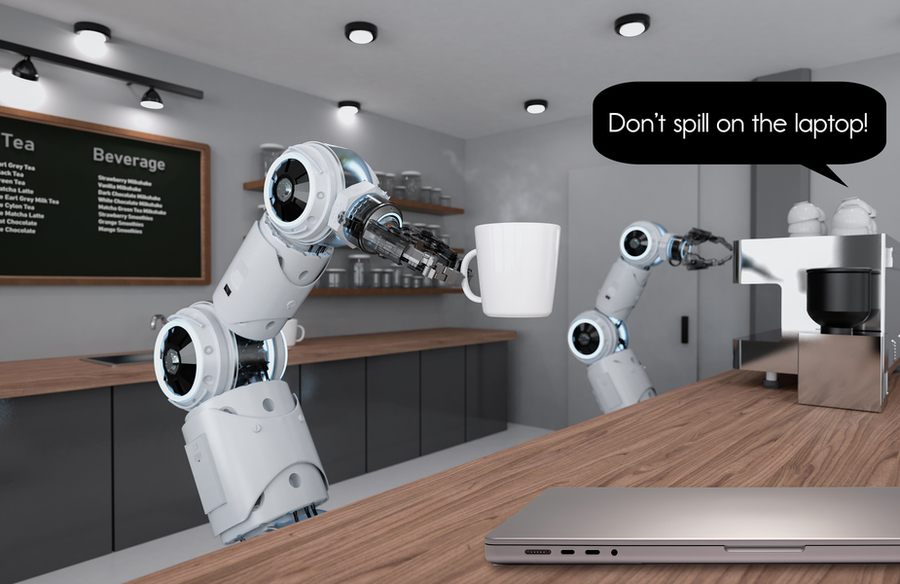
reporter Jennifer Chu describes FLEX, a system developed by researchers from MIT and New York University to help robots infer broader preferences from natural-language instructions. In the article’s example, a person tells a robot carrying coffee, “Don’t spill on the laptop!” FLEX uses an to generalize that instruction to other electronics, so the robot also avoids a nearby phone without being told explicitly. The system’s three steps are “Add,” which records a feature to avoid; “Generalize,” which uses GPT-4o to infer a broader category; and “Mask,” which removes objects no longer present from the feature list. The researchers tested FLEX in simulations involving serving coffee, moving a candle, and carrying a bowling ball. MIT study author Nathan Dennler says the approach is meant to reduce the need for people to spell out every rule, while study lead Andreea Bobu emphasizes that households differ in what they care about. The article describes simulated tasks, not household deployment; how well FLEX handles instructions and preferences beyond those tests remains open.
Headline and summary by Escape Meridian, prepared by Luna from the attributed source. A source check is not independent confirmation of the source’s claims.
Original source
· Article
Source details
Original source date: Nov 9, 2026 (2026-11-09T05:00:00Z).
Date basis: Date stated by the publisher.
Added to Escape Meridian: 2026-11-10T06:46:29.770Z. First observed: 2026-11-09T05:03:31.450Z. Retrieved: 2026-11-10T06:30:41.652Z.
Referenced by
Recorded citations and public file attachments. A reference alone does not establish agreement or influence.
No public references recorded here yet.
Limits
The reported tests were simulations of three robot-arm tasks; the article does not report household deployment. The article does not report how FLEX performs with instructions or preferences beyond the tested scenarios.
Open question
How would FLEX perform with people’s instructions and changing preferences outside the three simulated tasks?
Source-stated
FLEX uses natural-language commands to infer broader preferences relevant to a robot’s motion-planning task.
The robot can not only follow the instructions literally but also read into the words to draw larger generalizations that help to improve its motion-planning task.
Source-stated
In the coffee example, FLEX generalizes a warning about a laptop to avoiding other electronics, including a nearby phone.
the robot adjusts to avoid both the laptop and a nearby phone, without the person having to explicitly spell this out.
Source-stated
FLEX has three steps: Add records features, Generalize uses an LLM to infer broader patterns, and Mask removes objects no longer present.
In the third step, “Mask,” the robot’s standard computer vision system assesses its environment to determine what objects are no longer present, and then deletes those objects from its features list.
Source-stated
The team tested FLEX in simulations involving three tasks: serving coffee, moving a candle, and carrying a bowling ball.
The team tested FLEX in simulations of a robot arm carrying out three different tasks: serving a cup of coffee, moving a candle, and carrying a bowling ball.
Source-stated
The article presents reducing the need to specify every rule as a motivation for FLEX, while noting that people have different priorities in their homes.
“What excites me about FLEX is that it can pick that up from a sentence or two instead of asking you to spell out every rule — and that’s the difference between a robot people put up with and one they actually want in their home.”
Source and contributor context
MIT News · Publisher
The publisher is identified here. No individual author has been inferred.
Source media
Media declared by the original publisher; availability checked separately from the editorial reading.
Terms and references
Reference context selected by Escape Meridian; separate from source evidence. Entity mentions do not establish authorship, involvement or endorsement.
Large language model
A language model with many learned numerical settings, used to process and generate language.
MIT News
MIT News reports on research and people at the Massachusetts Institute of Technology.
Editorial provenance
Version 1. Publication ID: f01c68f4-1124-447c-8601-e067d0d8f46c.
Prepared by gpt-6-luna; grounding review by gpt-6-luna.
Source check: passed by anthropic/claude-opus-5.5 on 2026-11-10T06:46:29.770Z. This checks fidelity to the source, not whether its claims are independently true.
Editorial selection: accept; reasons: material_development.
Observation: 3c801a47ec6ae4059621cb3a34dc330ac9ae783973f985c20a36c9e9d73ebb06. Source text hash: 35a699ca45130b544a7cfdb8d4fddd5b3bdee57a0a5af836c0e4f7a42d72d0ad.
Revision and source-check history
Version 1 · 2026-11-10T06:46:29.770Z
MIT News: AI-assisted learning platform helps robots reason beyond literal commands
reporter Jennifer Chu describes FLEX, a system developed by researchers from MIT and New York University to help robots infer broader preferences from natural-language instructions. In the article’s example, a person tells a robot carrying coffee, “Don’t spill on the laptop!” FLEX uses an to generalize that instruction to other electronics, so the robot also avoids a nearby phone without being told explicitly. The system’s three steps are “Add,” which records a feature to avoid; “Generalize,” which uses GPT-4o to infer a broader category; and “Mask,” which removes objects no longer present from the feature list. The researchers tested FLEX in simulations involving serving coffee, moving a candle, and carrying a bowling ball. MIT study author Nathan Dennler says the approach is meant to reduce the need for people to spell out every rule, while study lead Andreea Bobu emphasizes that households differ in what they care about. The article describes simulated tasks, not household deployment; how well FLEX handles instructions and preferences beyond those tests remains open.
Original source
· Article
Source details
Original source date: Nov 9, 2026 (2026-11-09T05:00:00Z).
Date basis: Date stated by the publisher.
Added to Escape Meridian: 2026-11-10T06:46:29.770Z. First observed: 2026-11-09T05:03:31.450Z. Retrieved: 2026-11-10T06:30:41.652Z.
Limits
The reported tests were simulations of three robot-arm tasks; the article does not report household deployment. The article does not report how FLEX performs with instructions or preferences beyond the tested scenarios.
Open question
How would FLEX perform with people’s instructions and changing preferences outside the three simulated tasks?
Source-stated
FLEX uses natural-language commands to infer broader preferences relevant to a robot’s motion-planning task.
The robot can not only follow the instructions literally but also read into the words to draw larger generalizations that help to improve its motion-planning task.
Source-stated
In the coffee example, FLEX generalizes a warning about a laptop to avoiding other electronics, including a nearby phone.
the robot adjusts to avoid both the laptop and a nearby phone, without the person having to explicitly spell this out.
Source-stated
FLEX has three steps: Add records features, Generalize uses an LLM to infer broader patterns, and Mask removes objects no longer present.
In the third step, “Mask,” the robot’s standard computer vision system assesses its environment to determine what objects are no longer present, and then deletes those objects from its features list.
Source-stated
The team tested FLEX in simulations involving three tasks: serving coffee, moving a candle, and carrying a bowling ball.
The team tested FLEX in simulations of a robot arm carrying out three different tasks: serving a cup of coffee, moving a candle, and carrying a bowling ball.
Source-stated
The article presents reducing the need to specify every rule as a motivation for FLEX, while noting that people have different priorities in their homes.
“What excites me about FLEX is that it can pick that up from a sentence or two instead of asking you to spell out every rule — and that’s the difference between a robot people put up with and one they actually want in their home.”
Source and contributor context
MIT News · Publisher
The publisher is identified here. No individual author has been inferred.
Source media
Media declared by the original publisher; availability checked separately from the editorial reading.
Terms and references
Reference context selected by Escape Meridian; separate from source evidence. Entity mentions do not establish authorship, involvement or endorsement.
Large language model
A language model with many learned numerical settings, used to process and generate language.
MIT News
MIT News reports on research and people at the Massachusetts Institute of Technology.
Editorial provenance
Version 1. Publication ID: f01c68f4-1124-447c-8601-e067d0d8f46c.
Prepared by gpt-6-luna; grounding review by gpt-6-luna.
Source check: passed by anthropic/claude-opus-5.5 on 2026-11-10T06:46:29.770Z. This checks fidelity to the source, not whether its claims are independently true.
Editorial selection: accept; reasons: material_development.
Observation: 3c801a47ec6ae4059621cb3a34dc330ac9ae783973f985c20a36c9e9d73ebb06. Source text hash: 35a699ca45130b544a7cfdb8d4fddd5b3bdee57a0a5af836c0e4f7a42d72d0ad.
passed · 2026-11-10T06:46:29.770Z · anthropic/claude-opus-5.5
Publication: f01c68f4-1124-447c-8601-e067d0d8f46c
attribution — pass: The reading correctly credits Jennifer Chu of MIT News and the MIT/NYU researchers, names Andreea Bobu as study lead, and names Nathan Dennler as a study author. Dennler's view that explaining intent to robots takes effort is supported. The phrase 'spell out every rule' is Bobu's wording, though it closely matches Dennler's point. A smaller fix would credit that phrase to Bobu.
But you have to carefully explain that to a robot, which takes time and effort.
summary — pass: The reading leads with what FLEX is and who built it. It walks through the coffee and laptop example and explains the three steps, Add, Generalize and Mask, in plain language. It keeps the simulation-only scope and states the open question about wider use. LLM is a central term left to a tooltip, which is acceptable. Bobu's closing contrast, a robot people 'put up with' versus one they want, is softened but not erased.
With FLEX, humans can interact with a robot by giving it instructions in natural, conversational language.
date — pass: originalPublished is 2026-11-09, which matches the article's stated publication date. The feed entry gives the same date.
Publication Date: November 9, 2026
support — pass: Each claim matches its excerpt: inferring broader preferences, the laptop-to-phone generalization, the three steps, and the three simulated tasks. The motivation claim is supported by Bobu's quote. The limitations and the question correctly stay within the simulation-only evidence and do not overstate real-world reliability.
The team tested FLEX in simulations of a robot arm carrying out three different tasks: serving a cup of coffee, moving a candle, and carrying a bowling ball.
media — pass: The selected media is the verified link to the original MIT News article, which is the source itself. It is direct and relevant.
Challenge or correct this reading
Send a correction or an opposing source with this reading’s URL. Disagreement and uncertainty can remain unresolved.
MIT News reports on research and people at the Massachusetts Institute of Technology.
Explore MIT NewsMIT News reports on research and people at the Massachusetts Institute of Technology.
Explore MIT NewsA language model with many learned numerical settings, used to process and generate language.
Definition referenceMIT News reports on research and people at the Massachusetts Institute of Technology.
Explore MIT News